 Ferndale Window
 Lynden's Weather Is Harder on Siding Than It Looks
Lynden sits inland from the coast, but it doesn't escape the weather pattern that shapes exterior work across Whatcom County. Winters bring long stretches of driving rain, humidity stays high for months at a time, and shaded north-facing walls can hold onto damp air well into what should be dry season. Add in the salt-influenced air that moves through the broader Ferndale and Whatcom County region, and you have a climate that is quietly aggressive on any siding material that isn't built to handle repeated wet-dry cycling.
The result homeowners actually see isn't dramatic. It's slow: green-black streaking low on the wall, soft spots near trim, paint that fails years ahead of schedule, or siding that looks fine from the street but is starting to fail at the seams. None of that is unusual for this area. It's what happens when a house sits through decade after decade of Pacific Northwest moisture without siding, flashing, and installation details that were matched to the climate in the first place.
Why Moss Season Matters More Than Most Homeowners Realize
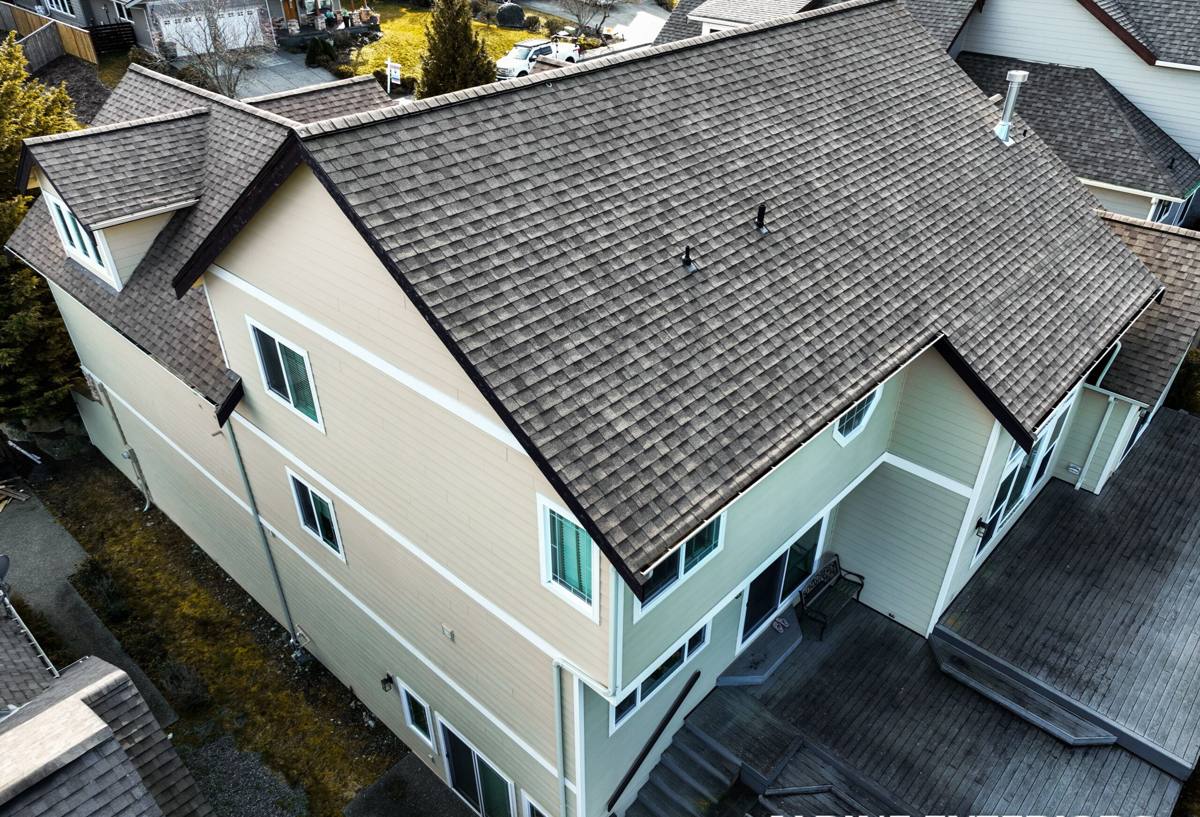
"Moss season" in Whatcom County isn't a cosmetic issue — it's a moisture issue wearing a green coat. Moss and algae need sustained dampness to establish, and they establish fastest on surfaces that hold water: wood-based sidings with worn finishes, seams where caulk has failed, and shaded wall sections that dry slowly after rain. Once moss takes hold, it holds moisture against the siding surface even longer, which accelerates whatever damage was already starting underneath.
This is one of the clearest reasons material choice matters as much as installation quality. A siding product that absorbs and holds moisture will feed a moss problem year after year, no matter how often it's cleaned. A siding product engineered to resist moisture absorption in the first place breaks that cycle at the source.
Why We Install James Hardie Fiber Cement — and Nothing Else
We made a deliberate decision to install only James Hardie fiber cement siding. We don't install vinyl, LP SmartSide, primed spruce, cedar, or other fiber cement brands. That's not a marketing position — it's a standard we hold because of what Lynden homes go through every winter.
Fiber cement is made from cement, sand, and cellulose fibers, engineered specifically to resist moisture absorption, swelling, and rot in ways that wood-based and engineered-wood products cannot match. James Hardie backs that with its HZ5 product line, engineered for the freeze-thaw and moisture demands of climates like ours, and a ColorPlus factory finish that's baked on rather than field-applied, giving far better resistance to fading and peeling than site-applied paint. It's also non-combustible, which matters for wildfire-adjacent risk and for long-term insurance considerations. And James Hardie backs installed products with a strong, transferable limited warranty — assuming the installation itself meets their specifications, which is where a lot of siding jobs quietly fall short.
We're not going to pretend other products have no merit. Vinyl is inexpensive and low-maintenance in mild climates. Engineered wood can look good initially and costs less upfront. But we've seen what driving rain and prolonged dampness do to those materials over ten and twenty years in this specific region, and we decided we'd rather stand behind one product installed correctly than offer several and hope the climate goes easy on the wrong choice.
Signs a Lynden Home's Current Siding Is Failing
Because failure is gradual, most homeowners don't catch it until it's already expensive. Here's what we look for, and what you can check yourself before calling anyone:
- Persistent green or black streaking on north- or shade-facing walls that returns within weeks of cleaning
- Soft, spongy, or bubbling spots when you press on the siding, especially near the bottom courses and around window trim
- Paint that's peeling, chalking, or failing well before its expected repaint interval
- Visible gaps, warping, or buckling in siding panels or lap joints
- Musty smell or visible staining on interior walls that back up to exterior siding
- Caulk that has cracked, shrunk, or pulled away from trim and seams
- Increased pest activity — carpenter ants and moisture-loving insects often follow rot before it's visible from outside
Any one of these on its own might be minor. Several together, especially on a home more than 15-20 years old, usually means the siding system as a whole is past the point where patching makes sense.
What a Correct Siding Installation Actually Involves
The siding you see is the last layer of a system, not the whole job. Most siding failures we're called to replace weren't caused by a bad product — they were caused by an installation that skipped or rushed the parts nobody sees once the job is done.
Moisture Management Comes First
Before a single piece of siding goes up, the wall needs a properly lapped weather-resistive barrier, correctly integrated flashing at every window, door, and penetration, and a drainage plane that lets any moisture that does get behind the siding find its way back out. In a climate with as much sustained rain as ours, this layer matters more than the siding itself — it's the difference between water that sheds harmlessly and water that gets trapped against sheathing.
Fastening and Clearances to Spec
James Hardie publishes specific fastening patterns, nailing zones, and minimum clearances — including ground clearance, roofline clearance, and gaps at butt joints — and those specifications exist because they're what the warranty is actually built on. Over-driven nails, missed studs, insufficient clearance from grade or roofing, and tight-butted joints with no room for expansion are the most common installation mistakes we see on tear-offs, and every one of them shortens the siding's life regardless of how good the material is.
Trim, Caulking, and Finish Details
Corner boards, window and door trim, and the caulking that seals transitions all need to be installed in a sequence that keeps water moving outward and downward, never trapped. This is also where ColorPlus-finished products have an advantage — factory-applied color means field touch-up is limited to cut edges, which reduces the number of places a finish can fail early.
Our Installation Process for Lynden Homes
We run every job through the same sequence, because skipping steps is exactly how the failures above happen.
1. On-Site Assessment
We walk the home, check existing siding and sheathing condition, look for signs of hidden moisture damage, and identify problem areas specific to the home's orientation and exposure — shaded walls, low clearance points, and areas prone to wind-driven rain.
2. Tear-Off and Substrate Check
Old siding comes off and we inspect the sheathing underneath before anything new goes up. If there's rot or moisture damage behind the old siding, it gets addressed before installation continues — covering it over is how small problems become structural ones.
3. Weather Barrier and Flashing Installation
A new, properly lapped weather-resistive barrier goes on, with flashing integrated at every window, door, and penetration to James Hardie's specifications and manufacturer flashing best practices.
4. Siding Installation to Manufacturer Spec
Panels are installed with correct fastening patterns, expansion gaps, and clearances, using the HZ5 product matched to this region's climate demands.
5. Trim, Caulking, and Final Inspection
Trim and caulking are finished in the correct sequence, then we walk the job with the homeowner to confirm everything meets spec before calling it complete.
Comparing Siding Materials for a Lynden Home
| Factor | Vinyl Siding | Engineered Wood (LP SmartSide) | James Hardie Fiber Cement |
|---|---|---|---|
| Moisture resistance in sustained rain | Moderate — seams and gaps can allow water intrusion | Lower — wood fiber core can swell if moisture reaches it | High — engineered for moisture resistance, HZ5 line built for this climate |
| Moss and algae resistance | Moderate, depends on surface texture | Lower — organic content can support growth if finish fails | High — factory ColorPlus finish resists moisture retention |
| Fire resistance | Melts/deforms under heat | Combustible | Non-combustible |
| Finish durability | Color molded in, can fade | Field or factory finish, depends on product | Factory-baked ColorPlus finish, resists fading/peeling |
| Typical warranty structure | Varies by manufacturer | Manufacturer-dependent | Strong, transferable limited warranty when installed to spec |
What Drives Cost on a Lynden Siding Job
| Cost Factor | Why It Matters |
|---|---|
| Home size and wall complexity | More corners, dormers, and trim details mean more labor and cutting |
| Substrate condition | Rot or moisture damage found during tear-off adds repair work before siding can go on |
| Siding profile and color | Lap width, board-and-batten, or shingle-style profiles vary in material and labor cost |
| Trim and detail work | Corner boards, window trim, and transitions add time relative to plain wall runs |
| Access and site conditions | Steep grades, tight lot lines, or limited equipment access affect labor time |
We don't publish blanket prices because every home's condition and scope differs, but we'll walk any Lynden homeowner through exactly what's driving their number during the estimate — no vague allowances, no surprise change orders for things we could have flagged upfront.
Why Local Experience in Whatcom County Matters
A siding crew that already works in and around Ferndale and Whatcom County has seen how this specific climate treats homes over years, not just read about it. That shows up in practical ways: knowing which wall orientations in this area tend to hold moisture longest, understanding how local permitting and inspection processes work, and having a realistic sense of how weather windows affect scheduling a tear-off so a home isn't left exposed longer than necessary. It also means we're not learning on your house — the flashing details, clearance requirements, and moisture management practices we use are the same ones we've applied on homes throughout this region.
Before hiring anyone for a siding job in Lynden, a few questions are worth asking directly:
- Do you install to the manufacturer's published fastening and clearance specifications, and can you show me what those are?
- What weather-resistive barrier and flashing details do you use, and why?
- Is your crew certified or specifically trained on the product you're installing?
- What does the manufacturer's warranty actually cover, and does it depend on installation method?
- Will you inspect the sheathing before installing new siding, not just cover over what's there?
A contractor who can answer those clearly, without hedging, is one who understands that siding is a system — not just a product nailed to a wall.
Ready to Talk About Your Lynden Home?
If your siding is showing moss staining, soft spots, failing paint, or you're simply planning ahead for a home that needs to hold up to another few decades of Whatcom County rain, we're happy to take a look. We'll give you a straightforward, no-pressure estimate and walk you through exactly what your home needs — no pressure, no upsell, just a clear plan. Use the form below to request your free estimate.