 Ferndale Window
 Building Decks in Lynden for Lynden Weather
Lynden sits inland from the coast, but it doesn't escape the same weather pattern that shapes construction all across Whatcom County: long wet stretches from fall through spring, a marine air layer that carries salt and moisture even away from the water, and short summers that don't give lumber much time to dry out between rain events. A deck built here has to handle a different load than a deck built in a dry inland climate, and the details that matter — fastener choice, footing depth, flashing at the house, and how the decking itself sheds water — are not the same details a generic national deck-building guide will tell you to focus on.
We build and repair decks for homeowners in and around Lynden and Ferndale, and this page covers what actually matters for a custom deck in this specific area: what the climate does to a deck over time, what a correctly built deck looks like structurally, the material tradeoffs worth knowing about, and how we approach the work from first visit to final walkthrough.
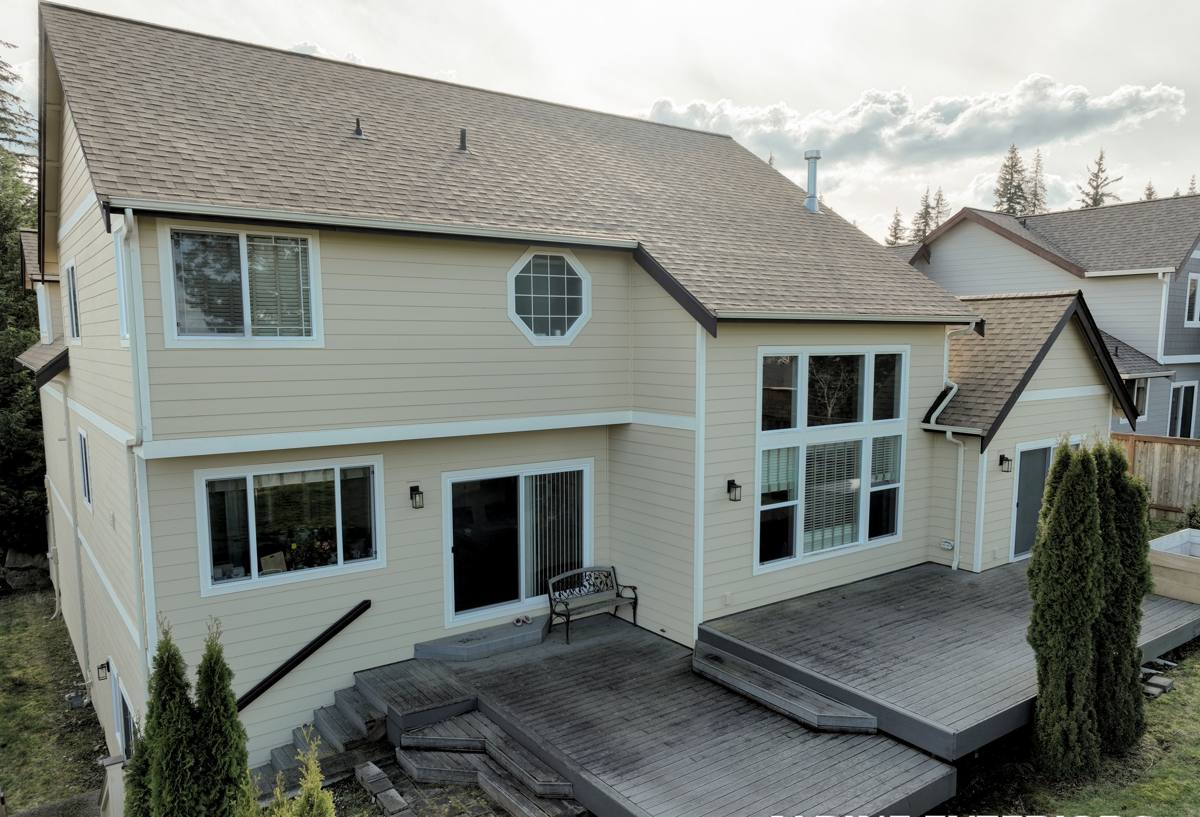
What Whatcom County Weather Does to a Deck
Three things drive most of the deck problems we see on service calls in this area, and they all trace back to the same regional climate.
Extended damp season
Whatcom County doesn't get brief rain and long dry recovery. It gets months of low-intensity rain, fog, and overcast humidity that keeps wood surfaces damp far longer than a short storm would. Untreated or poorly finished wood decking stays wet at the surface and in joints for days at a time during the wet season, which is exactly the condition that lets rot and fungal growth get started.
Moss and algae growth
Moss doesn't need standing water — it needs shade, moisture, and time, and this region provides all three for most of the year. Moss on a deck surface isn't just an appearance issue. It holds moisture against the wood or composite surface, it's slick underfoot, and if left to build up in board gaps and around fasteners it accelerates surface decay and can trap water against ledger boards and framing.
Salt-influenced marine air
Lynden is inland, but weather moving through Whatcom County off the Salish Sea still carries salt-laden moisture, especially with prevailing westerly weather. Salt air accelerates corrosion on exposed metal — fasteners, brackets, railing hardware — faster than it would in a dry inland climate. A deck built with standard interior-grade or minimally coated fasteners will show rust streaking and eventual fastener failure years earlier here than the same hardware would in a low-humidity region.
None of this means a deck can't hold up well in Lynden. It means the build has to account for these conditions from the framing up, not just at the surface finish.
Decking Material Options for This Climate
There's no single "best" decking material — the right choice depends on budget, maintenance tolerance, and how much you want the deck to look like natural wood. Here's how the common options perform specifically under Whatcom County conditions.
| Material | How it handles local moisture & moss | Maintenance | Typical lifespan here |
|---|---|---|---|
| Pressure-treated wood | Absorbs moisture readily; needs a sealed/stained surface to resist the wet season and slow moss uptake | Annual cleaning and re-sealing recommended | 15-20 years with upkeep, less if neglected |
| Cedar | Naturally rot-resistant heartwood, but still needs periodic sealing to resist graying and moss in a damp climate | Cleaning and oil/sealer every 1-2 years | 20-25 years with upkeep |
| Capped composite | Cap layer resists moisture absorption and moss gets a harder time gripping the surface; still needs periodic washing | Occasional wash, no staining or sealing | 25-30+ years, manufacturer-backed |
| PVC/cellular decking | Fully synthetic, essentially non-absorbent; performs well in constant damp conditions | Occasional wash | 25-30+ years, manufacturer-backed |
Composite and PVC decking cost more up front but remove most of the maintenance burden that wood decking carries in this climate — that tradeoff is worth walking through in person, because it changes depending on how the deck will be used and how much time you want to spend on upkeep. We install both wood and composite/PVC systems and will give you a straight comparison for your specific project rather than pushing one product line.
A note on why we're selective about which composite products we install
Not all composite decking is built the same way. Older-generation and lower-tier composite boards without a full cap layer can absorb moisture at cut ends and fastener penetrations, which is a real liability in a climate with this much sustained dampness. We stick to fully capped composite or PVC products with strong manufacturer warranties for exactly that reason — it's a maintenance and moisture-performance standard we hold the work to, not a comment on any particular brand.
Structural Details That Matter More Here Than Elsewhere
A deck can look finished and still be built wrong underneath. In a climate like this, a few structural details make the difference between a deck that lasts and one that develops hidden rot in five to eight years.
Ledger flashing
Where a deck attaches to the house, the ledger board connection is the single most common point of hidden water damage on any deck, anywhere — and in a region with this much sustained rainfall, a poorly flashed ledger will let water track behind the board and into the house rim joist over time. Correct flashing (metal flashing plus a water-resistant membrane behind it) isn't optional here; it's the detail that protects the house structure itself, not just the deck.
Footings below frost and bearing depth
Footings need to be sized and set to local code depth and soil-bearing requirements, not just "deep enough to look solid." Undersized or shallow footings can shift with seasonal ground saturation, which is common in Whatcom County's wet-season soil conditions.
Joist spacing and decking span ratings
Composite and PVC decking generally require tighter joist spacing than solid wood decking to avoid long-term sagging between boards — every manufacturer publishes span tables for this, and skipping them is one of the most common corner-cutting mistakes we see on decks that were installed by unlicensed or out-of-area labor.
Airflow underneath
A deck built too low to the ground, or without adequate ventilation underneath, traps moisture against the framing and accelerates rot regardless of what decking material is on top. Proper clearance and, where needed, ventilation gaps matter more here than in a dry climate.
Fasteners and Hardware Built for Salt Air
Given the corrosion risk from marine-influenced air moving through the county, we use stainless steel or heavy-coated (hot-dip galvanized or equivalent corrosion-rated) fasteners and structural hardware on every deck we build — joist hangers, ledger bolts, railing brackets, and the visible screws in the decking surface itself. Standard zinc-plated interior fasteners are not rated for sustained exterior exposure in this climate and are one of the most common causes of premature hardware failure and rust staining we get called out to fix on older decks in the area.
How Our Process Works
- Site visit and assessment. We look at the ground slope, existing structure (if it's a replacement or rebuild), sun/shade exposure, and how the space will actually be used before recommending materials or layout.
- Design and material selection. We walk through the material tradeoffs above in the context of your budget and maintenance preferences, and put together a clear scope before any work starts.
- Permitting. Deck projects in Whatcom County typically require a building permit depending on size and height — we handle that process as part of the job so it's not left on the homeowner.
- Framing and structural work. Footings, ledger flashing, framing, and hardware go in first, built to the spans and connection details the decking material and local code require.
- Decking, railing, and finish work. Surface installation, railing systems, stairs, and any lighting or fascia details are completed and inspected.
- Final walkthrough. We go over the finished deck with you, including what maintenance (if any) the material you chose will need going forward.
Maintenance That Actually Matters in a Lynden Climate
Whatever material you choose, a little seasonal attention goes a long way toward keeping a deck safe and good-looking through Whatcom County's wet season. This is the checklist we give homeowners after every installation:
- Sweep debris and leaves out of board gaps regularly, especially in fall — trapped organic matter is what feeds moss growth
- Wash the surface at least once or twice a year with a deck-safe cleaner to remove early moss and algae before it establishes
- Avoid pressure-washing wood decking at high pressure or close range, which can strip surface fibers and open the wood to faster moisture absorption
- Check and re-seal or re-stain wood decking on the manufacturer or product-recommended schedule (usually every 1-2 years in this climate)
- Inspect fasteners and railing hardware annually for rust streaking or loosening, particularly near ground level and stair stringers
- Keep gutters and downspouts near the deck clear so runoff isn't draining directly onto or under the structure
- Trim back overhanging vegetation to reduce shade and moisture retention on the deck surface
Why Hiring a Crew That Already Works Lynden Matters
Deck-building fundamentals are the same everywhere, but the details that make a deck last — flashing choices, fastener grade, footing depth relative to local soil conditions, and which decking products actually hold up to this specific combination of rain, moss, and salt air — are things a crew learns from building and later servicing decks in this exact region, not from a generic national playbook. We're familiar with Whatcom County permitting requirements, the soil and moisture conditions common around Lynden and Ferndale, and which material and hardware choices actually pay off over years of local weather rather than looking good on installation day.
If you're planning a new deck or replacing one that's showing its age, we're happy to come take a look, walk the site with you, and put together a straightforward estimate — no pressure, no obligation. Use the form below to get started.