 Ferndale Window
 What That Fog Between the Glass Actually Means
If you've got a window with a permanent haze, foggy patches, or streaky white residue trapped between the panes of glass — and it doesn't wipe away because it's on the inside — you're not looking at a cleaning problem. You're looking at a failed seal. Most windows made in the last several decades use an insulated glass unit, or IGU: two (sometimes three) panes of glass bonded around the edges by a spacer bar and a layer of sealant, with a pocket of dry air or inert gas sandwiched in between. That sealed gap is what gives the window its insulating value.
When the seal breaks down, outside air and moisture start working their way into that gap. The desiccant packed into the spacer bar (a drying agent meant to soak up trace humidity) does its job for a while, but eventually it saturates and stops keeping up. Once that happens, every temperature swing pulls in a little more moist air, and you get condensation forming inside the glass unit itself — somewhere you can't reach with a squeegee or a rag.
This is a mechanical failure of the glass unit, not a sign of a dirty window or a ventilation problem in the house. It's also not something that fixes itself or gets better with time. Once a seal has gone, the unit is going to keep fogging, usually worse in cold, damp weather and clearer on warm dry days — which is exactly the kind of swing Ferndale gets a lot of.
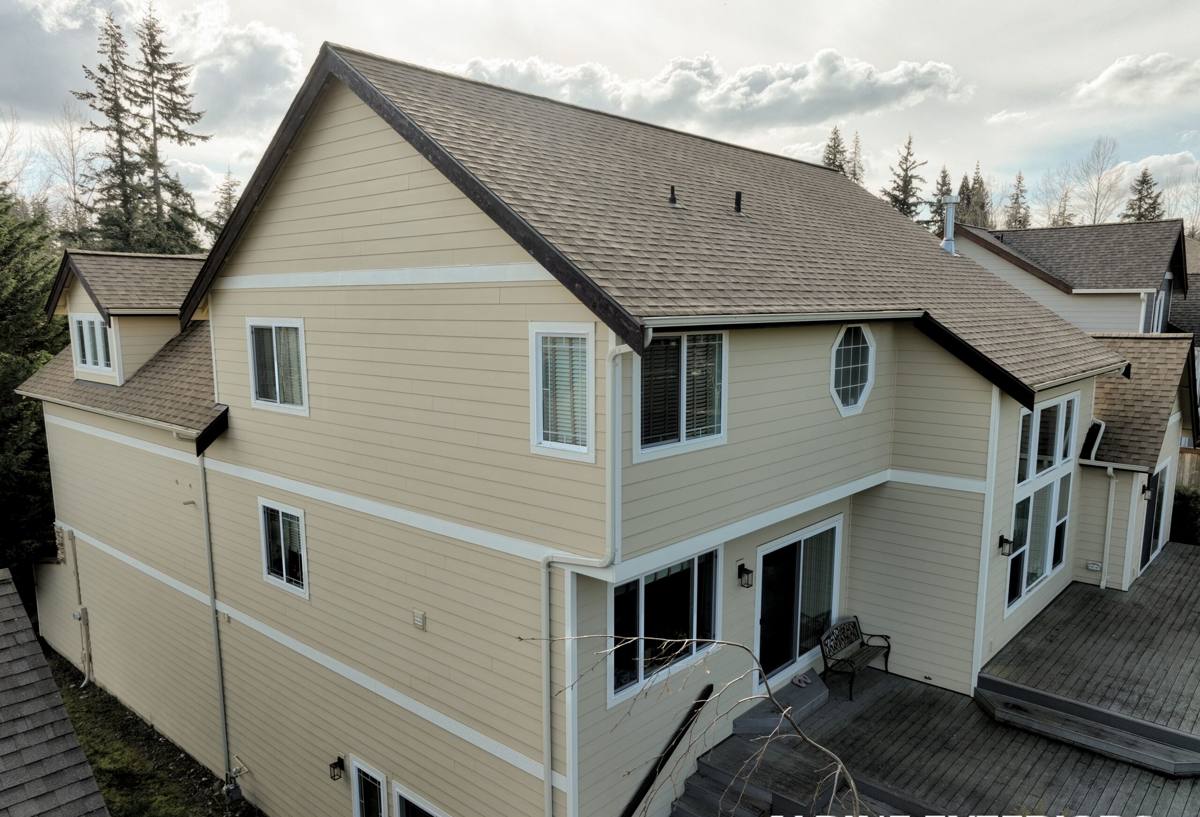
Why Whatcom County Windows Fail Seals Faster
Every window seal has a service life, but climate has a lot to say about how long that life actually is. Ferndale sits close enough to the water that salt-laden air is a regular visitor, and salt air is hard on the metal spacer bars and sealant compounds used in most IGUs — it accelerates corrosion and breaks down adhesion at the edge seal faster than it would in a dry inland climate. Add in the driving rain that comes through on a good winter storm, which pushes water sideways into frames and sash joints under wind pressure rather than just falling straight down, and you get more moisture cycling at the seal than the manufacturer's testing usually accounts for.
Then there's moss season. Whatcom County's long stretch of damp, mild weather is prime growing conditions for moss and algae on north-facing siding, trim, and window sills — and where organic growth sits against a frame or sill, it holds moisture against the window for extended periods instead of letting it dry out between rain events. Over years, that constant damp exposure works on caulking, frame seals, and eventually the IGU edge seal itself. None of this means the windows were built badly. It means this particular stretch of coastline asks more of a window seal than most places do, and seals that would coast along for 25 years somewhere drier can start showing failures here at 12 to 18.
Is a Fogged Window Just Cosmetic, or Does It Matter?
Both, honestly, and it's worth being straight about which is which.
On the cosmetic side, a foggy pane is annoying to look at and it kills your view — that's real, especially on a window you look through every day. But the bigger practical issue is that a failed seal also means the window has lost its designed insulating performance. The gas or dry air pocket that was doing thermal work is gone, replaced by humid outside air that conducts heat and cold far less efficiently. You'll usually notice it as a cold spot near that window in winter, more condensation on the room-side glass surface, and in some cases a higher heating bill than the rest of the house would suggest. It won't cause structural damage to the wall or let water actively leak into your home by itself — the failure is contained inside the sealed glass unit — but it is a permanent, one-way loss of the window's performance.
Sorting Out What's Actually Wrong
Before assuming every foggy window needs the same fix, it helps to know what you're dealing with. Use this quick check before calling anyone out:
- Fog or haze is trapped between the panes and never clears, even on dry days — that's a seal failure, confirmed.
- Condensation appears only on the inside room-facing surface of the glass and wipes away — that's household humidity, not a window failure, and it points to ventilation or indoor moisture levels instead.
- You see mineral deposits, streaking, or a "crackled" look inside the glass — the seal has been failed for a while and moisture has cycled through repeatedly.
- The window sash or frame feels soft, spongy, or shows rot at the corners — that's a separate frame issue, and it changes the repair math since the wood or vinyl housing is compromised too.
- Only one or two windows in the house are affected, especially ones facing the water or prevailing weather — consistent with localized wear rather than a bad batch.
- Most or all of the windows are fogging around the same age — that points to the whole set nearing the end of its seal life together.
Frame Condition Changes the Decision
A fogged IGU in a frame that's otherwise square, solid, and weathertight is a straightforward glass problem. A fogged IGU in a frame with rot, warping, or failed weatherstripping is a bigger conversation, because replacing just the glass in a frame that's on its way out is often money spent twice.
Your Real Options
Once a seal has failed, there are really three paths, and which one makes sense depends on the window's age, the frame condition, and how many units in the house are affected.
| Option | What It Involves | Best For |
|---|---|---|
| Glass unit replacement (sash swap or glass-only) | The failed IGU is removed and a new insulated glass unit is fitted into the existing sash and frame | Newer, good-condition frames with just one or a few failed panes |
| Full window replacement | Frame, sash, and glass are all replaced as one unit | Older frames, rotted or warped sashes, or windows that are inefficient beyond just the fogging |
| Leave it alone | No repair, just live with the fog | Rarely a good long-term call, but sometimes reasonable for a low-use window on a home you're planning to sell as-is |
Glass-only replacement is usually the more economical route when the frame itself is sound, since you're not paying to remove and reinstall trim, flashing, and siding tie-ins. But it only makes sense if the sash and frame are square and weathertight — trying to match a new IGU into a frame that's already twisted or rotting is a losing proposition, and it's not a repair we'd recommend standing behind.
What Drives the Cost
There's no single number that applies to every foggy window, because the cost swings on a handful of specific factors:
| Factor | Why It Matters |
|---|---|
| Glass size and shape | Larger units and custom shapes (arches, angles) cost more to fabricate than standard rectangular sizes |
| Glass type | Tempered glass, Low-E coatings, and gas-filled units all add cost over basic clear IGUs |
| Number of affected windows | Doing several units at once is typically more efficient per-window than one-off jobs |
| Frame condition | Sound frames keep it a glass-only job; deteriorated frames push toward full window replacement |
| Access and window location | Upper-story or hard-to-reach windows add labor time |
| Glass-only vs. full replacement | Full replacement costs more upfront but resets the frame, weatherstripping, and hardware as well |
As a general rule, glass-only replacement tends to run in the low-to-mid hundreds of dollars per window depending on size and glass spec, while full window replacement runs several times that once frame, installation, and finish work are included. Anyone quoting you a number without measuring the windows or looking at frame condition is guessing.
Why We're Careful About Glass-Only Fixes
We'll do glass-only replacements when the frame supports it, but we're upfront that it's not always the right call. A new IGU is only as good as the frame and installation around it — if the sash has any twist, if the weatherstripping is shot, or if there's been water intrusion into the frame itself, a new glass unit dropped into that same frame is exposed to the same conditions that failed the last one. Our standard is to actually inspect the frame and sash before quoting glass-only work, not just take a measurement and order glass. If a frame doesn't pass that check, we'll tell you honestly that a full replacement is the better long-term investment, even though it's the more expensive quote to give you.
Preventing It From Happening Again
You can't extend the life of a seal that's already failed, but you can reduce how fast the rest of your windows head that direction:
- Keep moss and organic growth cleared off sills, trim, and nearby siding so moisture isn't held against the frame.
- Make sure exterior caulking around window perimeters is intact, especially on walls that take direct driving rain.
- Check that gutters and downspouts aren't dumping water near window heads or sills.
- If you're near the water, expect shorter seal life on salt-exposed elevations and budget for it rather than being surprised by it.
- Address failed seals promptly rather than letting moisture cycle through the unit for years — it won't get better on its own, and it won't get cheaper to ignore.
If you've got one foggy window or you're noticing several going at once, we're happy to come take a look, check the frames, and give you a straight answer on whether it's a glass swap or a full replacement — no pressure, no upsell, just what the window actually needs. Reach out using the form below for a free estimate.