 Ferndale Window
 Building Decks That Hold Up in Sudden Valley
Sudden Valley sits in a part of Whatcom County where a deck earns its keep. Homes here deal with salt-laden air moving in off the water, long stretches of driving rain through fall and winter, and a moss season that seems to start earlier and last longer every year. A deck that's built the way it would be built somewhere drier — say, eastern Washington — will not last here. The fasteners corrode faster, the boards trap moisture in ways that invite rot, and moss gets a foothold in shaded corners within a season or two if the structure wasn't designed to shed water and air out properly.
We build and repair decks for homes in this area regularly, and the lessons are consistent: get the substructure right, choose materials that actually suit this climate, and detail the drainage and airflow carefully. Skip any of that and you're looking at a deck that needs real work again in five years instead of twenty.
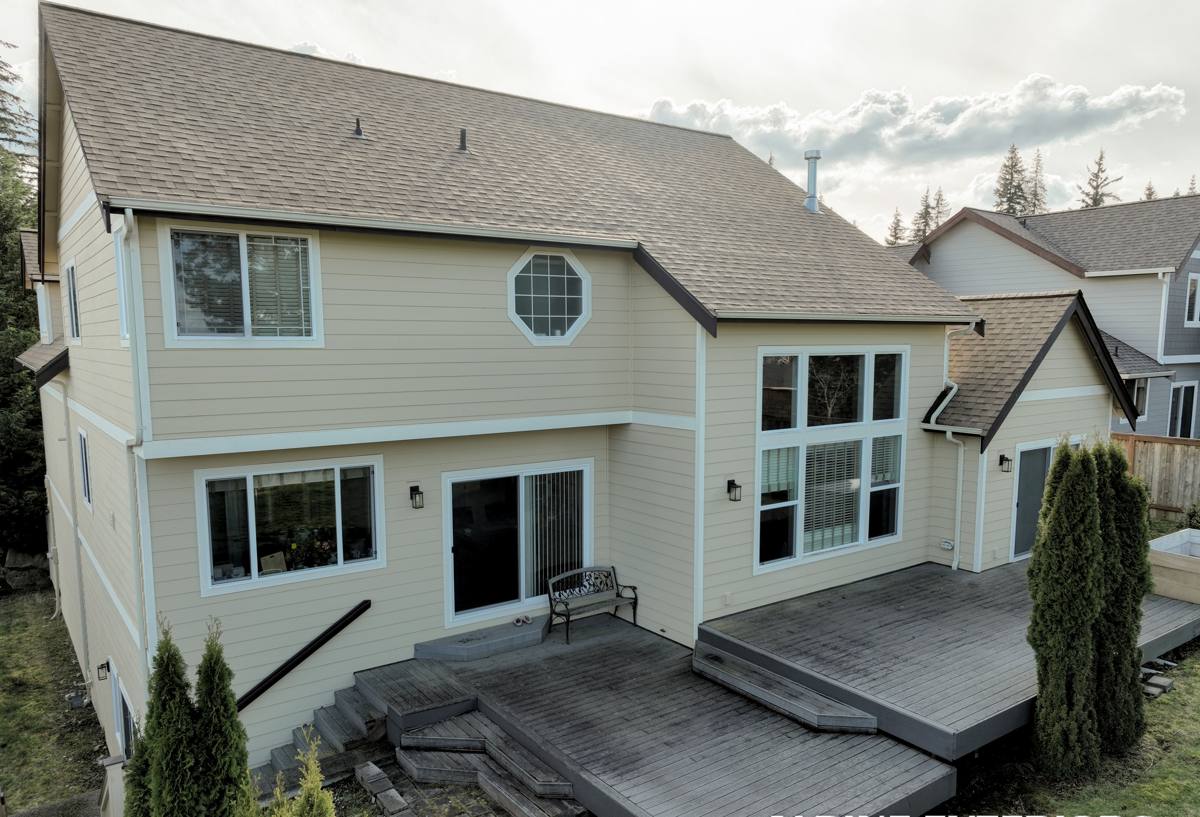
What This Climate Actually Does to a Deck
It helps to understand the specific mechanisms at work, because they drive every decision we make on a Sudden Valley deck build.
Salt Air and Metal Fasteners
Proximity to the water means airborne salt reaches framing hardware, screws, and connectors. Standard zinc-coated fasteners can start showing surface corrosion within a few years in a coastal-influenced environment like this. Corroding hardware doesn't just look bad — it's a structural problem, since ledger connections, joist hangers, and post bases are what keep the deck attached to the house and standing upright.
Driving Rain and Water Intrusion
Rain here doesn't always fall straight down. Wind-driven rain gets pushed sideways into ledger boards, under railings, and into any gap where flashing wasn't detailed correctly. Once water gets behind a ledger board or into an end grain cut that wasn't sealed, rot starts from the inside where you can't see it until the damage is advanced.
Moss and Shade
Whatcom County's tree cover and cloud cover mean a lot of decks sit in partial or full shade for much of the year. Combine that with moisture that doesn't evaporate quickly and you get moss and algae establishing on deck boards, especially on the north side of a house or under overhangs. Beyond being a slip hazard, moss holds moisture against the wood surface, which accelerates decay in untreated or poorly finished lumber.
What a Correctly Built Deck Needs Here
A deck that's going to perform well for a Sudden Valley home needs a handful of things addressed at the design and build stage — not patched in afterward.
- Corrosion-resistant hardware throughout — structural screws, joist hangers, post bases, and ledger bolts rated for exterior and coastal-adjacent exposure
- Proper ledger flashing where the deck attaches to the house, so water is directed away from the band joist and siding, not trapped against it
- Decking material chosen for moisture performance, not just appearance — some materials handle standing water and shade far better than others
- Adequate slope built into the decking surface (generally a slight pitch away from the house) so water sheds instead of pooling
- Gaps between boards sized correctly for drainage and for the specific material's expansion and contraction
- Under-deck airflow, especially for low-clearance decks, so the space beneath doesn't stay damp and become a moss and mildew trap
- Railing post connections that won't loosen or wick water into the post base over time
Decking Material Options for This Climate
There's no single "best" decking material for every home — it depends on budget, how much shade the deck sits in, and how much upkeep the homeowner wants to take on. Here's how the common options actually perform in a wet, shaded, salt-influenced environment like Sudden Valley.
| Material | Moisture & Moss Behavior | Maintenance | Typical Lifespan Here |
|---|---|---|---|
| Pressure-treated lumber | Absorbs moisture; needs sealing to resist moss and decay | Annual cleaning, resealing every 1-2 years | 10-15 years with upkeep |
| Cedar | Naturally moisture- and insect-resistant, but still needs finish maintenance in shade | Cleaning and re-staining every 1-2 years | 15-20 years with upkeep |
| Composite decking | Doesn't absorb water like wood; still needs occasional cleaning where moss can grow on the surface film | Periodic washing, no sealing/staining | 25-30+ years, varies by product warranty |
| PVC/capped polymer | Fully moisture-resistant surface; best resistance to staining and moss adhesion | Occasional washing | 25-30+ years, varies by product warranty |
For decks sitting in significant shade — common on wooded Sudden Valley lots — we often steer homeowners toward composite or capped polymer decking specifically because it doesn't give moss the same organic surface to grip that raw wood does. That's not a knock on wood decking; a well-maintained cedar deck looks great and can last decades. It's a maintenance-commitment conversation, and we'll walk through the honest trade-offs for your specific site and budget rather than push one product.
Framing and Substructure — Where Most Failures Actually Start
Homeowners tend to focus on the decking surface because that's what they see, but most of the deck failures we get called out to inspect start below the surface. The framing, ledger connection, and footings do the structural work, and in this climate they're also the parts most exposed to hidden moisture damage.
The Ledger Connection
This is the single most safety-critical joint on most residential decks — it's what ties the deck to the house. It needs proper flashing (typically a metal flashing that directs water out and away, paired with correct fastener spacing and type) to keep water from wicking into the house's band joist. A poorly flashed ledger is one of the most common causes of hidden rot we find on older decks in this region.
Footings and Post Bases
Footings need to be set below frost depth and sized appropriately for the soil conditions on the lot, which can vary across Sudden Valley depending on grade and drainage. Post bases should hold the post above the concrete and decking surface, not buried in it, so water doesn't wick straight into the end grain.
Joist Spacing and Hardware
Joist spacing depends on the decking material chosen — composite and PVC products often have tighter span requirements than solid wood, and installing them on framing meant for lumber decking is a common mistake that shows up as bounce or sag later. We frame to the manufacturer's spec for whatever surface material you choose, not a generic layout.
Our Process for a Sudden Valley Deck Project
- On-site assessment: We look at sun and shade exposure, drainage on the lot, house attachment point, and any existing structure if this is a rebuild or repair.
- Design and material selection: We talk through decking material, railing style, and layout based on how you'll actually use the space and how much maintenance you want long-term.
- Permitting: Most deck projects in Whatcom County require a permit, particularly for anything attached to the house or above a certain height. We handle that process as part of the job.
- Demolition (if applicable): Removal of an old deck, checking the house band joist and siding behind it for hidden moisture damage before building new.
- Framing: Footings, posts, ledger flashing, and joists built to the load and spacing requirements for your chosen decking material.
- Decking and railing installation: Surface material installed with correct gapping and fastening, railing system installed and secured.
- Final walkthrough: We go over the finished deck with you, including any maintenance recommendations specific to the material you chose.
Repair vs. Rebuild: How We Decide
Not every deck problem means starting over. Sometimes a deck has solid framing but failing decking boards, or a railing system that's loosened while the structure underneath is sound. Other times, what looks like a cosmetic issue — soft spots, discoloration near the ledger, persistent moss in one area — is a sign the framing itself has taken on water damage. Part of our estimate process is an honest look at what's actually salvageable versus what's compromised, so you're not paying to rebuild what didn't need it, or patching over a structural problem that needs to come out.
Signs Your Existing Deck Needs a Closer Look
- Soft or spongy spots when you walk across the decking
- Persistent moss or algae that returns quickly after cleaning
- Visible gaps, staining, or dark streaking where the deck meets the house
- Railing posts that wiggle or feel less rigid than they used to
- Rust streaks around fasteners or hardware
- Boards that have cupped, splintered, or separated at the ends
Why It Matters to Hire a Crew That Already Works This Area
Deck-building fundamentals don't change from town to town, but the details that make a deck last do change with the local climate. A crew that mostly builds in drier parts of the state may not think twice about hardware grade, ledger flashing detail, or under-deck ventilation — because in their usual conditions, those shortcuts don't show up as failures for a long time. In Whatcom County's wet, shaded, salt-influenced conditions, they show up fast.
We build decks in Ferndale and the surrounding communities, including Sudden Valley, and we spec every project — hardware, flashing, material, and framing — for what this climate actually does to a structure over the years, not just what looks finished on installation day.
Get a Free Estimate
If you're planning a new deck or dealing with an aging one that's showing signs of wear, we're happy to take a look and give you an honest assessment — what's salvageable, what needs replacing, and what materials make sense for your home's sun exposure and budget. Reach out using the form below for a free, no-pressure estimate.