 Ferndale Window
 Point Roberts Sits in a Tougher Climate Than Most of Whatcom County
Point Roberts is surrounded by water on three sides, and that changes what a window has to survive. Homes just a few miles inland in Ferndale or Blaine deal with normal Pacific Northwest weather. Homes out on the point deal with that same weather plus constant salt-laden air, stronger and more direct wind off the water, and a longer wet season where moss, algae, and standing moisture never really get a break. None of that is exotic or unusual — it's just more of everything a window already has to resist, applied more often and more aggressively.
That matters because a window that's rated fine for a typical inland install can underperform on the point within a few years. Salt air accelerates corrosion on hardware and fasteners. Driving rain finds gaps that would stay dry fifty miles east. And a long moss season keeps trim, sills, and cladding damp longer, which is exactly the condition that lets rot and seal failure get a foothold. None of this means windows on the point are doomed — it means the glass package, frame material, and installation details need to be chosen and executed with that exposure in mind from the start.
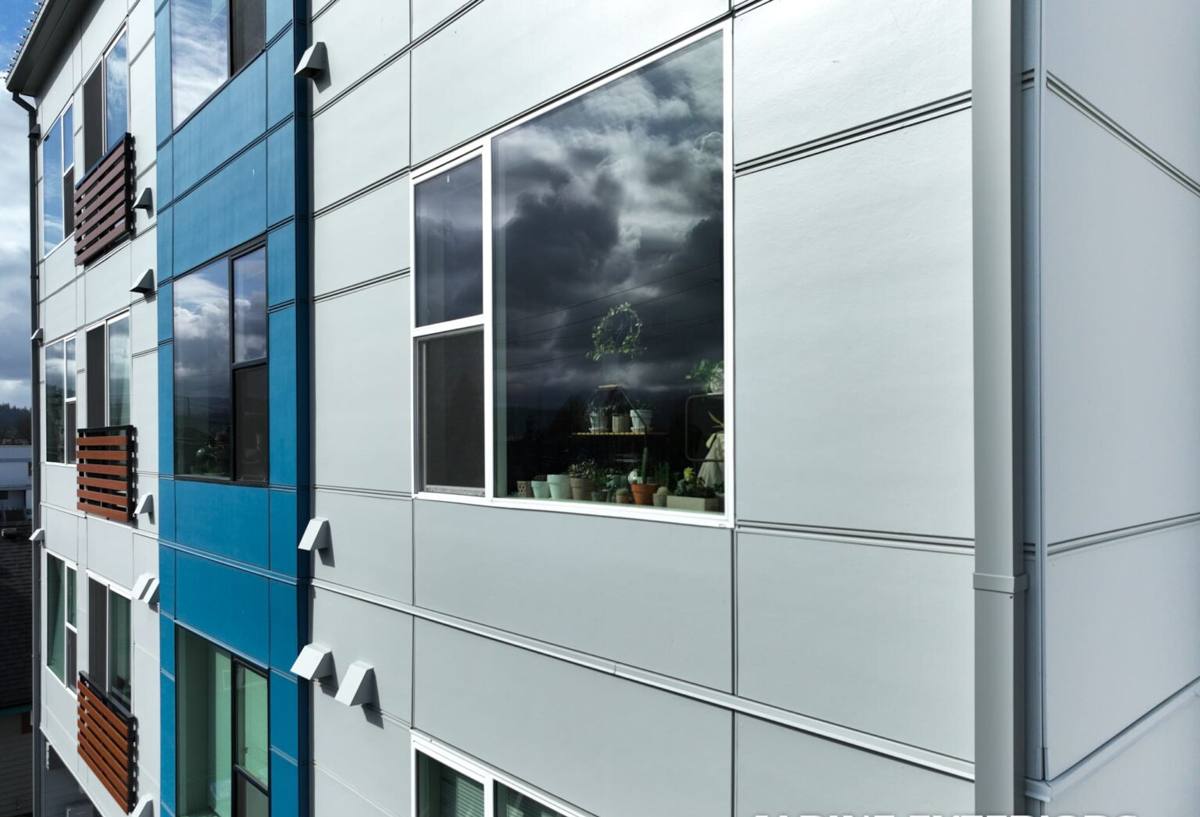
What "Energy-Efficient" Should Mean for a Coastal, Moss-Season Climate
Glass Package
Energy efficiency starts with the glass, but for a location like Point Roberts it's not just about keeping heat in — it's about controlling condensation and cutting down on the moisture load the window has to shed. A double-pane unit with a quality Low-E coating and an argon gas fill is the practical baseline for most homes here. Triple-pane glass is worth discussing on north- and west-facing walls that catch the worst of the wind and rain, or on homes with higher heating bills already, but it isn't automatically the right call for every wall or every budget.
Frame Material
The frame matters as much as the glass in this climate. Whatever material is chosen, it needs to hold up to repeated wetting and drying without warping, and its hardware needs to resist salt-air corrosion. We'll walk through the trade-offs by material below — there isn't one "correct" answer for every home, but there is a correct standard: no frame or hardware that we know will struggle with this specific exposure.
Weatherproofing and Flashing
A high-efficiency window installed with sloppy flashing or a skipped sill pan will leak eventually — usually behind the wall, where you won't see it until there's damage. In a driving-rain, high-moisture climate like Point Roberts, correct flashing and sealant work isn't a nice-to-have. It's the difference between a window that performs for twenty-five years and one that causes a rot problem in five.
Problems We Commonly See in Point Roberts Homes
A lot of the window issues we get called out for on the point trace back to the same handful of causes:
- Interior condensation and fogging between panes — usually a sign the seal has failed and the insulating gas has escaped
- Corroded locks, hinges, and cranks that stick or won't latch tight, letting drafts and moisture in around the sash
- Moss and algae buildup on sills, trim, and lower frame sections that traps moisture against the material longer than it should sit
- Soft or discolored trim and framing near the window, a sign water has been getting behind the exterior finish
- Drafts around older aluminum-frame windows, which conduct cold and don't insulate well compared to modern frame materials
- Wind-driven rain intrusion at the bottom corners of window openings, often traced back to missing or improperly lapped flashing
Most of these aren't defects in the window itself — they're the predictable result of a window built or installed without accounting for this specific exposure. That's the gap we're trying to close.
Choosing a Frame Material for Salt Air and Constant Moisture
There's no single "best" window frame material for every home — it depends on budget, the home's exposure, and how much upkeep an owner wants to take on. Here's how the common options compare for a marine, moss-prone climate like Point Roberts:
| Frame Material | Salt/Moisture Resistance | Maintenance | Typical Cost Position |
|---|---|---|---|
| Vinyl | Good — won't rot or corrode, hardware is the main wear point | Low — occasional cleaning | Most affordable |
| Fiberglass | Very good — dimensionally stable, holds up well to wet/dry cycling | Low | Mid to upper range |
| Wood, unclad | Weakest in this climate without diligent upkeep | High — regular repainting and sealing required | Mid to high |
| Wood-clad (vinyl or aluminum exterior) | Good on the exterior face; interior wood still needs normal care | Moderate | Upper range |
| Aluminum (older/uninsulated) | Prone to corrosion and pitting near salt air over time | Moderate | Varies widely by age |
For most Point Roberts homes we recommend vinyl or fiberglass as the frame material, specifically because they don't give salt air and standing moisture anything to work on. Where a homeowner wants a wood interior look, wood-clad options let you keep that appearance while putting a more weather-resistant material on the side that actually takes the abuse.
How We Approach a Job on the Point
- On-site assessment. We look at each opening individually — sun and wind exposure, existing flashing condition, any signs of past moisture intrusion, and the home's overall orientation.
- Product selection. We recommend glass packages and frame materials based on that specific wall's exposure, not a one-size answer for the whole house.
- Removal and inspection. When we pull the old window, we check the framing underneath for rot or hidden moisture damage before anything new goes in.
- Flashing and sealing. Sill pans, flashing tape, and sealant get installed to shed water outward and downward, matched to this climate's rain and wind patterns.
- Installation and air-sealing. The window is set, shimmed, and insulated around the frame so there are no gaps for drafts or moisture to travel through.
- Final check. We confirm operation, weatherstripping contact, and finish work before calling the job done.
Why Local Experience on Point Roberts Actually Matters
Point Roberts isn't like scheduling a job in Ferndale proper. It's a border community, reached by crossing into Canada and back, which means trips out there have to be planned — you can't run back to the shop for a forgotten part or send a second truck on short notice the way you would for a job five minutes down the road. A crew that already works the area knows to arrive with the right materials, the right fasteners, and a plan for the day's weather window, because a wasted trip costs real time on both ends.
There's also a practical benefit to a crew that has already seen how windows fail out here. Knowing which frame materials hold up, which flashing details actually stop wind-driven rain at this exposure, and which corners never to cut isn't something you get from a spec sheet — it comes from doing the work in this specific climate, in this specific community, more than once.
Maintenance Checklist for Point Roberts Windows
Whatever windows are already in your home, a little regular attention goes a long way in this climate:
- Rinse salt residue off exterior glass and frames a few times a year, especially after storms
- Clear moss and organic buildup off sills and lower trim before it holds moisture against the surface
- Check that weep holes (the small drainage openings in the bottom of the frame) aren't clogged with debris
- Lubricate locks, cranks, and hinges periodically to keep salt air from seizing them up
- Look for fogging between panes, which signals a failed seal rather than a cleaning problem
- Inspect exterior caulking and trim paint annually and touch up before gaps open up
What Affects the Cost of This Job
Every home is different, but the main variables that move the price on a Point Roberts window job are the number of openings, the glass package chosen, frame material, and how much repair work the existing framing needs once the old window comes out. Homes with hidden moisture damage from years of exposure will cost more to correct properly than a straightforward swap into sound framing — which is exactly why we inspect before quoting rather than guessing from the outside. We'll always give you the honest range for your specific home rather than a generic number that doesn't hold up once we're on site.
If you're dealing with drafty, fogged, or aging windows on Point Roberts, we're happy to come take a look and give you a straightforward, no-pressure estimate — just fill out the form below.