 Ferndale Window
 Decking Built for a Lummi Nation Lot, Not a Catalog Photo
Homes along the water near Lummi Nation deal with a different set of conditions than a deck fifteen miles inland in Ferndale proper. Salt-laden air off the bay, driving rain that comes in sideways more often than straight down, and a moss season that can run half the year all work against a deck at the same time. A deck built to a generic spec sheet, without accounting for this specific environment, tends to show its age fast — soft spots, corroded fasteners, green film that never fully goes away no matter how often it's scrubbed.
This page is about composite decking specifically for that setting: what the climate actually does to a deck here, what a correct installation looks like in response, and why it matters that the crew building it already works this part of Whatcom County rather than treating it like any other job site.
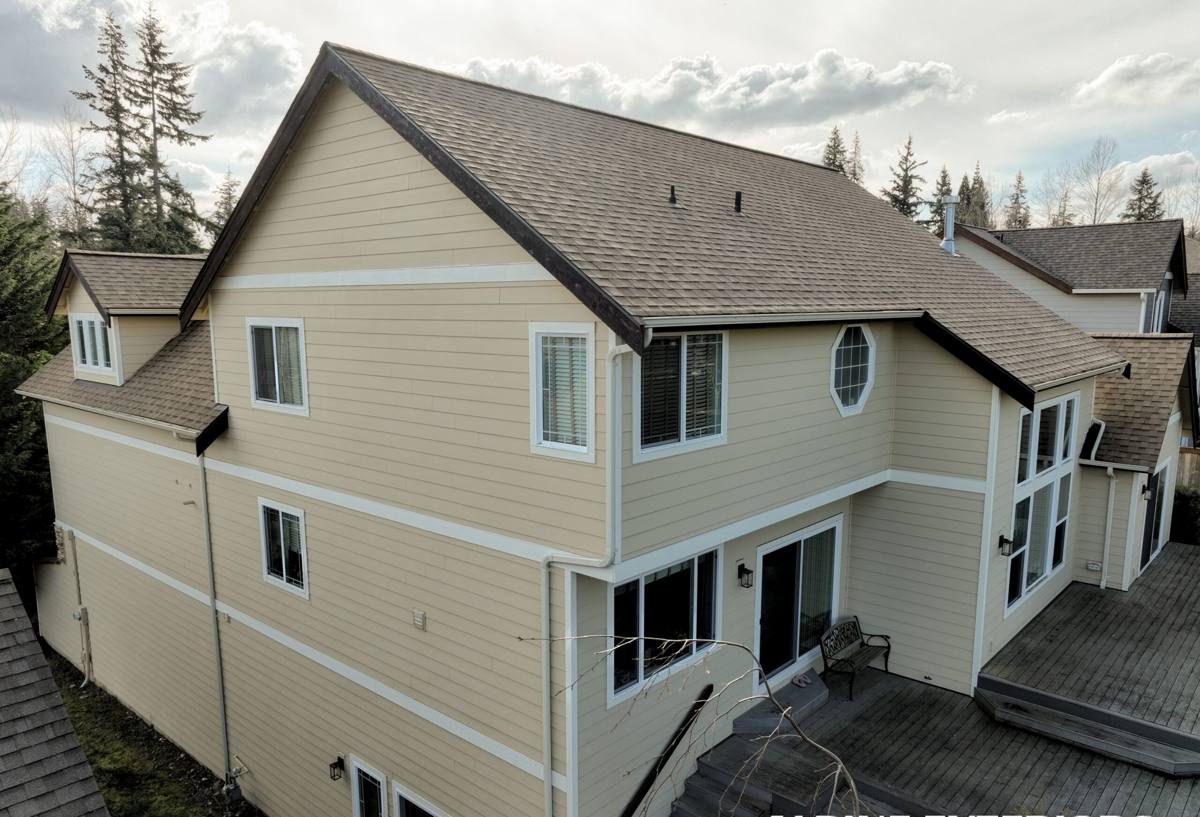
What Salt Air, Rain, and Moss Actually Do to a Deck
Each of these three factors causes a different kind of damage, and they compound each other.
Salt Air and Metal Hardware
Airborne salt accelerates corrosion in fasteners, brackets, and connectors — even hardware rated for exterior use can corrode faster near open water than the same product would fifteen minutes inland. Once a fastener starts to rust, it weakens the connection it's holding and can stain the surrounding decking material.
Driving Rain and Water Intrusion
Rain that comes in at an angle finds its way into gaps, end grain, and fastener holes that vertical rain would never reach. On a deck, that means water gets driven into board ends, under ledger connections, and into any joist that isn't properly flashed — well before the surface itself shows a problem.
Moss and Sustained Dampness
A long wet season means surfaces stay damp for extended stretches, which is exactly what moss and algae need to establish. On a shaded deck near mature trees or on the north side of a house, that dampness can persist for days after a storm passes, giving organic growth time to take hold in board grain and between boards.
Why Composite Decking Is Suited to This Environment
Composite decking doesn't eliminate every maintenance task, but it responds to each of the three issues above in a way that matters for a waterfront or near-waterfront lot.
Moisture Behavior
Composite boards don't absorb water into their fibers the way solid wood does, so they don't swell, cup, or check the same way after repeated wet-dry cycles. That matters directly here, where boards rarely get a long uninterrupted dry stretch to fully recover between rain events.
Surface Resistance to Moss and Mildew
Modern capped composite boards have a solid outer shell rather than exposed wood fiber, which gives moss and algae less to grip onto and makes routine cleaning far more effective. It's not a guarantee against growth in a consistently shaded, damp spot, but it's a meaningfully different starting point than bare or lightly sealed wood.
What Composite Doesn't Solve on Its Own
The decking surface is only part of the system. Fasteners, joists, flashing, and the substructure underneath still need to be specified for a salt-air, high-rain environment, or the deck will fail from the frame up while the surface still looks fine. This is where installation quality matters as much as the product choice.
What a Correct Installation Looks Like Here
A composite deck built for this stretch of coastline needs a few things a generic install often skips.
- Corrosion-resistant or coated fasteners and brackets rated for coastal or high-moisture exposure, not just standard exterior-grade hardware
- Proper ledger flashing where the deck attaches to the house, so driven rain can't work its way behind the connection
- Joist protection (tape or a compatible coating) on the framing lumber underneath the decking, since the substructure is still wood in most systems
- Consistent board spacing that allows drainage and airflow instead of trapping standing water between boards
- Adequate ventilation underneath the deck so the framing can dry out between rain events instead of staying damp
- Correct fastening pattern for the specific composite board being used — hidden-fastener systems and screw-down systems have different tolerances and failure points if installed incorrectly
Skipping any one of these doesn't show up on day one. It shows up in year three or four, usually as a soft joist, a rust-streaked board, or fasteners backing out.
Composite vs. Other Decking Materials for This Climate
There's no single "best" decking material in the abstract — the right call depends on how much upkeep an owner wants to do and what trade-offs they're comfortable with. Here's how the common options actually compare in a salt-air, high-rain, moss-prone setting.
| Material | Moisture Behavior | Moss/Mildew Resistance | Ongoing Maintenance | Typical Lifespan Here |
|---|---|---|---|---|
| Pressure-treated wood | Absorbs water, prone to swelling and checking | Needs regular cleaning and sealing to resist growth | High — sealing/staining on a recurring cycle | Shorter without diligent upkeep |
| Cedar or other natural wood | Absorbs water, more dimensionally stable than PT pine but still moves | Natural resistance helps some, but still needs care in constant damp | Moderate to high | Moderate |
| Capped composite | Doesn't absorb water into the core; minimal swelling | Solid outer shell resists surface growth better | Low — occasional washing | Longer, especially with correct substructure |
| PVC decking | Fully water-resistant, no wood fiber at all | Very resistant to moss and mildew on the surface | Low | Long, but different appearance and feel than composite |
We install composite as our standard recommendation for most Lummi Nation waterfront and near-waterfront homes because it strikes a workable balance: meaningfully lower maintenance than wood, a natural wood-grain look many owners want to keep, and a track record we can stand behind when we specify the substructure correctly. PVC is a legitimate option for owners who want the lowest possible upkeep and don't mind its different look and feel — we'll walk through that trade-off honestly if it's a fit for the project.
How We Approach a Deck Project Here
Site Assessment
We start by looking at sun exposure, tree cover, drainage patterns, and how exposed the lot is to wind off the water. A deck tucked against a shaded slope needs a different ventilation and cleaning plan than one sitting in open sun.
Substructure First
Before any decking goes down, we evaluate the ledger connection, joist spacing, and framing condition. On a rebuild, this is often where we find the real problem — a deck surface that looked fine but sat on framing that had been taking on water for years.
Hardware Selection
We spec fasteners and connectors rated for the exposure level of the specific site, not a one-size-fits-all hardware package. A deck sitting closer to open water gets a different hardware spec than one set further back and shielded by the house itself.
Installation and Drainage Details
Board spacing, end-gap allowances, and under-deck ventilation get set up during install, not left to chance. These are the details that determine whether the deck sheds water properly or holds onto it.
Maintaining a Composite Deck in This Climate
Composite decking is lower-maintenance than wood, not maintenance-free. In a salt air and high-rain area, a simple seasonal routine keeps a deck performing the way it's supposed to.
- Rinse or wash the surface a few times a year to clear salt residue, pollen, and organic debris before it has time to establish
- Sweep leaves and needles out of gaps between boards regularly, especially in fall, so trapped debris doesn't hold moisture against the board edges
- Check the underside periodically for adequate airflow — trimmed vegetation and clear vents help the substructure dry between storms
- Inspect fasteners and connectors annually for early rust or loosening, particularly on decks close to open water
- Clear gutters and downspouts feeding onto or near the deck area so runoff isn't dumping extra water onto the structure
Why It Matters That We Already Work Lummi Nation
A crew that only occasionally works this area has to relearn the conditions on every job — how exposed a given lot is, how the rain pattern moves off the water, where moss tends to establish first. A crew that regularly works Lummi Nation and the surrounding Ferndale waterfront already knows what hardware spec a given exposure level calls for and what substructure details actually hold up here, because we've seen what happens when they're skipped.
That familiarity also shows up in smaller ways — knowing what permitting and access look like for waterfront and near-waterfront properties in this part of Whatcom County, and being straightforward about what a project realistically costs and how long it should last, rather than giving a generic estimate that doesn't account for the site.
Getting a Straight Answer for Your Property
Every lot near Lummi Nation has its own mix of sun, shade, wind exposure, and drainage, and that mix should drive the decking and hardware spec — not the other way around. If you're planning a new deck or looking at replacing one that's showing its age, we're happy to walk the site, look at what's actually going on with the existing structure if there is one, and give you a straightforward assessment of what it needs. There's a free, no-pressure estimate form below — reach out and we'll take it from there.