 Ferndale Window
 Marietta's Climate Puts Board & Batten Siding to the Test
Marietta sits in one of the more exposed corners of Whatcom County — close enough to the water that salt air is a daily fact of life, open enough that driving rain off passing storms hits walls at an angle instead of straight down, and shaded and damp enough in places that moss doesn't take a season off. Any siding installed here has to hold up to all three at once, year after year, not just look good on install day. Board & batten is a striking profile when it's done right, but it's also less forgiving of shortcuts than standard lap siding, which is exactly why the details matter more in a place like Marietta than they would somewhere drier and more sheltered.
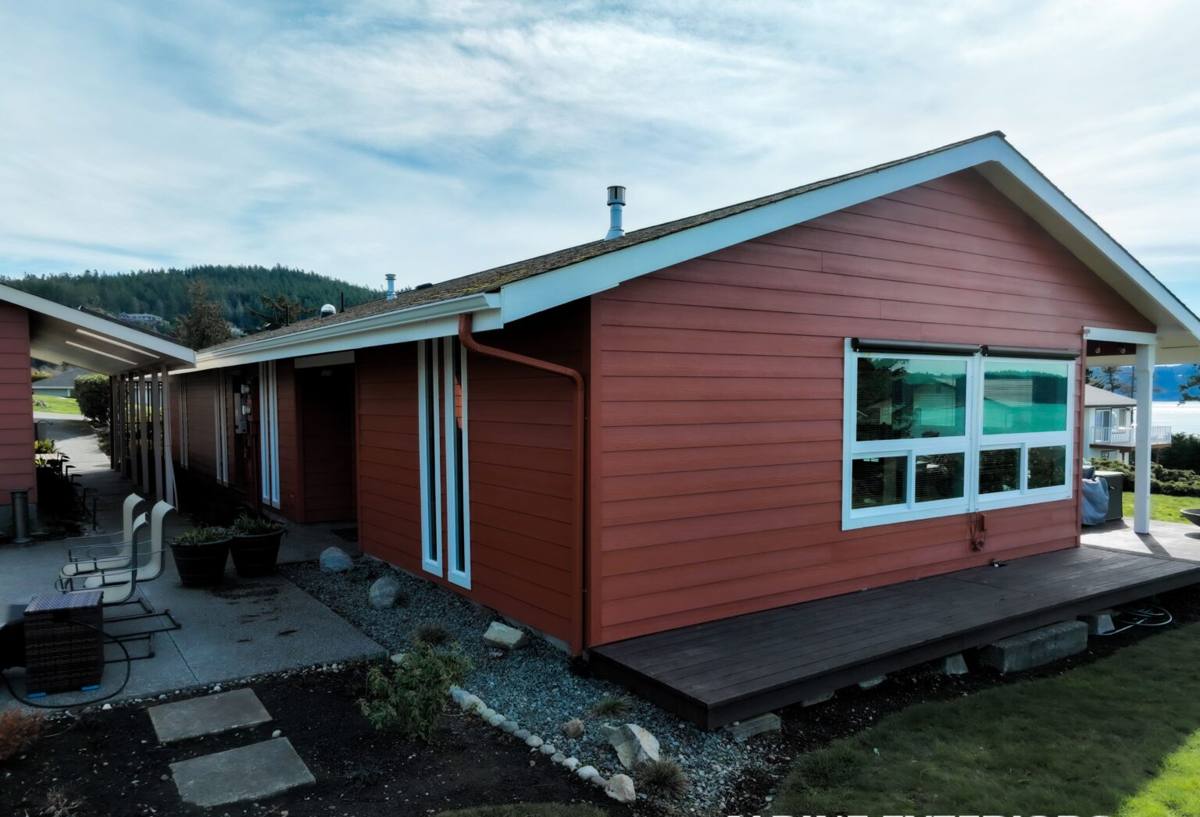
What Board & Batten Siding Actually Is
Board & batten is a vertical siding profile: wide flat panels installed side by side, with narrower strips — the battens — covering the seams between them. It's an old barn-and-farmhouse style that's come back strong on modern exteriors because of the clean vertical lines and the deep shadow reveal the battens create. It reads completely differently than horizontal lap siding, and a lot of Ferndale-area homeowners choose it specifically for that look on a front elevation, a gable, or an accent wall.
Vertical Lines, Different Trade-offs
The look comes with a different set of physical demands than lap siding. Water runs down a vertical seam rather than shedding off a horizontal overlap, so the drainage plane behind the panels has to do more work. Board & batten also has more linear seams per square foot in most layouts, which means more fastening points and more places where a flashing detail can be done well or done poorly. None of that makes it a bad choice — it just means the installation has to be treated with the seriousness the profile deserves.
The Moisture Problem Underneath the Look
This is the part that doesn't show up in a photo. Whatcom County's rain doesn't fall politely straight down most of the year — wind pushes it sideways into walls, and vertical board & batten seams can act like channels that carry that water downward if there's nowhere else for it to go. Add in the salt content in the air near the bay, which accelerates corrosion on any fastener or flashing that isn't rated for it, and the long stretch of the year when north- and shade-facing walls stay damp enough for moss and algae to establish themselves, and you've got three separate stresses working on the same wall assembly at the same time.
None of these problems are dramatic on their own. A little trapped moisture behind a panel doesn't rot sheathing in one winter. A steel fastener with the wrong coating doesn't fail in one season of salt air. A patch of moss doesn't destroy a finish overnight. But over five, ten, fifteen years, an installation that ignored any one of these factors compounds into real damage — and by the time it's visible from the outside, the sheathing or framing behind it is usually already affected.
What a Correct Board & Batten Installation Involves
A correct install in Marietta's conditions isn't just nailing panels to studs. It's a system, and every layer matters:
- A continuous weather-resistive barrier behind the panels, lapped correctly at every seam and penetration
- A rainscreen gap — typically furring strips — that lets any water that gets behind the panel drain and lets the wall assembly dry out instead of staying wet
- Corrosion-resistant fasteners, sized and spaced to the manufacturer's specification, not just "close enough"
- Flashing at every window head, door head, and roof-to-wall intersection, installed before the siding goes on, not caulked in afterward
- Battens fastened on the correct spacing over solid backing, not just over the seam with no attachment plan of their own
- Cut edges and field-cut panel ends sealed per the manufacturer's instructions, since a factory finish only protects what it was applied to
Fastening & Flashing Details That Get Skipped
Most siding failures we get called out to inspect don't trace back to the panel material itself — they trace back to a flashing detail that got skipped to save an hour, or a fastener that was the wrong type for a coastal environment. Kickout flashing where a roofline meets a wall, head flashing above every window and door, and correct end-cut sealing are small, cheap details during installation and expensive, disruptive repairs once they're missed and the wall has been wet behind the siding for a few years.
Why We Install Only James Hardie for This Profile
We install James Hardie fiber cement exclusively, and board & batten is one of the clearest cases for why. Hardie's vertical siding and matching trim battens are engineered as a system — panel and batten dimensions, fastener patterns, and flashing details are designed to work together, not improvised on site. Hardie's HZ5 formulation is specifically engineered for wetter, harsher climates like the Pacific Northwest, which matters directly for Whatcom County's rain load.
The factory-applied ColorPlus finish is baked on under controlled conditions and backed by its own finish warranty, which holds up better against moss staining and salt exposure over time than a field-applied paint job ever will. Fiber cement is also non-combustible, which matters increasingly for insurance and for peace of mind, and it doesn't swell, rot, or attract insects the way wood-based board & batten products can. We don't install vinyl, LP SmartSide, primed wood, or cedar board & batten — not because those products can't be installed competently by someone, but because we've made a standard for what goes on the homes we work on, and Hardie is the product that meets it.
Our Installation Process for a Marietta Project
- On-site assessment of the home's exposure — which elevations take the worst of the driving rain, which stay shaded and damp longest, where salt air exposure is heaviest
- Removal of existing siding and inspection of the sheathing underneath for any moisture damage that needs repair before new siding goes on
- Installation of the weather-resistive barrier and rainscreen furring, with attention to every seam, corner, and penetration
- Flashing installed at all windows, doors, and roof intersections before panels go up
- Hardie panels and battens installed to manufacturer spacing and fastener specifications
- Trim, caulking, and touch-up done per Hardie's published details — not generic field practice
- Final walkthrough and inspection before we consider the job finished
Board & Batten Material Comparison
| Material | Moisture & Rot Resistance | Salt Air / Corrosion Behavior | Moss & Algae Resistance | Typical Maintenance |
|---|---|---|---|---|
| James Hardie fiber cement | Excellent when installed to spec | Panel itself is non-organic; use rated fasteners | Factory finish resists staining better than field paint | Periodic wash, no repainting on the schedule |
| Cedar / primed wood | Vulnerable if finish fails or water gets behind it | Fasteners and finish both stressed by salt exposure | Organic material is a food source for moss/algae | Regular refinishing and inspection |
| Vinyl board & batten | Won't rot, but seams and fastening are less rigid | Can become brittle faster in harsh coastal UV/salt combo | Can still stain; surface can't be easily refinished | Low, but damage often means full panel replacement |
| LP SmartSide (engineered wood) | Treated, but still wood-based and moisture-sensitive at cut edges | Depends on fastener choice and edge sealing diligence | Better than raw wood, still organic substrate | Edge sealing and finish upkeep over time |
What Drives Cost on a Board & Batten Job
Board & batten pricing varies more than lap siding pricing because so much depends on the condition of what's underneath and the complexity of the elevation it's going on. Here's what actually moves the number on a Marietta project:
| Cost Factor | Why It Matters |
|---|---|
| Condition of existing siding and sheathing | Rot repair found during tear-off adds material and labor before new siding can go on |
| Number of elevations and complexity | Gables, dormers, and multiple roof-wall intersections mean more flashing and cutting |
| Trim and batten detail level | Wider trim, corner treatments, and accent detailing add material and install time |
| Access and site conditions | Scaffolding, tight lot lines, and multi-story sections affect labor time |
| Color and finish selection | Factory ColorPlus finishes vary by line, which can shift material cost |
We'll always walk a home and give a straightforward, itemized number rather than a rough per-square-foot guess — board & batten's cost swings too much project to project for a generic figure to mean much.
Maintenance Checklist for Marietta Homeowners
- Rinse siding annually to clear salt residue and moss spores before they get a foothold, especially on shaded or north-facing walls
- Check caulking and sealant at window and door penetrations once a year and after major storms
- Keep gutters and downspouts clear and directing water away from the base of the siding, not down the wall face
- Walk the exterior each fall and note any panels or battens that look discolored, loose, or damaged before winter rains set in
- Trim back vegetation and tree cover that keeps any wall section shaded and damp longer than the rest of the house
Why a Crew That Already Works in Marietta Matters
Board & batten done right depends on understanding how weather actually hits a specific house, not a textbook house. A crew that works Marietta regularly already knows which elevations tend to take the worst of the wind-driven rain, how long moss season really runs in the shaded pockets near the water, and how salt air exposure changes fastener and flashing choices compared to a job twenty miles inland. That local pattern recognition is the difference between an installation that looks right on day one and one that's still performing the way it should ten winters later.
If you're considering board & batten siding for a home in Marietta, we're happy to walk the property, talk through what your specific elevations are dealing with, and give you a straightforward, no-pressure estimate using the form below.