 Ferndale Window
 Why Blaine's Climate Is Hard on a Roof
Blaine sits at the northern edge of Whatcom County, right where the Salish Sea, Drayton Harbor, and Semiahmoo Bay meet the mainland. That location is beautiful, but it's rough on a roof. Salt-laden air moves inland off the water almost year-round, driving rain comes in sideways during winter storms, and the long stretch of gray, damp months from October through April gives moss and algae every advantage they need. A roof that would hold up fine forty minutes inland can fail early here if it wasn't built with this specific environment in mind.
Metal roofing handles these conditions better than most materials, but only when it's specified and installed correctly for a marine environment. A metal roof put together the same way you'd do it in a dry inland town will corrode faster, hold moisture in the wrong places, and lose its finish years before it should. This page covers what a Blaine metal roof actually needs, what a correct installation looks like, and how our process is built around this particular stretch of coastline.
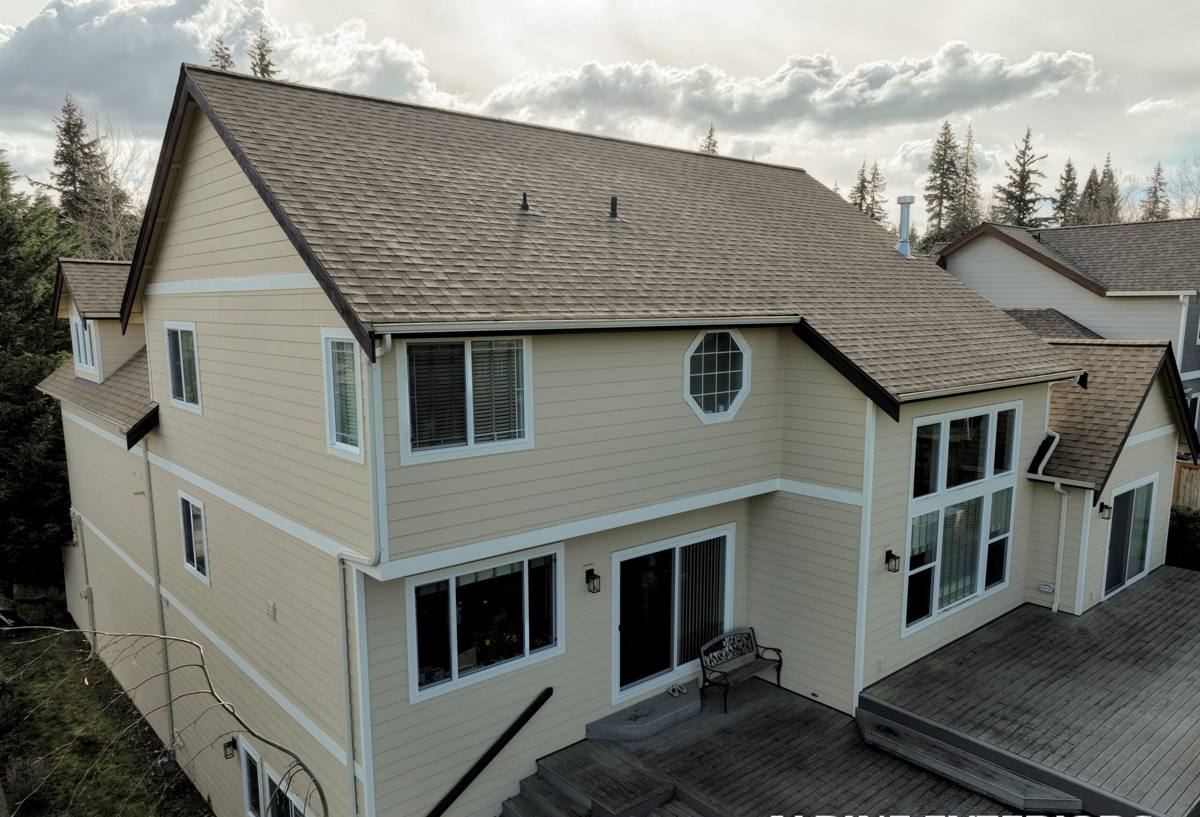
Why Metal Roofing Makes Sense for Blaine Homes
Metal roofing isn't the right fit for every home or every budget, but for Blaine's climate it has real advantages over asphalt shingles:
- Moss resistance: Metal's smooth, non-porous surface gives moss and algae far less to grip onto compared to the rough texture of asphalt shingles, which matters a lot during our long moss season.
- Wind performance: Properly fastened metal panels resist uplift better than shingles during the wind-driven storms that come off the water, especially on homes with more open exposure near the bay.
- Water shedding: Standing seam profiles in particular move heavy, wind-driven rain off the roof quickly rather than letting it work its way under lapped edges.
- Longevity, when specified right: A correctly coated and fastened metal roof can outlast several cycles of asphalt shingles, which matters given how much labor goes into any roof replacement.
None of that happens automatically just because the material is metal. Corrosion resistance, fastener choice, and coating quality all have to be matched to a salt-air environment, or you trade one set of problems for another.
Standing Seam vs. Exposed Fastener: Which Fits a Coastal Property
Most residential metal roofing in this area comes down to two basic systems. Each has a legitimate place, but they behave differently in salt air and driving rain.
| Factor | Standing Seam | Exposed Fastener |
|---|---|---|
| How it attaches | Concealed clips under raised seams — no exposed screws on the field of the panel | Screws driven through the panel face, typically with rubber-washer heads |
| Weak point over time | Seam and clip detailing at penetrations | Washer gaskets, which harden and shrink with UV and salt exposure |
| Best suited for | Full water-tightness, low-slope sections, homes with direct water exposure | Outbuildings, shops, budget-conscious re-roofs on steeper, well-drained slopes |
| Upfront cost | Higher | Lower |
| Maintenance over the roof's life | Minimal if installed correctly | Periodic gasket/fastener inspection recommended |
For homes closer to open water, or on lower-slope sections where wind-driven rain has more time to find a weak spot, we generally steer clients toward standing seam. On steeper, well-protected roof sections, a quality exposed-fastener system can still be a sound, budget-friendly choice — the honest answer depends on the specific roof, not a blanket rule.
Corrosion Protection: The Part That Gets Skipped Inland
Salt air accelerates two kinds of corrosion that matter on a metal roof: general oxidation of the panel and fastener surfaces, and galvanic corrosion, which happens when two dissimilar metals touch in the presence of moisture and essentially eat each other. A contractor who doesn't work coastal jobs regularly can easily miss this and mix metals that shouldn't be in contact — steel flashing against a copper vent stack, for example, or the wrong fastener alloy against the panel material.
What we specify to manage this
- Fasteners and flashing metal matched to the panel material to avoid galvanic reaction.
- Marine-grade or coated fastener heads rather than standard hardware store screws.
- Panel coatings rated for coastal/marine exposure rather than a standard inland-grade finish.
- Sealed, gasketed penetrations at every pipe boot, vent, and fixture rather than relying on caulk alone.
None of this is exotic or expensive to get right at the time of installation — it just has to actually be specified. It's far cheaper to use the correct fastener up front than to deal with rust streaks and failed seals in six or seven years.
Coatings: Why the Finish Matters as Much as the Metal
The base metal (steel, aluminum, or occasionally copper) only tells part of the story — the factory-applied coating is what actually faces the weather day to day. In a salt-air environment, coating quality is not a cosmetic decision, it's a durability decision.
| Coating Type | How It Holds Up Near Salt Air | Typical Trade-Off |
|---|---|---|
| PVDF / Kynar-type finishes | Best chalk and fade resistance, holds color longest in UV and salt exposure | Higher material cost |
| SMP (polyester) finishes | Adequate for many inland applications, fades and chalks noticeably faster near the coast | Lower upfront cost, shorter color life |
| Bare/mill-finish galvalume | Functional but shows staining and streaking faster without a topcoat | Lowest cost, least forgiving in this climate |
We lean toward PVDF-class coatings for homes with direct exposure to Drayton Harbor, Semiahmoo Bay, or Boundary Bay winds, and we'll say so plainly if a lower-grade coating isn't a good match for a particular roof's exposure — even if it costs us the upsell.
What a Correct Installation Actually Involves
A metal roof is only as good as the details underneath it. Here's what we treat as non-negotiable on every Blaine metal roofing job:
Deck and structure first
We check the roof deck for soft spots, prior water damage, and proper attachment before anything goes on top of it. Metal panels are unforgiving of an uneven or spongy deck — problems that were hidden under old shingles show up as visible waviness in a metal roof.
Underlayment matched to risk
Given how much rain this area gets, we use synthetic underlayment rated for high-moisture exposure across the field, and self-adhered ice-and-water membrane in valleys, at eaves, and around every penetration — the places where wind-driven rain is most likely to work its way backward under a lap.
Ventilation, not just watertightness
Metal roofs need airflow beneath them to prevent condensation from forming on the underside of the panel, which can otherwise drip back into the deck and insulation from the inside. We check existing ridge, soffit, and gable ventilation as part of every project rather than assuming it's adequate.
Flashing and penetration detail
Chimneys, plumbing vents, and any roof-to-wall transitions are where most roof leaks actually start, metal or not. We custom-fit flashing at these points rather than relying on generic trim pieces and sealant.
Fastening and thermal movement
Metal panels expand and contract with temperature swings more than shingles do. Standing seam clip systems are installed to allow that movement without stressing the panel or fasteners; exposed-fastener systems are set with correct spacing and torque so gaskets seal without over-compressing.
Our Process, Start to Finish
- On-site assessment: We inspect the existing roof, deck condition, ventilation, and the home's specific wind and rain exposure before recommending a system.
- Honest scope and estimate: You get a clear breakdown of material, labor, and any deck repair or ventilation work needed — no vague allowances.
- Material staging: Panels, flashing, and fasteners are confirmed and staged before demolition begins, so your roof isn't exposed to the weather longer than necessary.
- Tear-off or overlay decision: We'll tell you honestly whether your existing roof can be built over or needs to come off — this depends on deck condition and local code, not on which option is easier for us.
- Installation: Deck repair, underlayment, panel installation, and custom flashing, in that order, with attention to the corrosion and ventilation details above.
- Final walkthrough: We review the finished roof with you, including care and warranty documentation, before calling the job done.
What Drives the Cost of a Blaine Metal Roof
Every roof is different, and we won't quote a number without seeing yours, but these are the factors that move the price most:
| Factor | Why It Matters |
|---|---|
| Roof pitch and complexity | More valleys, dormers, and penetrations mean more custom flashing labor |
| Panel material | Steel, aluminum, and copper carry different material costs and corrosion profiles |
| Coating grade | PVDF coatings cost more upfront but hold color and resist chalking far longer near salt air |
| Tear-off vs. overlay | Removing an old roof adds labor and disposal cost but allows full deck inspection |
| Ventilation upgrades | Older homes often need added ridge or soffit venting to meet what a metal roof requires |
| Accessory work | Gutters, downspouts, and drip edge sized for heavy rainfall add to scope but reduce future water problems |
Keeping a Metal Roof Working Over Time
Metal roofing needs far less maintenance than shingles, but "far less" isn't "none" — especially with our moss season and salt exposure. A short annual check catches almost everything before it becomes a repair:
- Clear debris and organic buildup from valleys and behind chimneys, where moss and moisture linger longest.
- Check gutters and downspouts are clear and pitched correctly for heavy rain events.
- Look for any early rust streaking at fasteners, flashing, or cut panel edges.
- Confirm sealant at penetrations hasn't cracked or pulled away.
- Rinse off salt residue near the harbor and bay-facing sides of the home if it's visibly built up.
Why It Matters That We Already Work in Blaine
A metal roof installed by someone unfamiliar with this specific stretch of coastline can look identical to a correct one on install day — the difference shows up years later as premature rust, a failed seam, or moss finding a foothold where it shouldn't. Working regularly in Blaine and the surrounding Whatcom County area means we already know which coatings and fastener combinations hold up against this air, which roof exposures near the water need the extra flashing detail, and how to schedule around the driving-rain weather windows that can turn a straightforward install into a mess if timed wrong. That local familiarity is not a marketing line — it's the difference between a roof that's still doing its job in twenty years and one that needed early repairs.
If you're weighing a metal roof for a home in Blaine, we're glad to take a look and give you a straight assessment — no pressure, no inflated claims, just what your roof actually needs. Use the form below to request a free estimate.