 Ferndale Window
 Why Siding Choice Matters More Here Than Most Places
Homes around Bellingham and Ferndale sit in one of the more demanding exterior environments in Washington. You've got Bellingham Bay and the Strait of Georgia pushing salt-laden air inland, a wet season that stretches for months at a time, and enough shade and moisture on north- and west-facing walls to keep moss and algae established year-round. None of that is dramatic on its own, but stacked together over a few decades, it's exactly the combination that finds every weak point in a siding system — every unsealed seam, every board that wicks water instead of shedding it, every finish that wasn't built for constant damp.
That's the lens we use when we talk to homeowners in this area about siding. It's not about picking whatever looks good in a showroom. It's about picking a product and an installation method that will still look good, and still be doing its job, after fifteen or twenty Whatcom County winters.
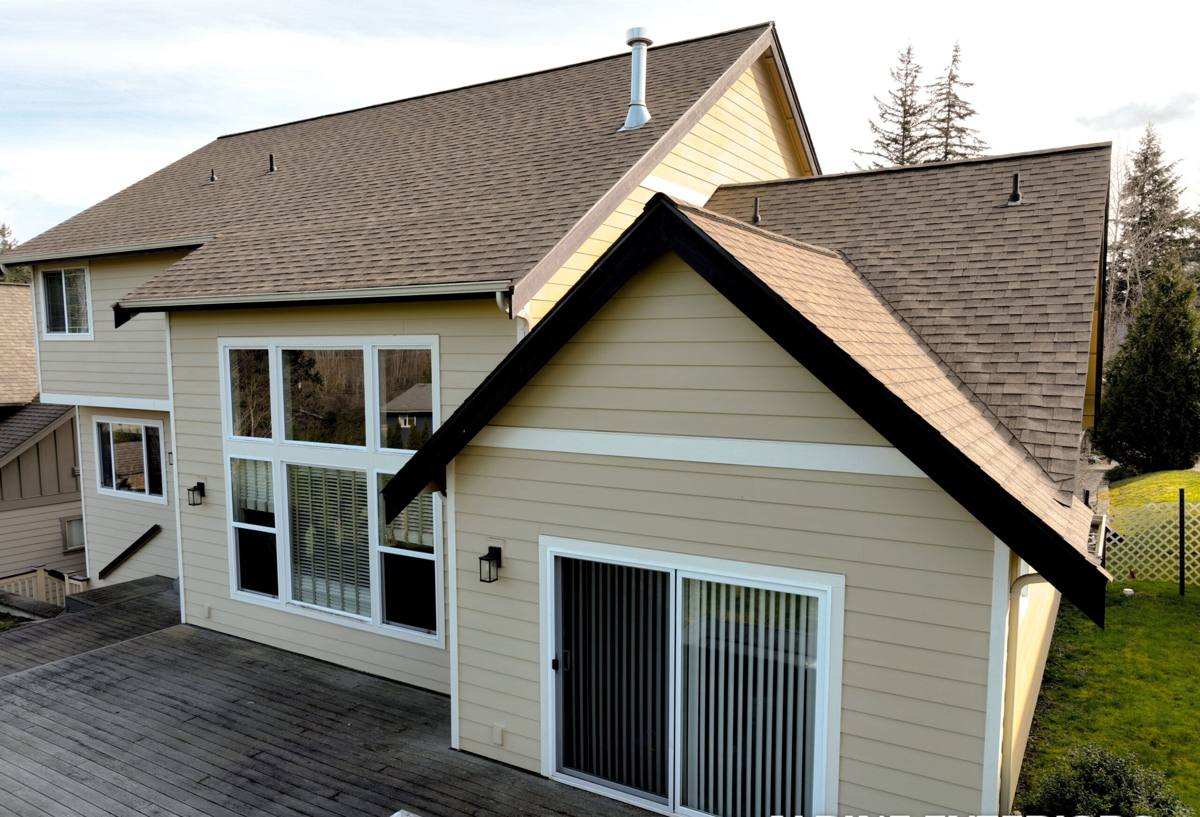
What Bellingham's Climate Actually Does to Siding
Salt Air and Coastal Moisture
Proximity to the bay means airborne salt and moisture settle on exterior surfaces more than they would further inland. This doesn't rot fiber cement the way it can accelerate corrosion on metal fasteners or degrade certain paints, but it does mean any siding product needs a finish that resists chalking, fading, and moisture absorption at the surface level. Cheaper site-applied paint jobs tend to break down faster in this kind of environment because the paint film is thinner and less consistently cured than a factory-applied finish.
Driving Rain
Rain here rarely falls straight down. Wind off the water pushes it sideways into wall assemblies, which puts real pressure on flashing details, siding laps, and butt joints. A siding system that's only designed for gentle vertical rain — or that depends on caulk to do the work water-resistive barriers and proper flashing should be doing — will eventually let moisture behind the cladding. Once that happens, the problem usually isn't visible until sheathing or framing damage shows up.
Moss and Algae Season
Shaded, north-facing walls and anything under tree cover stay damp long after a storm passes. That's ideal growing conditions for moss and green algae staining. Some siding materials absorb enough surface moisture to feed that growth; others simply don't offer it anything to hold onto. This is one of the more visible differences between siding products over time, even though it rarely gets discussed up front.
Why We Standardized on James Hardie Fiber Cement
We install James Hardie fiber cement siding exclusively. We don't install vinyl, LP SmartSide, Cemplank, Allura, primed spruce, or cedar. That's a deliberate standard, not a sales preference, and it's worth explaining why.
- Non-combustible core: Fiber cement is cement and cellulose fiber, not wood or wood byproduct, so it doesn't burn, warp from heat, or feed a fire the way engineered wood siding can.
- Factory-cured ColorPlus finish: Hardie's ColorPlus finish is baked on in a controlled factory process, not brushed or sprayed on site. That gives a more consistent, UV- and moisture-resistant surface than field-applied paint, which matters directly in a coastal, high-moisture climate.
- Climate-engineered HZ product lines: Hardie manufactures HZ5 boards specifically formulated for wetter, cooler climate zones like the Pacific Northwest, with moisture management built into the product itself rather than relying entirely on the installation to compensate.
- Dimensional stability: Fiber cement doesn't swell, cup, or split the way wood-based products can when they take on repeated moisture cycles.
- Transferable warranty backing: Hardie's warranty structure is well established and transfers with the home, which matters to buyers and to resale value in a market where exterior condition gets noticed.
We're not going to tell you other products are junk — vinyl, engineered wood, and other fiber cement brands all have legitimate use cases elsewhere. But given what this specific climate does to a home over time, and what we've found holds up versus what requires more maintenance or fails earlier than homeowners expect, Hardie is what we're willing to put our name behind.
What a Correct Fiber Cement Job Actually Involves
The siding board itself is only part of the system. Most siding failures we get called out to inspect — regardless of brand — trace back to installation shortcuts, not the material. A correct job in a wet, wind-driven-rain climate includes:
Water-Resistive Barrier and Drainage Plane
A properly lapped weather-resistive barrier behind the siding, ideally with a drainage gap, gives any moisture that does get past the cladding a way out instead of a place to sit against the sheathing.
Flashing at Every Penetration
Windows, doors, hose bibs, vents, and any other wall penetration need proper flashing integrated with the water-resistive barrier — not just caulked over. Caulk is a backup, not a primary defense, and it's the first thing to fail under sustained UV and moisture exposure.
Correct Fastening and Clearances
Hardie specifies fastener type, spacing, and minimum clearance from grade, decks, and roof lines. Boards installed too close to grade or without proper clearance from horizontal surfaces will wick moisture regardless of how good the product is.
Proper Lap and Joint Treatment
Butt joints need to be treated and, where possible, backed with flashing rather than just caulked and butted tight. This is one of the most commonly skipped details on rushed jobs.
Factory-Cut Edges Where Possible
Field cuts expose the raw core of the board, which needs to be sealed per manufacturer spec. Minimizing field cuts and properly sealing the ones that are necessary protects the long-term finish.
Our Process for Bellingham-Area Installations
- On-site assessment: We look at wall orientation, existing moisture damage, shading, and how wind and rain typically hit the home before we ever talk product specifics.
- Tear-off and sheathing inspection: Old siding comes off and we check sheathing condition underneath — this is often where hidden damage from a previous, less protective system shows up.
- Repair and prep: Any compromised sheathing or framing gets addressed before new siding goes on. Covering up existing rot is not something we do.
- Weather barrier and flashing installation: This is the step that determines whether the home stays dry for the next few decades, so it gets done to spec, not shortcut.
- Hardie board installation: Installed per manufacturer fastening, clearance, and joint specifications, matched to the correct HZ product line for this climate zone.
- Final detailing and walkthrough: Caulking, touch-up, and a walkthrough so you understand what was done and why.
Comparing Siding Approaches in This Climate
| Factor | Vinyl Siding | Engineered Wood (e.g. LP SmartSide) | James Hardie Fiber Cement |
|---|---|---|---|
| Moisture resilience | Doesn't rot, but can trap moisture behind panels if not vented properly | Wood-based core is more vulnerable to sustained moisture exposure | Cement-based core resists moisture damage; engineered for wet climates in HZ lines |
| Fire resistance | Can melt or deform under heat exposure | Combustible wood-based product | Non-combustible |
| Finish durability | Color molded in, but can fade and become brittle over time | Factory-primed, typically needs field paint | Factory-baked ColorPlus finish resists fading and chalking |
| Dimensional stability | Can warp or buckle in temperature swings | Can swell or delaminate with repeated moisture cycling | Stable across moisture and temperature cycles |
| Typical maintenance | Low, but damage often means panel replacement | Periodic repainting and moisture monitoring | Occasional wash and caulk check; repainting only if going off-ColorPlus |
Maintenance Expectations Once It's Installed
Fiber cement isn't maintenance-free, but it's low-maintenance compared to what most homeowners are used to. In this climate specifically:
- Rinse siding periodically to remove salt residue and organic buildup, especially on walls facing the water or under tree cover.
- Inspect caulking at joints and penetrations every year or two — caulk is a wear item regardless of siding brand.
- Trim back vegetation and branches that keep a wall shaded and damp, since that's what accelerates moss and algae growth.
- Check gutters and downspouts are directing water away from siding, not letting it run down the wall face.
- Address any impact damage (from debris, equipment, etc.) promptly rather than letting a chip become an entry point for moisture.
Quick Pre-Project Checklist for Homeowners
- Confirm the crew is installing to James Hardie's published fastening and clearance specs, not a generalized standard.
- Ask what HZ product line is being used and why it fits this climate zone.
- Confirm sheathing will be inspected and any damage addressed before new siding goes on.
- Ask how flashing will be integrated at windows, doors, and penetrations — get specifics, not just "we'll caulk it."
- Get the warranty terms in writing, including what's manufacturer-backed versus installer-backed.
Why Local Installation Experience Matters
Fiber cement siding is a forgiving product when installed correctly and an unforgiving one when it isn't — moisture problems from bad flashing or clearance mistakes often don't show up for a few years, by which point the fix is more expensive than it would have been to do right the first time. A crew that's installed siding across Whatcom County homes already knows how local wind-driven rain patterns, moss-prone shading, and salt exposure typically play out on a wall, and adjusts detailing accordingly instead of applying a one-size-fits-all approach pulled from a manual written for a drier climate.
That local pattern recognition is hard to shortcut. It comes from having stood on ladders in Bellingham and Ferndale weather, seen what fails first, and adjusted the process to prevent it — not from a general contracting background applied to siding as a side service.
Get a Straight Answer for Your Home
Every home's exposure is a little different depending on orientation, tree cover, and proximity to the water, so a walkthrough is worth more than a generic estimate. If you're weighing a siding replacement in the Bellingham or Ferndale area, we're happy to take a look, explain what we're seeing, and give you a straightforward, no-pressure estimate using the form below.