 Ferndale Window
 Blaine's Coastal Exposure Is Hard on Siding
Blaine sits close to the water at the northern edge of Whatcom County, and that location comes with a specific set of siding problems. Salt-laden air moves inland off the Salish Sea and settles on exterior walls, wind-driven rain gets pushed sideways into seams and trim during winter storms, and the long, damp shoulder seasons keep north-facing and shaded walls wet enough, long enough, for moss and algae to take hold. None of this is dramatic on its own. It's the accumulation — season after season — that eventually shows up as cupped boards, soft trim, peeling paint, or a green cast creeping up the lower courses of siding.
A siding repair in this climate has to account for all three of those stressors at once: salt accelerating corrosion of fasteners and hardware, moisture finding its way behind panels through failed caulking or damaged flashing, and moss holding water against the surface longer than it should sit there. A repair that only patches the visible damage without addressing what let the moisture in will need to be redone within a few years.
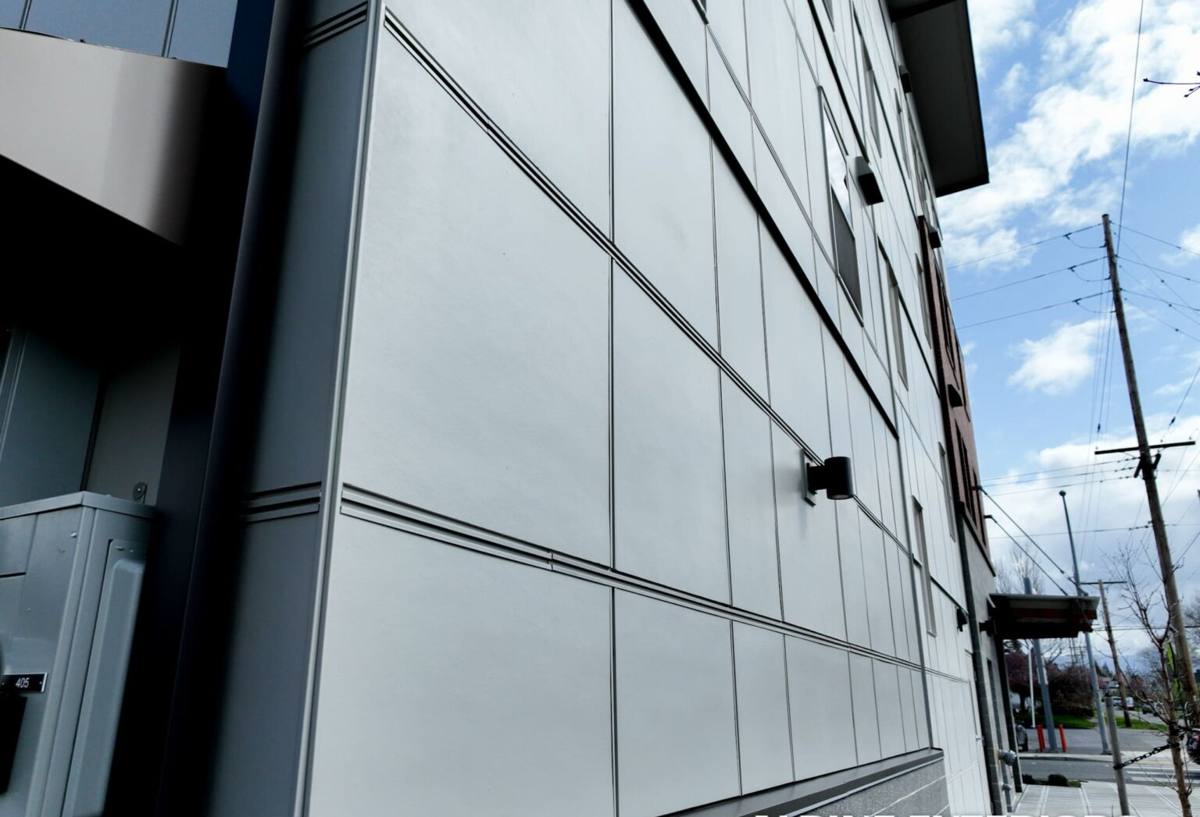
Signs a Blaine Home Needs Siding Repair — Not Just a Repaint
Homeowners often call about paint that "won't stay on," when the real issue is underneath. Here's what usually signals a repair job rather than a cosmetic fix:
- Soft or spongy spots when you press on the siding, especially near the bottom courses or under windows
- Visible cupping, bowing, or separation at panel seams
- Paint that bubbles or peels repeatedly in the same spots after repainting
- Dark streaking, green or black growth that returns quickly after cleaning
- Gaps or cracked caulking around windows, doors, and trim boards
- Rust staining running down from nail heads or metal flashing
- Any give or sponginess in the wall sheathing when you tap near the base of the wall
If more than one of these shows up on the same wall, there's a good chance moisture has already gotten past the siding and into the assembly behind it, and the repair needs to start with an inspection of what's underneath, not just what's visible.
What a Correct Siding Repair Actually Involves
Finding the Cause, Not Just the Symptom
Cutting out a damaged section and screwing in a patch is the easy part. The harder — and more important — part is figuring out why that section failed in the first place. Was it a missing kick-out flashing above a roofline? A caulking joint that opened up and let wind-driven rain track behind the panel? A downspout dumping water against one section of wall every time it rains? If the underlying cause isn't fixed, the new material will fail the same way, usually within a couple of seasons.
Matching What's Already There
Repairs also need to match the existing siding in profile, exposure, and finish as closely as possible — mismatched reveal lines or a visibly different material stand out immediately, especially in bright coastal light. When an exact match isn't practical (discontinued products, weathered originals, or materials we don't install), we talk through the options honestly rather than forcing a patch that will always look like one.
Checking What's Behind the Siding
Any time we open up a wall for repair, we check the water-resistive barrier, flashing, and sheathing underneath. In a climate that sees this much driving rain, a repair that reinstalls new siding over compromised sheathing or torn house wrap is a repair that's already failing — it just hasn't shown on the surface yet.
How Common Siding Materials Hold Up in This Climate
Most of the repair calls we get in the Ferndale and Blaine area involve one of a handful of materials. Here's a straightforward look at how each one tends to behave under sustained salt exposure, driving rain, and a long moss season:
| Material | Moisture Behavior | Repair Considerations |
|---|---|---|
| Vinyl | Doesn't absorb water, but seams and J-channels can let wind-driven rain behind the panel; brittle in cold snaps | Cracked or warped panels are hard to source in an exact color match years later |
| LP SmartSide (engineered wood) | Wood-based core swells and can delaminate if moisture gets past a compromised edge seal or caulk joint | Damaged sections often need wider replacement than they first appear, since swelling spreads beyond the visible spot |
| Cedar / primed spruce lap | Natural wood — absorbs and releases moisture, prone to cupping and rot without diligent repainting and caulk maintenance | Requires the most frequent maintenance cycle of the group in a coastal climate |
| James Hardie fiber cement | Non-combustible, dimensionally stable, engineered specifically for Pacific Northwest moisture cycles (HZ5/HZ10 climate lines) | Repair sections integrate cleanly with factory ColorPlus finish; doesn't swell or rot |
Our Siding Repair Process
1. Inspection
We walk the exterior wall by wall, checking not just the damaged area but the surrounding sections, trim, flashing, and grade conditions nearby — a lot of siding failures trace back to something a few feet away, like a downspout or a grading issue directing water at the wall.
2. Diagnosis
We identify the actual cause of the damage before proposing a fix. If that means opening a small section to check the sheathing, we do that first rather than guessing.
3. Repair Plan
We give a clear, honest scope: what needs to be cut out, what's salvageable, and what the underlying issue is that needs to be corrected so the repair holds.
4. Execution
Repairs are cut back to sound material, flashing and moisture barrier details are corrected as part of the work, and new sections are installed to manufacturer spec — proper fastening, clearances, and joint treatment.
5. Cleanup and Walkthrough
We walk the finished work with the homeowner, point out what was fixed and why, and flag anything else on the exterior worth keeping an eye on.
Why We Repair and Replace With James Hardie Fiber Cement
When a repair calls for new siding sections — whether it's a few boards or a full wall — we use James Hardie fiber cement, and we don't install vinyl, LP SmartSide, cedar, or primed spruce as a substitute. That's a standard we hold to on every job, not just repairs. Fiber cement is non-combustible, it doesn't swell or rot the way wood-based products can, and Hardie's HZ climate-engineered product lines are built specifically for wet, temperature-swinging regions like ours. The factory-applied ColorPlus finish also means a repaired section can match the existing wall's color without an on-site repaint, and it carries a strong transferable warranty when installed to spec. For a coastal town dealing with salt air and a long wet season, that combination of stability and finish durability is exactly what a repair needs to actually last.
What Siding Repair Typically Costs
Repair costs vary a lot depending on how much damage there is above and below the surface, so we're cautious about quoting a number before we've actually looked at the wall. That said, homeowners should expect the price to be shaped by a few consistent factors:
- How much hidden damage is found once we open the wall (sheathing and framing repair adds cost beyond the siding itself)
- How much of the existing siding needs to be removed to reach sound material
- Wall height and access — second-story and steep-site repairs take more setup time
- Whether a color/finish match is needed, and how close the existing product can be matched
- Whether flashing, trim, or moisture barrier detailing needs correction as part of the fix
A small, isolated repair with no hidden damage is a modest job. A repair that uncovers rot in the sheathing or a failed moisture barrier behind a larger section is a bigger scope — and we'd rather tell a homeowner that up front than surprise them mid-project.
Why Hiring a Crew That Already Works in Blaine Matters
A siding repair crew that regularly works Blaine and the surrounding Whatcom County coastline has already seen how this specific mix of salt air, wind-driven rain, and shaded, moss-prone walls plays out on real houses. That matters for diagnosis — recognizing a moisture pattern that's specific to a coastal-exposure wall versus a sheltered one, for example — and it matters for the practical side of the job, since local crews already understand permitting norms and typical construction in the area. It also means a shorter wait for a look at the damage and a repair schedule that isn't competing with unrelated travel time.
If you're seeing soft spots, recurring paint failure, or moss that keeps coming back on a wall in Blaine, we're happy to take a look and give you a straight answer about what's actually going on. Reach out for a free, no-pressure estimate using the form below.