 Ferndale Window
 Why Birch Bay's Waterfront Air Is Tougher on Siding Than It Looks
Birch Bay sits right where Whatcom County meets the Strait of Georgia, and that location changes what a house needs from its exterior. Homes here deal with a combination that inland Ferndale properties see less of: salt-laden air moving off the water, wind-driven rain that hits walls sideways instead of falling straight down, and a moss season that can stretch for most of the year in our marine climate. Siding that would hold up fine in a drier, more sheltered part of the county can fail early on a waterfront or near-waterfront lot in Birch Bay.
None of this means a home near the bay needs anything exotic. It means the material and the installation both have to account for constant moisture exposure and airborne salt, rather than being treated as an afterthought behind a nice paint color.
What Siding Actually Has to Do on a Birch Bay Home
Manage moisture, not just shed it
Driving rain doesn't just run down a wall — it gets pushed into laps, seams, and trim joints. Siding on a Birch Bay home needs a drainage plane behind it and a surface that doesn't absorb and hold water at the joints, or you get soft spots, paint failure, and eventually rot in the sheathing behind the cladding.
Resist salt air without relying on paint alone
Salt air accelerates corrosion of fasteners and hardware and speeds up the breakdown of lower-grade paint films. A siding system that depends entirely on a field-applied paint job to protect it will need repainting sooner near the water than it would a few miles inland.
Handle a long moss and algae season
Constant damp shade on north- and west-facing walls in this climate feeds moss and algae growth. Siding with a rough, porous surface gives that growth something to hold onto. A denser, factory-finished surface sheds it more easily and keeps it from working into seams.
Stay non-combustible
Wildfire risk gets most of the attention east of the mountains, but a non-combustible exterior is still a meaningful, low-cost safety upgrade anywhere, including a coastal Whatcom County property.
Why We Only Install James Hardie Fiber Cement
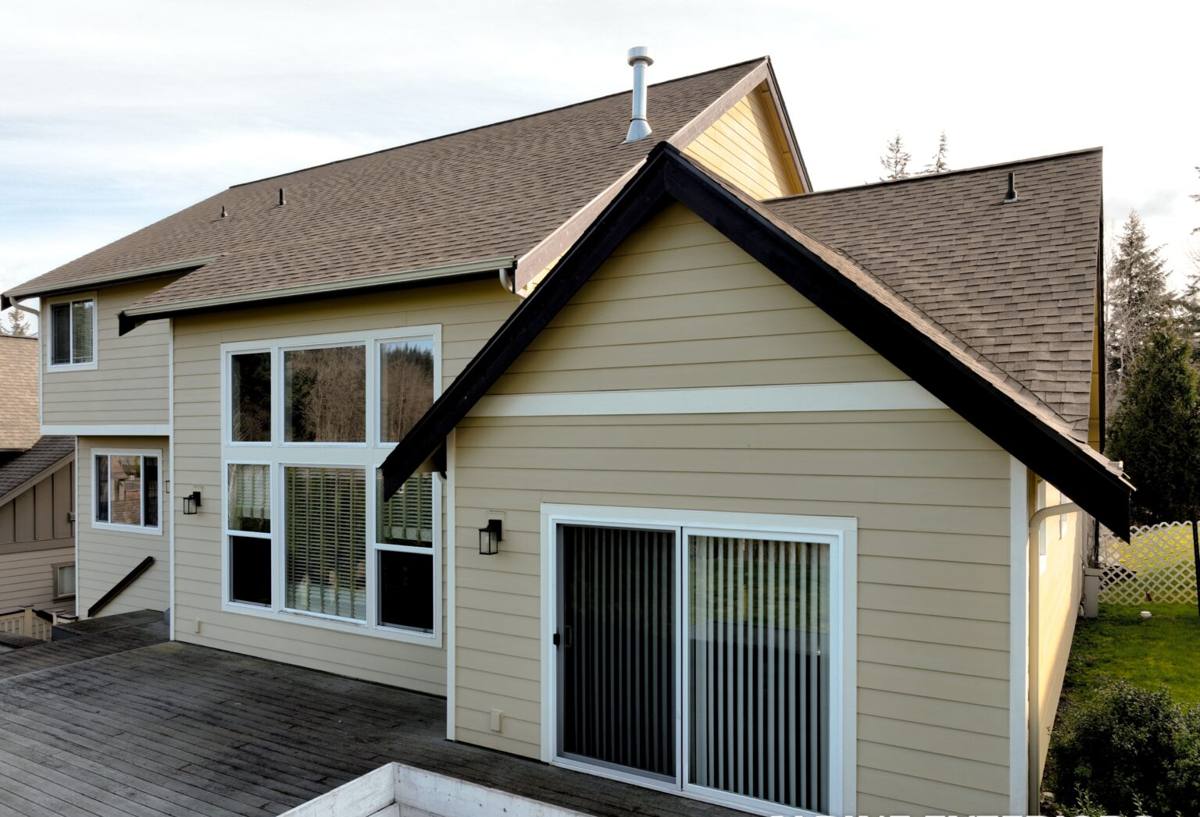
We made a decision as a company to install James Hardie fiber cement exclusively — not vinyl, not LP SmartSide, not Cemplank or Allura, not primed wood or cedar. That's not a marketing position; it's because Hardie's product system solves the specific problems Birch Bay's climate creates, and we'd rather stand behind one system we know cold than offer several we have to hedge on.
A few reasons this matters for a home near the bay:
- Climate-engineered HZ formulations. Hardie makes region-specific versions of its product for high-moisture climates like ours, engineered for better moisture and warping resistance than a generic, one-size-fits-all board.
- ColorPlus factory finish. The color is baked on at the factory under controlled conditions, which holds up to UV and salt air noticeably longer than field-applied paint, and it comes with its own finish warranty separate from the product warranty.
- Non-combustible core. Fiber cement doesn't feed a fire the way wood-based products can.
- A real, transferable warranty. If the home sells, the coverage doesn't die with the original owner — a genuine selling point for a market with vacation and second homes.
We're upfront that fiber cement isn't the cheapest option on the shelf and it's heavier and less forgiving to install than vinyl. Those trade-offs are exactly why installation quality matters as much as the product choice.
What a Correct Fiber Cement Installation Involves
Fiber cement performs the way it's supposed to only when it's installed to the manufacturer's specifications. Cutting corners here shows up years later as moisture intrusion — often after the visible finish still looks fine.
Behind the boards
A continuous water-resistive barrier, correctly lapped and sealed at every penetration, is the actual moisture defense — the siding is the second line, not the only one. On a wind-exposed Birch Bay wall, gaps in this layer are where problems start.
Flashing and gapping
Every window, door, and roof-to-wall transition needs proper flashing, including kickout flashing where a roofline meets a wall — a detail that's easy to skip and is a common source of hidden rot when it's missed. Boards need the manufacturer's specified gap at trim and butt joints so the material can move without cracking the caulk line.
Fastening and cut edges
Fasteners need to be corrosion-resistant and driven to the correct depth — overdriven nails crack the board's edge and create an entry point for water. Any field-cut edge has to be sealed per Hardie's instructions, since a raw cut edge left exposed will wick moisture.
Caulk where it belongs, not everywhere
Hardie's details call for sealant at specific joints, not as a blanket fix for every seam. Over-caulking can trap moisture behind the board instead of letting it drain and dry.
Comparing How Common Siding Materials Hold Up in This Climate
| Material | Salt air / moisture | Maintenance burden | Fire resistance |
|---|---|---|---|
| James Hardie fiber cement | Engineered HZ lines built for wet, coastal climates | Low — factory finish resists fading and chalking | Non-combustible |
| Vinyl | Doesn't rot, but can warp and fade; seams can allow water behind panels | Low, but color fades unevenly over time | Melts/contributes fuel in fire |
| Wood-based siding (LP SmartSide, cedar) | Vulnerable to moisture intrusion at cuts, edges, and joints | Higher — repainting and sealant checks on a regular cycle | Combustible |
| Other fiber cement brands | Varies by formulation; fewer climate-specific product lines | Depends on finish quality | Non-combustible |
Our Process for a Birch Bay Fiber Cement Project
We treat a home near the water differently from one further inland in Ferndale, and it starts before we ever install a board:
- Exposure assessment. We look at which walls take the brunt of the wind and driving rain versus which are more sheltered, since that changes flashing priorities and detailing.
- Check what's happening behind the existing siding. Where there's evidence of past moisture intrusion, we address the sheathing and water-resistive barrier before anything new goes up — new siding over a damaged wall just hides the problem.
- Product and color selection. We walk through the ColorPlus lineup and HZ product options so the choice fits both the home's exposure and how the color reads in this region's grey-sky light.
- Weather-aware scheduling. We plan installation around the wetter stretches typical of this climate rather than rushing a job into a rain window.
- Installation to spec. Fastening, gapping, flashing, and sealant all follow Hardie's published installation guidelines — not shortcuts that happen to look fine from the curb.
- Walkthrough and cleanup. We review the finished work with the homeowner and haul away all debris and cutoffs.
Maintenance to Expect in a Moss-Prone Climate
Correctly installed Hardie siding is genuinely low-maintenance, but "low" isn't "none," especially this close to the water. A yearly rinse-down helps keep salt residue and early moss growth from building up on north- and west-facing walls. It's also worth a quick visual check of caulk lines and trim after the wetter months, since sealant is the one component that ages faster than the board itself. Keeping gutters clear matters more here too — overflow onto siding during a heavy driving-rain event is one of the more common causes of premature wear we see on homes near the bay.
A Homeowner's Checklist Before Hiring a Siding Contractor Near Birch Bay
- Ask whether the crew installs to the manufacturer's written specifications, not just "how we've always done it."
- Confirm they'll address the water-resistive barrier and flashing, not just the visible siding.
- Ask how they handle kickout flashing at roof-to-wall transitions — a detail that's frequently skipped.
- Get clarity on which warranty applies: manufacturer's product warranty, the finish warranty, and the contractor's workmanship warranty.
- Ask about experience with wind- and rain-exposed walls specifically, not just siding installation in general.
- Get everything — product line, color, scope, and warranty terms — in writing before work starts.
Why Local Experience in Birch Bay Matters
A crew that already works in Birch Bay knows which walls on a given lot are going to take the worst of the weather before they even climb a ladder, and they've seen firsthand what a rushed or generic installation looks like five or ten years later in this exact climate. That local pattern-recognition — not just general siding knowledge — is what separates a job that looks good at handoff from one that's still performing well after several wet Whatcom County winters.
If you're weighing a siding project on a home in or around Birch Bay, we're happy to take a look and walk you through what we'd recommend for your specific exposure — no pressure, no obligation. Use the form below to request a free estimate.