 Ferndale Window
 Sandy Point's Exposure Problem
Sandy Point sits close enough to the water that homes here take a different kind of weathering than houses a few miles inland in Ferndale or elsewhere in Whatcom County. Wind off the water carries salt spray onto exterior walls, wind-driven rain gets pushed sideways into seams and laps that would stay dry on a more sheltered lot, and the shaded, moisture-heavy stretches of the year keep moss and algae established on siding, trim, and roof surfaces for months at a time. None of this is exotic — it's just a more concentrated version of what every Pacific Northwest home deals with. But it means the margin for error on a siding installation is smaller here than it is on a typical inland job.
A siding system that's merely "installed correctly" on paper can still fail early in this kind of exposure if the material itself isn't suited to it, or if the details that matter most in salt air and driving rain got rushed. That's the gap we're addressing on this page: what Sandy Point homes actually need from a siding installation, and what separates a job that holds up for decades from one that starts showing problems in five to eight years.
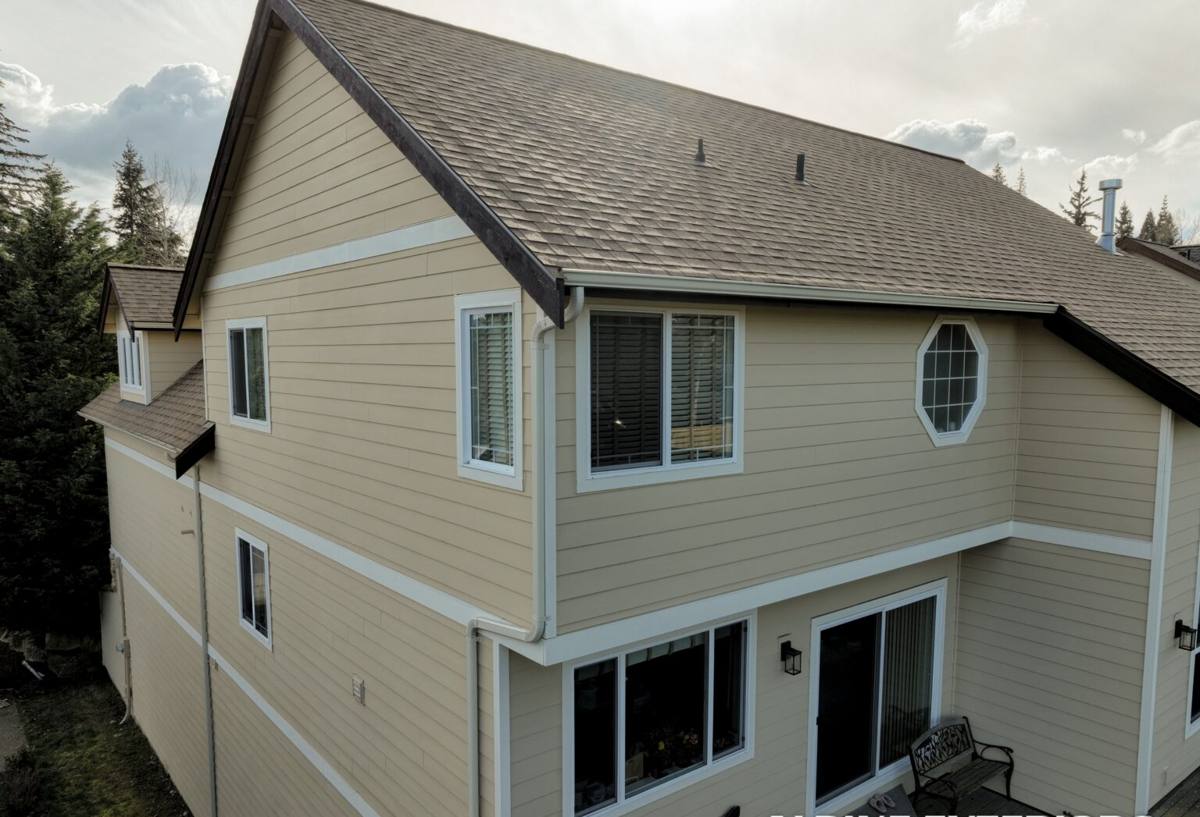
What Salt Air, Rain, and Moss Actually Do to Siding
These three stressors don't act independently — they compound each other.
Salt Air
Airborne salt is corrosive to exposed metal fasteners, flashing, and trim, and it accelerates the breakdown of paint films and coatings that aren't formulated to resist it. On siding with a weak factory finish, salt exposure shows up as chalking, fading, and early coating failure — years before the underlying material would otherwise need replacement.
Driving Rain
Wind-driven rain doesn't just fall on siding, it gets forced into it — up under laps, sideways through poorly sealed joints, and behind trim that isn't flashed correctly. On a well-built wall, that moisture hits a drainage plane behind the siding and runs back out. On a wall where the water-resistive barrier, flashing, or gapping wasn't done right, that moisture gets trapped against sheathing and framing, where it does damage no one sees until there's a soft spot or a stain.
Moss and Algae
Whatcom County's long wet season keeps north-facing and shaded siding damp for extended stretches, which is exactly what moss and algae need to take hold. Beyond the appearance issue, moss holds moisture against the siding surface longer than it would otherwise sit there, which extends every one of the problems above.
Individually, each of these is manageable. Together, on the wrong material or a rushed installation, they shorten the useful life of a siding job significantly.
Why We Install Only James Hardie Fiber Cement
We don't install vinyl, LP SmartSide, primed wood, Cemplank, or Allura. That's a deliberate standard, not a lack of options.
Vinyl softens, warps, and can crack in temperature swings, and its seams and J-channels give wind-driven rain more places to work its way behind the cladding over time. Wood-based and engineered wood products — including LP SmartSide and primed spruce — are organic materials at their core, which means they're more vulnerable to moisture absorption and rot in a marine climate unless every cut edge and joint is sealed and maintained without fail, indefinitely. Cedar has real appeal but the same fundamental vulnerability, plus a maintenance schedule most homeowners underestimate. Cemplank and Allura are fiber cement products like Hardie, and they're not without merit, but we've standardized on one manufacturer so our crews install one system to one spec, every time, with warranty coverage we understand completely.
James Hardie fiber cement is non-combustible, dimensionally stable, and doesn't absorb moisture the way wood-based products do. Its ColorPlus factory finish is baked on and warrantied against fading and flaking, which matters directly in salt air exposure — you're not relying on a field-applied paint job to hold up against corrosion-accelerated weathering. Hardie also engineers its products by climate zone (HZ5 for our region), which affects the formulation for moisture and freeze-thaw performance. It's not the cheapest siding material on the market, and we're upfront about that. It's the one we're willing to put our name behind on a waterfront-exposed lot.
What a Correct Siding Installation Actually Involves
The material is half the equation. The installation details are the other half, and they matter more in Sandy Point's exposure than almost anywhere else in the area.
- Water-resistive barrier: a continuous, properly lapped WRB behind the siding, installed shingle-style so water sheds down and out, not into the wall.
- Flashing at every penetration: windows, doors, hose bibs, vents, and any other wall penetration get flashed so driving rain can't track in around them.
- Correct gapping and clearance: Hardie panels and lap siding require specific gaps at butt joints, trim, and any horizontal surface (like a deck ledger or roofline) to allow drainage and prevent capillary wicking.
- Fastener selection: corrosion-resistant fasteners, installed at the manufacturer's specified pattern and depth — not overdriven, not underdriven — because both extremes compromise the panel's performance over time.
- Field-cut sealing: any cut edge exposed on site gets sealed per Hardie's specification, since factory-finished edges are protected but field cuts are not unless treated.
- Caulking at the right joints, not all of them: Hardie's install spec calls for sealant at specific transitions — over-caulking every joint can trap moisture instead of letting it drain.
Any one of these done wrong won't necessarily cause a visible problem in year one. In a driving-rain, salt-air environment, it tends to show up in year three to seven — which is exactly why installation quality matters as much as the product choice.
How We Approach a Sandy Point Siding Job
1. On-Site Assessment
We walk the home's full exterior, checking existing siding condition, trim and flashing details, any moss or moisture staining, and how exposed each elevation is to prevailing wind and rain. Waterfront and near-waterfront lots often need different detailing on the exposed side than on the sheltered side of the same house.
2. Tear-Off and Substrate Check
Old siding comes off and we inspect the sheathing underneath for rot, soft spots, or prior water intrusion — problems that are invisible until the old cladding is off the wall. Anything compromised gets repaired before new siding goes on; installing over damaged sheathing just locks the problem in.
3. Water-Resistive Barrier and Flashing
We install a continuous WRB and flash every penetration and transition before a single piece of siding goes up. This step is the one most likely to get shortcut on a rushed job, and it's the one that determines whether the wall stays dry underneath.
4. Hardie Installation to Spec
Panels or lap siding go up with correct gapping, fastening, and trim detail, following James Hardie's published installation instructions for our climate zone — not a generalized approach borrowed from a different product.
5. Finish and Final Inspection
We check reveals, caulking at the correct joints, and overall lines before calling the job done, and we walk the finished exterior with the homeowner.
Comparing Siding Materials for a Sandy Point Lot
| Material | Moisture Behavior in Salt Air/Driving Rain | Maintenance Burden | Typical Lifespan Here |
|---|---|---|---|
| James Hardie fiber cement | Non-combustible, doesn't absorb moisture like wood; factory finish resists salt-accelerated fading | Low — occasional wash, no repainting on ColorPlus finish for the warranty term | Decades, when installed to spec |
| Vinyl | Seams and channels give wind-driven rain entry points; can warp in heat/cold swings | Low, but limited repair options if damaged | Moderate, shorter in harsh exposure |
| LP SmartSide / engineered wood | Absorbs moisture at unsealed cuts and edges; performance depends on unbroken maintenance | Moderate to high — edge sealing, monitoring | Shorter without diligent upkeep |
| Cedar / primed wood | Organic material, most vulnerable to rot and moss retention | High — regular refinishing and inspection | Shortest without strict maintenance |
This isn't a claim that the other materials fail outright — plenty of homes carry them for years. It's why, on a lot with this much salt and moisture exposure, we don't think the trade-offs are worth it, and why we only install the material that gives Sandy Point homeowners the widest margin for error.
Maintaining Hardie Siding in This Climate
Fiber cement is low-maintenance, not zero-maintenance. In a salt-air, moss-prone environment, a little routine attention goes a long way:
- Rinse siding annually (more often on shaded, north-facing walls) to clear salt residue and slow moss growth
- Keep gutters and downspouts clear so roof runoff isn't sheeting down the siding face
- Trim back vegetation and landscaping that keeps siding shaded and damp
- Watch caulked joints and trim for cracking or separation and have them re-sealed before gaps open up
- Address any moss or algae growth promptly rather than letting it establish
None of this is heavy work, but it's the difference between a Hardie installation that reaches its full lifespan and one that gets neglected in exactly the conditions it was engineered to resist.
What Affects the Cost of a Siding Project in Sandy Point
| Factor | Why It Matters Here |
|---|---|
| Home size and elevation complexity | More corners, gables, and dormers mean more cutting, flashing, and trim work |
| Current siding removal and substrate condition | Rot or water damage found under old siding adds repair scope before new cladding goes on |
| Exposure level | Waterfront-facing walls often need more attention to flashing and joint detailing than sheltered elevations |
| Panel vs. lap profile and trim selection | Different Hardie product lines and trim packages carry different material costs |
| Access and site conditions | Tight lots, landscaping, or limited equipment access can affect labor time |
We won't quote a number without seeing the house — anyone who does is guessing. What we can say honestly is that James Hardie costs more upfront than vinyl or engineered wood, and that difference reflects both the material and the labor of installing it correctly, not just a markup.
Why Hiring a Crew That Already Works Sandy Point Matters
Siding contractors who mostly work inland, sheltered lots don't always adjust their approach for a shoreline-exposed home — and in this climate, that gap shows up later as premature caulk failure, moisture intrusion, or early moss buildup on the shaded side of the house. A crew that regularly works Sandy Point and the surrounding Ferndale and Whatcom County waterfront knows which elevations typically take the worst of the wind-driven rain, where extra flashing attention pays off, and how the local moss season actually behaves on different siding orientations. That's not a marketing point — it's the practical difference between an installation that's technically to code and one that's built for the specific way this location gets weathered.
If you're planning a siding project for a Sandy Point home, we'd rather walk your house, look at your current siding and trim details, and give you a straight answer about what it needs than sell you a generic estimate. Reach out for a free, no-pressure estimate using the form below.