 Ferndale Window
 Fiber Cement Siding, Sized to What Sudden Valley Actually Deals With
Sudden Valley is one of the more distinct residential settings in the Ferndale and greater Whatcom County area — a private, heavily wooded community on the south shore of Lake Whatcom, with its own internal road network and homeowners association, and homes spread across hilly, tree-covered terrain at a range of elevations. We install James Hardie fiber cement siding exclusively, and Sudden Valley is one of the areas where that standard matters most. Between salt-laden air that moves through this part of Whatcom County, driving rain that doesn't always fall straight down, and a moss season that runs longer here than in most parts of the region, this is not an environment where a mediocre siding job just looks a little worse over time. It fails, and it fails from the inside out, behind the wall, before most homeowners ever notice a problem on the surface.
This page is specifically about fiber cement siding for Sudden Valley — what the material needs to do here, what a correct installation actually involves, and why we send crews who already know this neighborhood rather than treating it like any other job on the calendar.
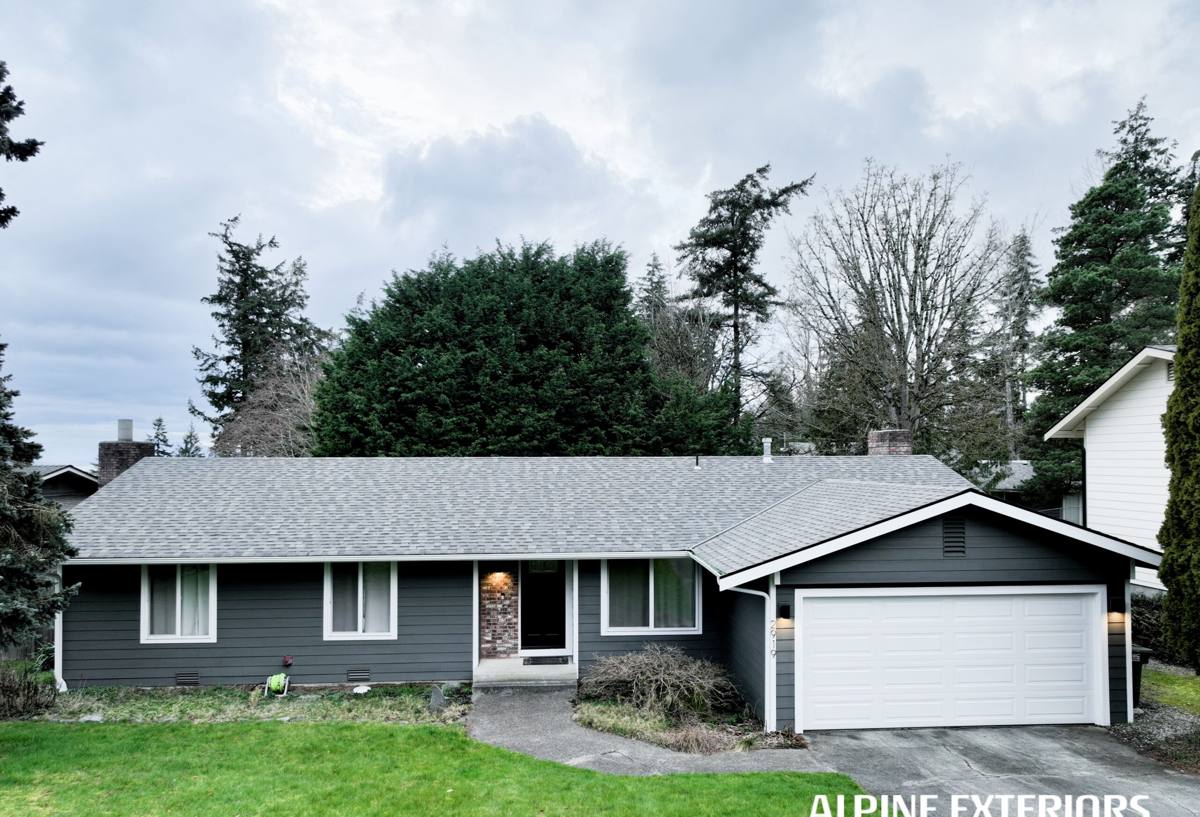
What This Climate Does to Siding in Sudden Valley
Salt Air and Driving Rain
Whatcom County sits close enough to Bellingham Bay and the Strait that salt-laden air moves through the region even on properties that aren't directly on the water, and that salt exposure accelerates corrosion in fasteners and flashing and degrades lower-grade finishes faster than a drier inland climate would. Combine that with rain that regularly comes in on wind rather than falling straight down, and siding, trim, and flashing details all take a harder test than a simple rainfall total suggests. Water finds its way into lap joints and trim seams that aren't detailed correctly, and it doesn't take a storm to do it — a sustained windy rain over a normal winter afternoon is enough.
Heavy Shade and a Long Moss Season
Sudden Valley's tree canopy is denser than most of the surrounding area, and a lot of homes here have at least one wall face that gets very little direct sun for most of the year. Shaded walls stay damp longer after every rain, which means the county's already-long moss and mildew season runs even longer on a typical Sudden Valley lot than it does on a more open property closer to town. Moss doesn't just look bad on siding and trim — sustained growth holds moisture against the wall assembly, and that's the exact condition that leads to rot behind the cladding if it isn't addressed.
Hilly Terrain and Uneven Exposure
Because Sudden Valley is built across sloped, wooded terrain around the lake, elevation and orientation vary a lot from lot to lot, and even from wall to wall on the same house. One elevation might catch the brunt of wind-driven rain off a clearing while another stays shaded and still all day. That variability means a siding job here can't be detailed the same way on every wall — the flashing, drainage, and fastening approach needs to respond to what each specific elevation actually faces, not a single generic spec applied uniformly.
The James Hardie System We Install
We install James Hardie fiber cement and nothing else. That's a professional standard we settled on after years of seeing which siding materials actually hold up under sustained coastal-influenced, heavily shaded conditions like Sudden Valley's, and which ones quietly pass maintenance costs back to the homeowner a few years down the road.
- Non-combustible core: Fiber cement doesn't feed a fire the way wood-based siding can, which matters for household safety and is worth noting for a community surrounded by forest.
- Factory-applied ColorPlus finish: Color is baked on under controlled factory conditions instead of brushed on in the field, so it resists fading, chalking, and salt exposure far longer than site-applied paint — especially on walls that stay damp longer in the shade.
- Climate-engineered HZ5 formulation: Hardie's HZ5 product line is built specifically for regions with heavy, sustained moisture exposure and freeze-thaw cycling, which is a good match for Sudden Valley's lake-adjacent, tree-shaded conditions.
- Dimensional stability: Fiber cement doesn't swell, cup, or warp the way engineered wood siding can after repeated wet-season moisture cycles that never fully resolve on a shaded wall.
- Strong transferable warranty: Hardie backs its products with a substantial warranty structure, provided the installation follows their published specifications — real protection, not just a marketing claim.
We don't install LP SmartSide, vinyl siding, Cemplank, Allura, primed spruce, or cedar. Each has a legitimate place in the broader market, and plenty of homeowners elsewhere are happy with them. But on a shaded, moisture-retentive lot like a typical Sudden Valley property, we've made a professional call that we'd rather stand behind one system completely than offer a cheaper alternative that quietly shifts long-term maintenance risk onto the homeowner.
Hardie Siding Profiles We Commonly Use Here
| Profile | Typical Use | Why It Fits Sudden Valley |
|---|---|---|
| HardiePlank lap siding | Primary wall cladding, most homes | Wide range of textures and reveals; performs well under sustained moisture when installed with proper lap and clearance |
| HardieShingle | Accent gables, dormers, feature walls | Shadow-line texture holds up visually even on shaded, slower-drying elevations |
| HardiePanel with battens | Modern or board-and-batten style homes | Fewer horizontal laps can mean fewer water-entry points if flashing is detailed correctly |
| HardieTrim | Corners, window and door trim, fascia | Matches the siding's finish and moisture behavior instead of pairing fiber cement walls with a mismatched trim material |
What a Correct Fiber Cement Install Actually Involves
Material choice only gets a Sudden Valley home halfway there. Fiber cement performs the way it's engineered to only when it's installed to spec, and on a shaded, hilly, moisture-heavy lot, cutting corners on install detail shows up faster than it would somewhere drier and sunnier.
Fastening and Clearance
Correct fastener type, spacing, and embedment matter more here because of the added salt exposure — undersized or wrong-grade fasteners corrode faster and can eventually let panels work loose. Proper clearance from grade, roof lines, and decks keeps splashback and ongoing moisture from wicking into the bottom edge of the siding, which is one of the more common failure points we find on older installs.
Joints, Laps, and Sealant
Butt joints should be flashed or backed, not just caulked and left to depend on sealant alone — caulk is a maintenance item, not a water barrier by itself, and it fails faster under the kind of wind-driven rain this area sees. Laps need to be consistent and sized to shed water down and out, not just close a visual gap.
Drainage Plane and House Wrap
A functioning water-resistive barrier and, where the assembly calls for it, a drainage gap behind the panels give any moisture that does get past the siding a way out instead of a place to sit against the sheathing. On shaded walls that stay damp longer, that drainage path is doing real work most of the year, not just during storms.
- Fastener spacing and type matched to Hardie's published spec, not a generic nail schedule
- Consistent, code-minimum clearance from grade, roofing, and deck surfaces
- Butt joints flashed or backed rather than caulk-only
- Continuous, correctly lapped house wrap with no reliance on sealant to bridge gaps
- Flashing integrated at every window, door, and penetration — not added as an afterthought
- Trim and corner details finished to shed water rather than collect it
Our Process for a Sudden Valley Siding Job
We start with an in-person walk of the home, looking at every elevation individually rather than assuming uniform exposure, since a Sudden Valley lot can have one wall in near-constant shade and another catching most of the wind-driven rain. From there we check the substrate — on a re-side, that means confirming whether sheathing and framing behind the existing siding are sound or whether hidden moisture damage needs to be addressed before anything new goes on. Only after that assessment do we talk through product selection, trim details, and color, then move into the tear-off or overlay decision, install, and a final walk-through before we call the job done.
Repair, Partial Replacement, or Full Re-Side?
Not every siding issue on a Sudden Valley home calls for a full tear-off. Isolated impact damage, a failed section around a single window, or storm-damaged trim can often be repaired and matched into existing Hardie siding. But if water has been tracking behind the wall for a while, or the home still has an older, non-Hardie product nearing the end of its service life, patching it usually just delays a bigger job while hidden rot keeps spreading underneath. We'll tell you which situation you're actually in rather than defaulting to whichever answer is more profitable for us.
Cost Factors for Fiber Cement Siding in Sudden Valley
| Factor | What It Affects | Why It Matters Here |
|---|---|---|
| Tear-off vs. overlay | Labor scope and substrate access | Tear-off reveals hidden moisture and rot damage that's common under older siding on shaded lots |
| Substrate condition | Repair costs before new siding goes on | Sustained shade and moisture can quietly rot sheathing behind older, poorly detailed siding |
| Siding profile and trim complexity | Material and labor cost | Board-and-batten, shingle accents, and detailed trim packages add labor time beyond a straight lap job |
| Elevation-specific detailing | Flashing and drainage work per wall | Shaded and wind-exposed walls on the same house often need different levels of water-management detail |
| Site access | Labor time and equipment staging | Sudden Valley's private road network, hilly lots, and tree cover can limit access and staging compared to an open, flat lot |
Exact costs depend on the specific property, its substrate condition, and how many elevations need extra water-management detail, which is why we walk the home in person before giving a real number instead of quoting off a generic price sheet.
Why a Crew That Already Works Sudden Valley Matters
Sudden Valley isn't a typical subdivision — it's a private community with its own road network and HOA, spread across wooded, sloped terrain where exposure changes dramatically from one lot to the next. A crew that already works here knows how to navigate community access, how to read which walls on a given lot need extra drainage attention because they never see direct sun, and which fastening and flashing details are worth the added time so a homeowner isn't dealing with a callback after the next wet winter. That local familiarity is the difference between a fiber cement installation that performs the way Hardie designed it to and one that looks right on install day but starts showing problems within a couple of wet seasons.
What to Ask Before Hiring for Fiber Cement Work in Sudden Valley
- Do they install James Hardie specifically, and can they explain why, beyond just carrying the brand?
- Have they worked in Sudden Valley before, and do they understand the community's access and HOA requirements?
- Will they check substrate condition before quoting a firm price, rather than assuming what's under the existing siding?
- Do they detail flashing and drainage differently on shaded versus exposed elevations, or apply one generic approach to every wall?
- Is their fastening and clearance work backed by a written scope, not just a verbal promise?
- Do they carry current Washington contractor licensing and insurance, and can they provide proof without hesitation?
If your Sudden Valley home needs new siding, a partial repair, or just an honest look at what's happening behind an aging wall, we're glad to take a look. Reach out using the form below to schedule a free, no-pressure estimate.