 Ferndale Window
 Building New in Custer? Your Windows Are the First Thing the Weather Tests
Custer sits close enough to the water that salt-laden air is a fact of life, and Whatcom County's weather pattern means driving rain off the Pacific hits window walls at an angle, not straight down. Add a damp season that runs long enough to grow moss on north-facing siding and trim, and you've got a climate that punishes any shortcut taken during the window install. On a new build, this is the one chance to get the window-to-wall connection right before siding, trim, and paint cover it up for good.
New-construction windows aren't just "windows for a new house." The term describes a specific installation method — one built around a nailing flange that gets integrated into the wall's water-resistive barrier (WRB) before siding goes on. Done correctly, that assembly is what keeps wind-driven rain out of the wall cavity for the next few decades. Done poorly, it's a slow leak that doesn't show up until there's rot, mold, or a soft spot in the drywall — often years after the framing crew and builder have moved on.
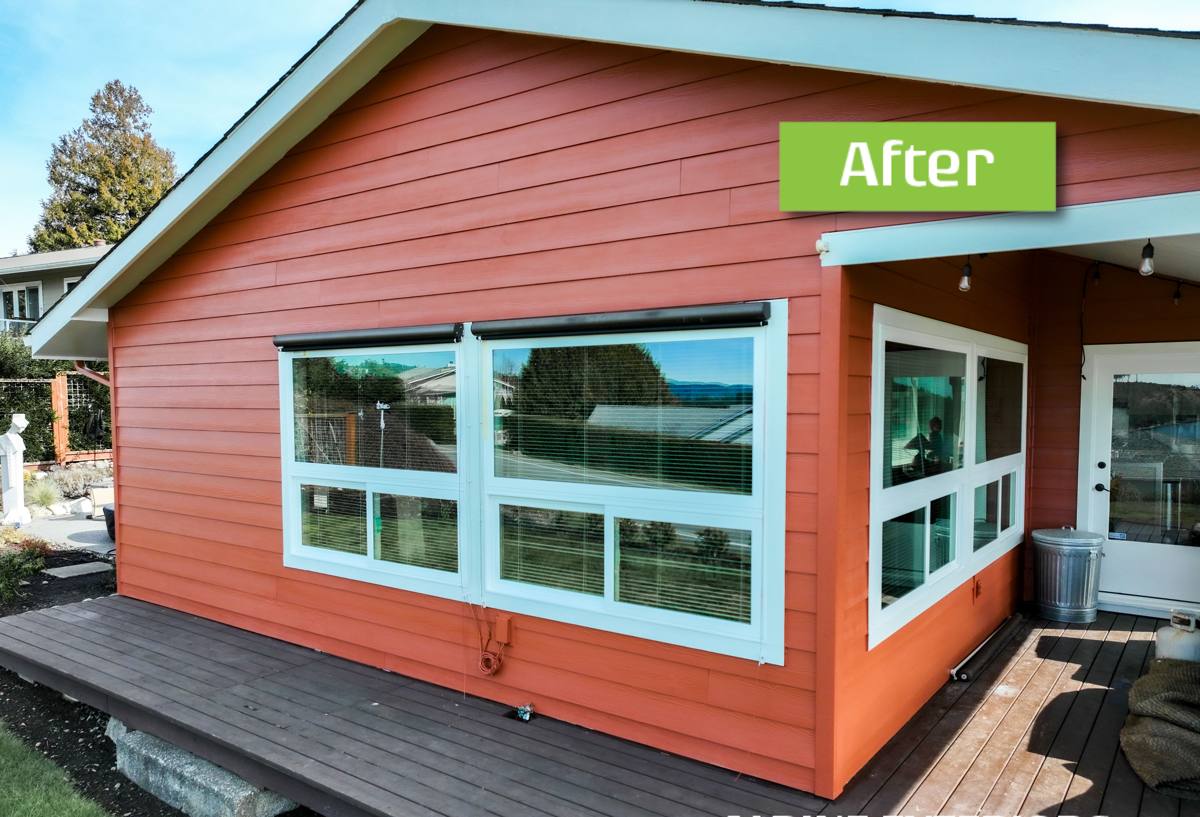
New-Construction vs. Replacement Windows: Why the Distinction Matters
Homeowners and even some builders use "new-construction window" and "replacement window" interchangeably, but they're built and installed differently, and mixing them up on a new build creates real problems.
- New-construction windows have a nailing fin around the perimeter of the frame. The window gets set into the rough opening from the outside, fastened through the fin into the sheathing, and then flashed as part of the wall's water management system — before house wrap and siding close everything in.
- Replacement windows (also called pocket or retrofit windows) have no nailing fin. They're sized to fit inside an existing frame and are sealed with caulk and trim rather than integrated into the WRB.
Using a replacement-style window in a new-construction opening — or installing a new-construction window without properly lapping the flashing into the WRB — leaves gaps in the water barrier that a house in a drier climate might tolerate for years. In Custer's combination of salt air and driving rain, those gaps get found fast.
What a Correct New-Construction Install Actually Involves
The window itself is often the easy part. The flashing sequence around it is where the job is won or lost, and it has to happen in the right order, every time, on every opening.
The Flashing Sequence, In Order
- Rough opening is checked for square, level, and correct size before the window ever shows up on site.
- A sloped sill pan is installed at the bottom of the opening, so any water that gets past the window has a built-in path back outside instead of pooling on the framing.
- Window is set, shimmed level and plumb, and fastened through the nailing fin per the manufacturer's schedule — under-fastening lets the frame flex and rack in wind; over-fastening can bow the frame and bind the sash.
- Flashing tape goes over the fin at the sides and top, lapped shingle-style (bottom pieces go on first, top pieces overlap them) so water always sheds down and out, never into a seam.
- House wrap is integrated last, lapping over the head flashing — never tucked behind it.
- Interior and exterior sealant joints are set at the specific points the window manufacturer specifies — sealing everywhere sounds thorough but can actually trap moisture that should be draining out.
Skip the sill pan, flash out of order, or seal the wrong joint, and the window can look perfect from the street while quietly feeding water into the wall assembly every time it rains sideways.
Product Considerations for a Coastal-Adjacent Climate
Custer isn't oceanfront, but it's close enough to Georgia Strait and Birch Bay that salt-bearing air reaches building materials regularly, especially on west- and south-facing walls that also take the brunt of driving rain. That combination shapes which products make sense.
Frame Material
Vinyl and fiberglass frames handle salt air and moisture cycling well because they don't corrode and don't need repainting to stay protected. Aluminum-clad wood frames can look great and perform well, but the cladding seams and any exposed fasteners need to be genuinely corrosion-resistant hardware — standard-grade hardware in a salt-air environment corrodes faster than most homeowners expect, sometimes within a handful of years.
Glazing and Weatherstripping
Double-pane with a low-E coating and an argon fill is the baseline for new construction in this climate — it manages both heat loss and condensation risk on cold, damp mornings. Weatherstripping and corner-seal quality matter more here than in drier climates, since driving rain tests every seam far more often than it would inland.
Moss and Growth Considerations
Moss doesn't grow on the glass, but it does take hold in window sills, tracks, and any horizontal trim ledge that stays damp and shaded. Sill design with a positive slope to shed water, and trim details that don't create flat, shaded catch points, cut down on the buildup that otherwise needs scraping and cleaning every year or two.
Cost Factors on a New Build
New-construction window pricing depends on more than the window unit itself. Here's what actually moves the number on a Custer build:
| Factor | Why It Matters |
|---|---|
| Frame material (vinyl vs. fiberglass vs. clad wood) | Vinyl is the most budget-friendly; fiberglass and clad wood cost more but offer different long-term maintenance profiles |
| Number and size of openings | Larger units and multi-window combinations (bays, sliders next to fixed units) cost more per opening to flash and set correctly |
| Glazing package | Upgraded low-E coatings or triple-pane glass add cost but improve comfort and condensation resistance |
| Hardware and finish grade | Corrosion-resistant hardware costs more up front and pays off in a salt-air environment |
| Coordination complexity | Working around a tight framing schedule or a general contractor's timeline can affect labor cost |
Broad ranges vary widely by project size and window count, which is why we walk every opening on the plan set before quoting rather than pricing off a square-footage guess.
Working With Your Builder or GC
On most new-construction jobs, the window install happens on a schedule set by the general contractor, sandwiched between framing and siding. That timing window is often tight, and it's also the point where responsibility for waterproofing can get fuzzy — the framer thinks the window crew handles flashing, the window crew assumes the siding crew laps the WRB correctly, and nobody owns the whole sequence.
We work directly with builders and GCs on Custer projects to make sure that sequence has a single point of responsibility from sill pan to final flashing lap, with the window manufacturer's installation instructions followed to the letter — which also keeps the manufacturer's warranty intact, something that can be voided by an installation that deviates from spec.
Why a Crew That Already Works Custer Makes a Difference
Custer's building department, permitting expectations, and typical lot conditions (drainage, exposure, proximity to agricultural land or the water) are things you learn by working the area repeatedly, not by reading a spec sheet once. A crew that's already installed windows on Custer builds knows which orientations take the worst weather, which product lines hold up locally, and how to sequence with the other trades on a Whatcom County job site without slowing the build down.
That local track record also means fewer surprises during final inspection — flashing details that meet code and match what local inspectors expect to see, not a generic install pattern pulled from a different climate.
Checklist: What to Confirm Before Windows Go In
- Rough openings have been checked for square and correct size against the window order
- Sill pans are specified and included in the install plan, not treated as optional
- Flashing tape and sequence match the window manufacturer's written installation instructions
- Hardware and fasteners are rated for coastal/salt-air exposure
- Glazing package is appropriate for the wall's sun exposure and the room behind it
- Installer will coordinate directly with the framing and siding crews on timing
- Manufacturer warranty terms are confirmed as intact based on the planned install method
Get a Straight Answer Before You Frame Another Wall
If you're building new in Custer, the window package is worth getting right the first time — it's cheaper to spec correctly during framing than to chase a leak after the siding's up. We're happy to walk your plans, talk through frame and glazing options for your lot's exposure, and give you a straightforward, no-pressure estimate. Reach out through the form below to get started.