 Ferndale Window
 Decks Built for Kendall's Corner of Whatcom County
Homes out toward Kendall deal with a specific mix of weather that a lot of national deck-building advice simply doesn't account for. You're close enough to the water to get salt-laden air working on your fasteners and metal hardware, but you're also under enough tree cover and cloud that decks stay damp for days at a stretch. Add in a moss season that can run from early fall through late spring in a typical Whatcom County year, and you've got a structure that's fighting three different kinds of wear at once: corrosion, rot, and the slow work of organic growth finding every low spot and shaded board.
A deck built the same way you'd build one in a dry inland climate will show problems within a few seasons — soft spots near the ledger board, streaking and slickness on the walking surface, hardware that rusts and stains the wood around it. A deck built for this specific corner of Ferndale's service area holds up because every decision, from fastener grade to board spacing, assumes the deck will be wet more often than it's dry.
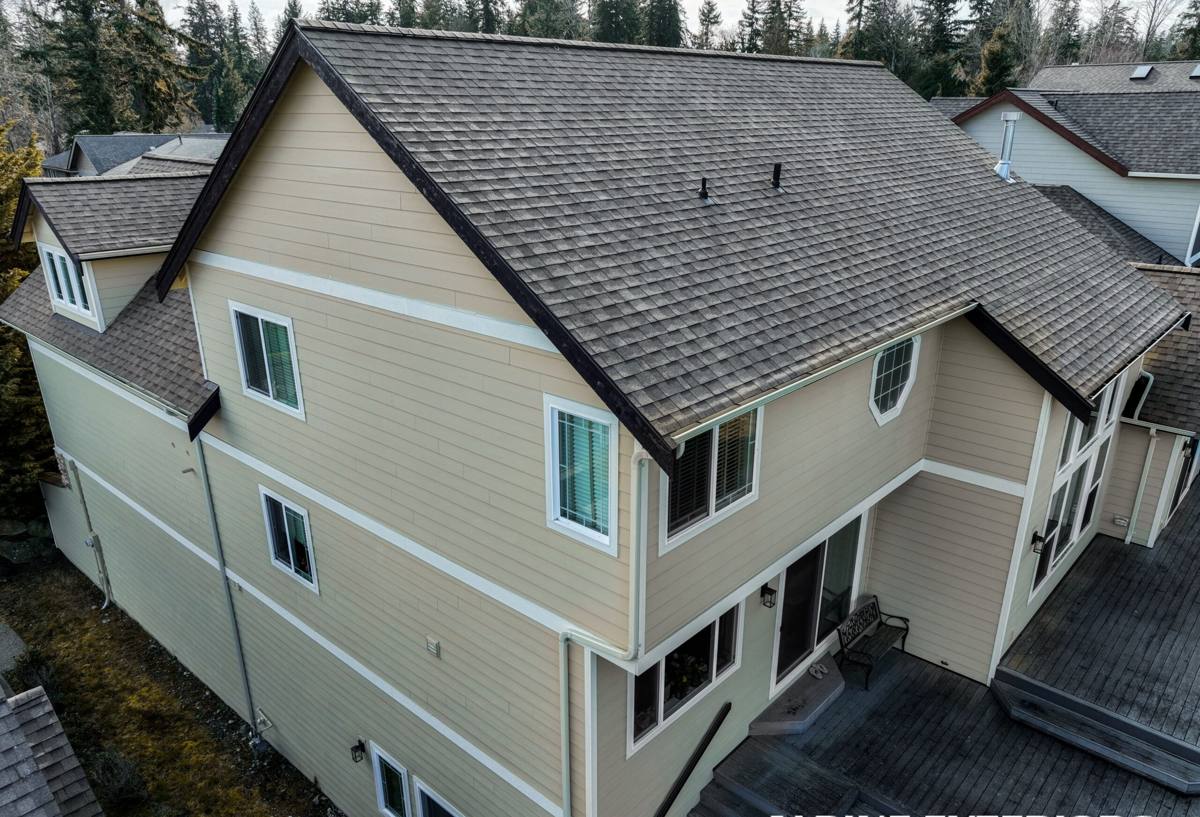
What a Correctly Built Deck Has to Handle Here
Fasteners and Hardware
Salt air accelerates galvanic corrosion, and it doesn't take direct ocean spray to do it — moist, salt-tinged air moving inland is enough over years. Standard electro-galvanized screws and joist hardware will eventually rust, and rusting hardware doesn't just look bad — it loses holding strength and can stain the wood or composite around it. We spec stainless steel or heavy hot-dip galvanized fasteners and connectors rated for coastal exposure on every Kendall-area project, not just the ones closest to open water.
Footings and Ground Contact
This region's soil holds moisture longer than homeowners expect, especially on lots with mature trees and shade. Footings need to go below frost depth and bear on undisturbed or properly compacted soil, and any post base sitting near grade needs a standoff so the wood post itself never sits in standing water. We see the most expensive deck failures start at the bottom — a post base that trapped water against the post for a few years, hidden from view until the deck starts to feel spongy underfoot.
Board Spacing and Airflow
Moss and algae need two things to take hold: moisture and a surface that doesn't dry out between rains. Boards spaced and installed without enough gap, or decks built low to the ground without real airflow underneath, stay damp far longer after our driving rain events. Correct gapping, proper joist spacing for the decking product, and keeping the structure high enough for airflow underneath all buy you real time before moss becomes a maintenance headache.
Choosing the Right Decking Material for This Climate
There's no single "best" decking material — there's a best material for your budget, your maintenance appetite, and how much shade and moisture your specific site sees. Here's how the common options actually perform in a wet, moss-prone Whatcom County yard:
| Material | Upfront Cost | Maintenance Needed | Moss/Moisture Resistance | Realistic Lifespan |
|---|---|---|---|---|
| Pressure-treated fir/pine | Lowest | Annual cleaning, re-sealing every 1-2 years | Fair — needs upkeep to stay ahead of moss | 10-15 years with maintenance |
| Cedar | Moderate | Regular cleaning, periodic oil/sealer | Good natural rot resistance, still grows moss if shaded | 15-20 years with care |
| Composite decking | Higher | Periodic washing, no sealing needed | Good — but capped boards resist moss far better than uncapped | 20-25+ years |
| PVC decking | Highest | Low — occasional washing | Best moisture and moss resistance of the group | 25-30+ years |
We don't push any one product as "the" answer. Composite and PVC cost more up front but trade away the recurring sealing and staining work that wood demands — which matters more on a shaded Kendall lot where a deck stays wet longer than one in full sun. Wood costs less initially but only performs if the maintenance actually happens on schedule; skipped sealing years are exactly how moss and soft spots get ahead of a homeowner.
A Word on Ground-Level and Low Decks
Low, ground-hugging decks are popular for a clean look, but they're the hardest style to keep moss-free in this climate because airflow underneath is limited by design. If you want that look, we build in extra ventilation gaps and use a moisture-resistant substructure, but it's worth knowing upfront that a low deck will need more frequent cleaning than a deck built with a few feet of clearance underneath.
Our Process for a Kendall-Area Deck Project
Site Visit and Design
Every project starts with us walking the actual site — the slope, the shade pattern, drainage paths, and how close the deck sits to the house and grade. Two lots a mile apart in the Kendall area can have very different moisture and sun exposure, and the design should reflect the site in front of us, not a generic template.
Permitting
Deck permitting in Whatcom County depends on height, attachment to the house, and size, and we handle that paperwork as part of the job rather than leaving it to the homeowner. Skipping a required permit is a common way homeowners end up with problems at resale, so we build to code and pull permits when the project calls for it.
Framing and Build
We frame with the fastener and footing standards described above regardless of decking material, because the substructure is what actually determines how long a deck lasts. The visible boards get replaced eventually — a well-built frame shouldn't need to be.
Final Walkthrough
Before we call a job done, we walk it with the homeowner: fastener check, railing solidity, drainage confirmation, and a plain-English rundown of what maintenance that specific material and site will actually need going forward.
What Actually Drives the Cost of a Deck
Homeowners often ask for a flat price before we've seen the site, and the honest answer is that a handful of factors move the number more than square footage alone:
| Cost Factor | Why It Matters | Effect on Price |
|---|---|---|
| Height above grade | Taller decks need more substantial framing, railings, and often stairs | Moderate to significant increase |
| Ground conditions | Sloped or soft ground needs deeper or more numerous footings | Moderate increase |
| Decking material | Wood, composite, and PVC have very different material costs | Largest single factor |
| Railing style | Cable, glass, and custom rail systems cost more than standard wood or metal baluster rail | Small to moderate increase |
| Attachment method | Ledger-attached decks need proper flashing and house-side work; freestanding decks avoid that but need more footings | Varies by site |
We give real, project-specific numbers after seeing the site rather than a rough per-square-foot guess, because on a climate-sensitive build like this, the framing and drainage decisions matter as much as the finished square footage.
Keeping Moss and Algae From Taking Over
No decking material is entirely maintenance-free in a moss season this long, but the amount of upkeep varies a lot by material and design. A short list that applies to almost every deck in this area:
- Sweep debris and needles off the deck regularly — trapped organic matter holds moisture and feeds moss growth
- Rinse or wash the surface at least once or twice a year, more often in heavily shaded yards
- Keep gutters and downspouts directed away from the deck structure, not dumping onto it
- Trim back overhanging branches where possible to let more light and airflow reach the deck
- Check railing posts and ledger connections yearly for looseness, which can signal moisture getting into a joint
- Reseal wood decking on schedule — don't let a missed year turn into two or three
None of this is difficult, but it has to actually happen. A deck built right and then never cleaned will still grow moss; a deck built right and maintained on this kind of schedule will outlast the manufacturer's stated lifespan in most cases.
Railings and Hardware That Hold Up Over Time
Railings take more direct weather exposure than the deck surface in a lot of ways — they're vertical, don't shed water as fast, and every joint is a place for moisture and salt air to work into a connection. We use fastener and post-connection hardware rated for coastal/marine exposure on railings specifically, since a railing failure is a safety issue, not just a cosmetic one. Composite and PVC rail systems have become popular here for the same reason as decking — less recurring maintenance in a climate that doesn't give wood much of a break.
Why a Crew That Already Works in the Kendall Area Matters
Deck-building advice that works in a dry, sunny climate can be actively wrong here — the fastener grade, footing depth, and material choices that hold up in Whatcom County's combination of salt-tinged air, heavy rain, and long moss season aren't the default settings most national contractors or big-box installers start from. A crew that regularly builds and repairs decks in and around Ferndale and the Kendall area has already seen which details cause callbacks in this specific climate, and builds to avoid them the first time rather than learning it on your project.
That local pattern-recognition also shows up in smaller ways — knowing which permit reviewers in Whatcom County ask for what documentation, having a realistic sense of how long lumber and composite orders actually take to arrive locally, and being available to come back for warranty work without a multi-hour drive.
If you're planning a new deck or replacing one that's showing its age, we're happy to walk the site with you, talk through material and design tradeoffs honestly, and put together a free, no-pressure estimate. There's a form below whenever you're ready.