 Ferndale Window
 What Fairhaven's Climate Does to Exterior Siding
Homes in the Fairhaven area near Ferndale sit close enough to the water that salt-laden air is a daily fact of life, not an occasional event. Add Whatcom County's long wet season — months of driving rain pushed sideways by coastal wind — and a shaded, humid moss season that can stretch from fall through spring, and you have one of the more demanding siding environments in the Pacific Northwest. Salt air accelerates corrosion on fasteners and metal trim. Wind-driven rain finds gaps that would never leak in a calmer climate. And moss doesn't just look bad — it holds moisture against a wall long after the rain has stopped, which is exactly the condition that rots wood-based siding and delaminates poorly made composites.
None of this means siding is doomed here. It means the material and the installation both have to be chosen for this specific climate, not for a national average. That's the lens we bring to every Fairhaven-area project.
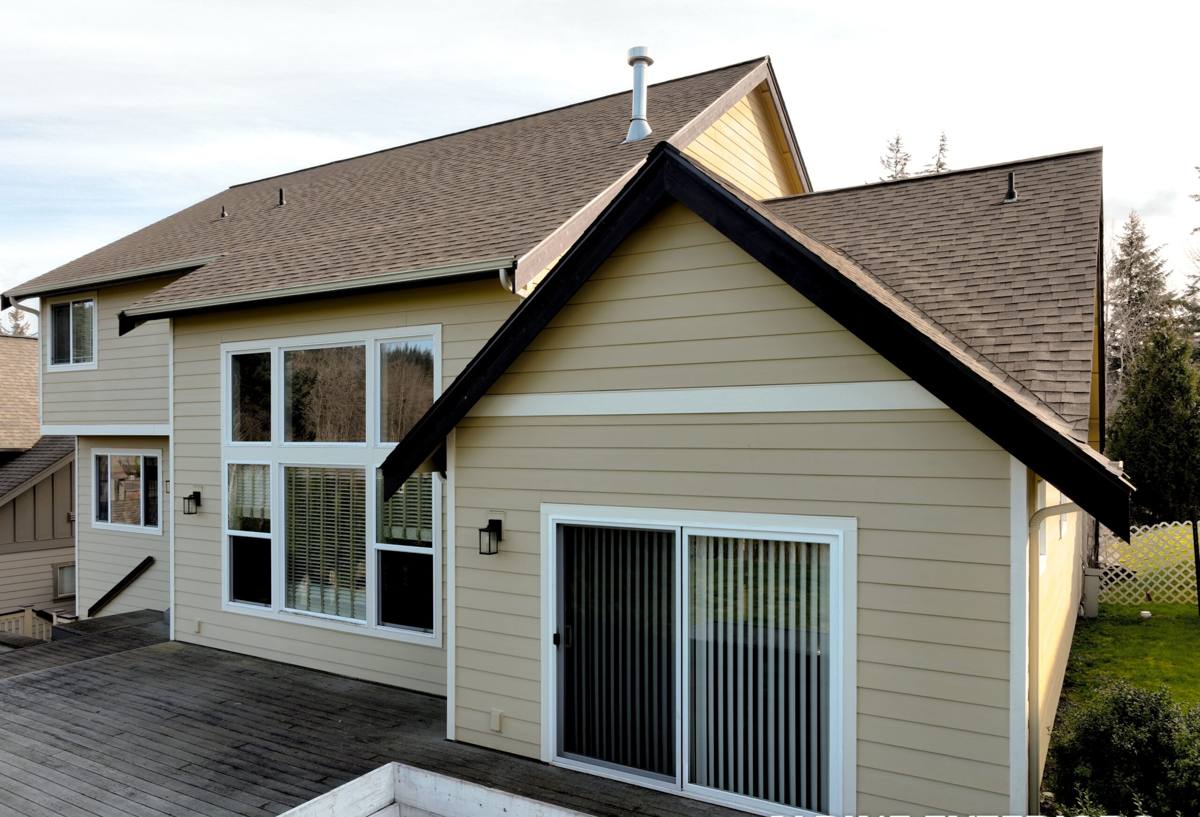
Why We Only Install James Hardie Fiber Cement
We don't offer vinyl, LP SmartSide, Cemplank, Allura, or primed wood siding. That's a deliberate standard, not a limitation in what we're capable of installing. Each of those products has a real place in the market and does some things well — but each also has a trade-off that shows up faster in a salt-air, high-moisture climate like this one than it would somewhere dry.
Vinyl expands and contracts with temperature swings and can crack or warp under long-term UV and salt exposure. Wood-based composite sidings like LP SmartSide are engineered wood — better than raw lumber, but still wood at the core, which means any breach in the factory coating opens the door to moisture absorption and swelling. Primed cedar or spruce siding needs ongoing paint maintenance and is vulnerable to moisture intrusion at end grain and cut edges, exactly the kind of detail that's hard to keep perfect on a house that gets pelted with sideways rain for half the year.
James Hardie fiber cement is cellulose fiber, sand, and cement — non-combustible, dimensionally stable, and engineered specifically for the swelling, cracking, and moisture problems that plague other materials. It won't rot, and it doesn't feed insects. That's why it's the only product we put our name behind.
What "ColorPlus" Actually Buys You
Most Hardie siding we install uses the factory-applied ColorPlus finish rather than field-applied paint. It's baked on in a controlled environment, bonds more consistently than a painter can achieve on a jobsite, and comes with its own finish warranty. In a climate where site-painted trim tends to need attention again within a few years, that factory finish is one less maintenance item for a Fairhaven homeowner to think about.
Choosing the Right Hardie Product Line
James Hardie doesn't sell one generic siding — it builds different product lines and engineers them for different climate zones. Coastal Whatcom County falls into Hardie's HZ5 climate engineering zone, which accounts for higher moisture exposure and freeze-thaw cycling. Within that, the choice of profile is mostly about the look you want and how the house is built.
| Product | Best Use | Look |
|---|---|---|
| HardiePlank lap siding | Most single-family homes, the default choice | Traditional horizontal lap, smooth or cedar-textured |
| HardiePanel vertical siding | Accent walls, gables, modern or farmhouse styles | Clean vertical lines, often paired with batten strips |
| HardieShingle | Accent areas, dormers, Cape Cod-style detailing | Staggered or straight-edge shingle profile |
| HardieTrim | Corners, window and door surrounds, fascia | Smooth, paintable trim boards |
Most Fairhaven-area homes end up with HardiePlank as the field material, with HardieTrim boards at corners and openings and sometimes a shingle or panel accent on a gable or entry feature. We'll walk through which combination fits your home's style and exposure during the estimate rather than defaulting to one look for every house.
What a Correct Installation Involves Here
Fiber cement siding fails early almost exclusively because of installation mistakes, not because of the material itself. In a climate that gets as much wind-driven rain as this one, the details most crews treat as optional are the ones that actually keep water out.
Drainage Behind the Siding
We install a weather-resistant barrier and, on most jobs, a drainage gap (a rainscreen) between that barrier and the siding. Any wall will let a small amount of moisture past the outer layer over time — the question is whether that moisture has a path to drain and dry out, or whether it gets trapped against the sheathing. Given how many wet weeks this area sees in a typical year, we treat that drainage gap as standard practice rather than an upsell.
Flashing and Fastening
Every window, door, and horizontal trim transition gets proper flashing so water is directed out and down, never behind the siding. Fasteners are placed and set to Hardie's specification — over-driven or under-driven nails are one of the most common causes of cracked boards and premature failure, and it's a detail that's easy for a crew unfamiliar with fiber cement to get wrong.
Gaps, Caulk, and Clearance
Hardie boards need the specified gap at trim and butt joints, sealed with a high-quality, paintable sealant rated for exterior use — not caulked tight with no room to handle the material's slight seasonal movement. We also maintain proper clearance between the bottom of the siding and grade, decks, patios, and roof lines, since one of the fastest ways to invite rot and moss growth is siding that sits too close to standing moisture or splash-back.
Our Process, Start to Finish
- On-site assessment — we look at your current siding, sheathing condition, trim, flashing, and any moisture damage before quoting anything.
- Product and color selection — choosing the Hardie line, profile, and ColorPlus color that fits the home and your budget.
- Removal and prep — stripping old siding down to sheathing, repairing any rot or damage found underneath, and confirming the wall assembly is sound before anything new goes on.
- Weather barrier and drainage plane — installing the water-resistant barrier and rainscreen gap where called for.
- Installation — hanging siding and trim to Hardie's fastening and clearance specifications, with flashing detailed at every penetration.
- Final walkthrough — checking caulk lines, fastener patterns, and clearances with you before we call the job done.
Living With Fiber Cement Through Salt Air and Moss Season
Fiber cement is genuinely low-maintenance compared to wood or vinyl, but "low-maintenance" doesn't mean "no attention ever." In a Fairhaven-area climate, a short annual check goes a long way toward protecting the investment.
- Rinse salt residue and grime off the siding once or twice a year with a garden hose and soft brush — avoid pressure washers, which can force water behind boards or damage the finish.
- Watch shaded, north-facing walls and areas under overhangs for early moss or algae growth and remove it before it spreads.
- Keep gutters and downspouts clear so water isn't overflowing directly onto siding below.
- Trim back vegetation and keep at least a few inches of clearance between the siding and soil, mulch, or deck surfaces.
- Inspect caulk lines at trim and joints every year or two and have any cracked or missing sealant replaced.
- Check for any fastener heads that have popped or corroded and have them addressed promptly.
What Fiber Cement Siding Costs to Install
Every home is different, but the factors that move the price on a Fairhaven-area fiber cement project are fairly consistent. We'll give you specific numbers after a walkthrough, but this is generally what drives cost up or down.
| Factor | Effect on Cost |
|---|---|
| Tear-off and disposal of existing siding | Adds labor and disposal cost, especially with multiple layers or hazardous old materials |
| Sheathing or framing repair | Hidden rot or water damage found during removal increases scope |
| Home size and number of stories | More wall area and taller walls both raise labor and access costs |
| Trim, accents, and profile mix | Combining plank, panel, and shingle profiles costs more than a single field material |
| Color and finish | Factory ColorPlus finishes vary by color; custom field-painting adds cost |
| Site access | Difficult access, landscaping, or scaffolding needs add labor time |
Why Hiring a Crew That Works This Area Already Matters
Fiber cement installation isn't forgiving of guesswork, and a coastal, wet climate leaves even less room for it. A crew that regularly works in and around Fairhaven already knows how the wind and rain patterns behave against different wall orientations, how quickly moss establishes on shaded elevations here, and where the moisture problems on older Whatcom County homes tend to hide. That local pattern recognition shows up in small decisions — where to add extra flashing, which walls need the most attention to the drainage plane, how tight to run clearances near grade — that a crew unfamiliar with this specific coastline might not think twice about.
We stand behind James Hardie fiber cement because, installed correctly, it's built for exactly the conditions this stretch of coastline throws at a house year after year. If your current siding is showing moss, cracking, soft spots, or peeling paint, or if you're planning ahead for a home in the Fairhaven area, we're happy to take a look and talk through what's actually going on with your walls — no pressure, no upsell. Use the form below to request a free estimate.