 Ferndale Window
 Why Lummi Island Decks Take a Different Kind of Beating
A deck on Lummi Island lives in a harder climate than a deck fifteen minutes inland. You've got salt-laden air coming off the water, driving rain that comes in sideways during a good Whatcom County storm, and a moss season that can run from October clear through May under any kind of tree cover. Put those three together and you get a deck that ages faster than the same structure would in a drier, more sheltered yard.
Salt air is the one people underestimate most. It doesn't just sit on the surface — it works into metal fasteners, hinges, and connectors, accelerating corrosion in hardware that would otherwise last decades. Combine that with near-constant moisture and you have the two main drivers of deck failure on the island: rot in wood that stays wet too long, and rust in the hardware holding everything together.
None of this means a deck on Lummi Island can't last — it means the repair has to account for the environment it's actually sitting in, not just patch what's visibly broken.
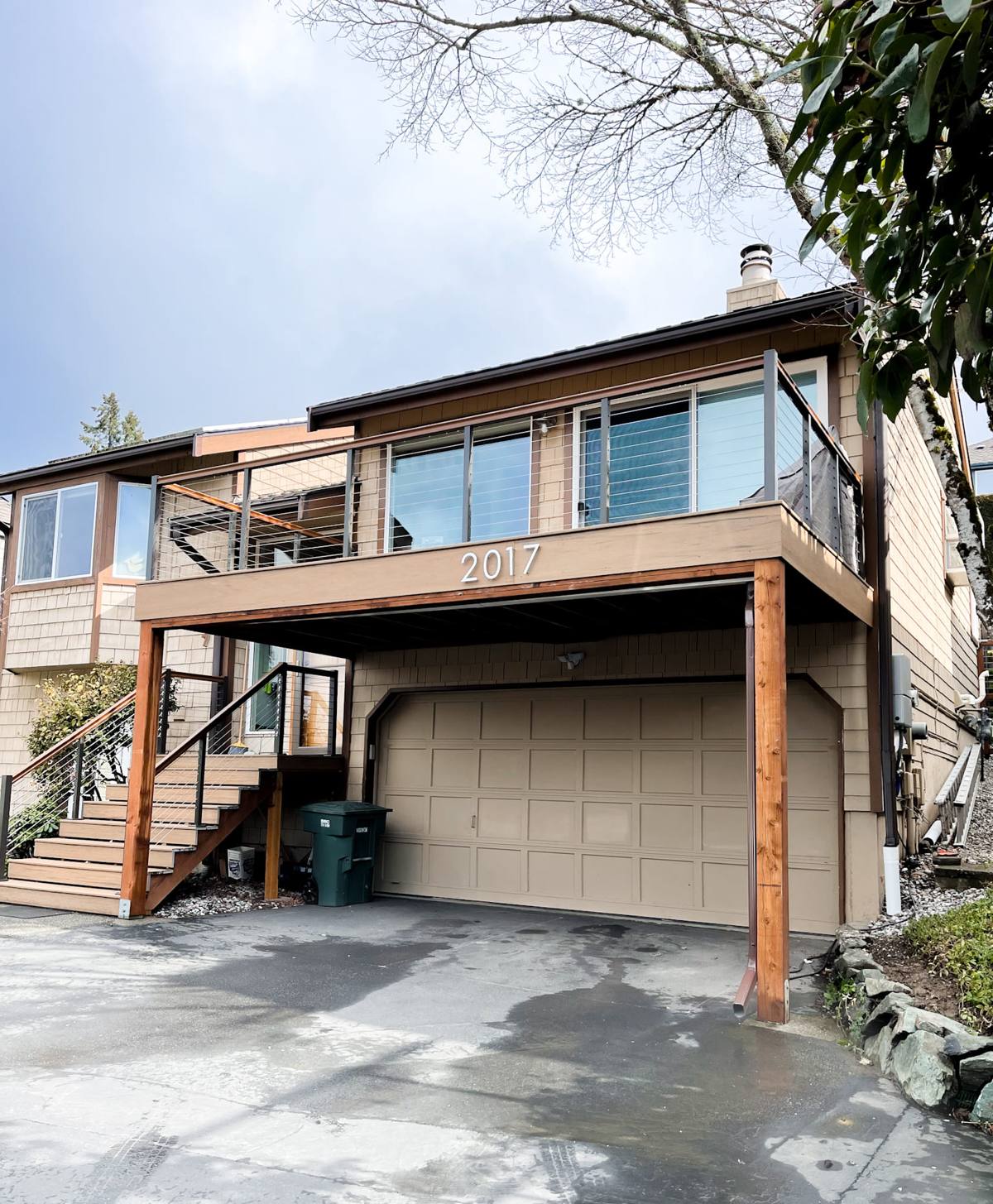
Signs a Deck Needs Repair — Not Just a Coat of Sealant
Structural warning signs
- Bounce or give when you walk across the deck, especially near the middle of a span
- Railings that wiggle or flex when leaned on
- Soft or spongy spots in the decking boards, often near the house or under planters
- Visible gaps where the ledger board meets the house, or staining below that connection
- Posts that have shifted, tilted, or separated from their footings
Surface and material warning signs
Not every problem is structural. Cracked or splintering boards, rusted-out screw heads, peeling or bubbling finish, and dark moss or algae staining are all common on Lummi Island decks — and they're worth addressing before they become entry points for water. A board that's just weathered is a cosmetic issue. A board that's soft to the touch or delaminating is a structural one.
What a Proper Deck Repair Actually Involves
A repair that's done right addresses the framing first, then the surface — not the other way around. Skipping straight to new boards over a compromised frame just hides the problem for another season or two.
Framing and structure
This means checking joists, beams, and posts for rot, especially anywhere water has been pooling or draining slowly. It also means confirming that ledger board attachment to the house is sound and properly flashed, since that connection point is one of the most common failure spots on any Pacific Northwest deck.
Decking boards
Individual boards get replaced where they're cracked, soft, or badly cupped. Where the whole surface has reached the end of its life but the frame underneath is solid, a full resurfacing — new boards over an existing structural frame — is often the more cost-effective path than a full teardown.
Railings and guards
Railings take direct wind and rain exposure and see constant hand contact, so they often show wear before the deck surface does. Loose balusters, corroded connectors, and posts with play in them all get addressed as part of a repair — this is also a safety item, not just an appearance one.
Fasteners and hardware
Given the salt air off the water, hardware choice matters more here than in a lot of Whatcom County neighborhoods. Repairs on Lummi Island call for corrosion-resistant fasteners and structural connectors rated for exterior, coastal-adjacent use — replacing standard hardware with the same standard hardware just resets the clock on the same failure.
Drainage and flashing
Water that doesn't drain is the root cause behind most of the rot we find. Part of a correct repair is making sure flashing at the house connection is intact, gaps between boards allow water to shed instead of pool, and nothing is trapping moisture against untreated wood.
Repair or Replace? What Actually Drives That Decision
Homeowners often assume visible damage means the whole deck needs to come out. In our experience, it's usually more nuanced than that — it comes down to what condition the framing is in.
| Factor | Leans toward repair | Leans toward replacement |
|---|---|---|
| Framing condition | Joists and posts are sound, no rot at connections | Structural rot at multiple joists, posts, or the ledger |
| Age of structure | Under 15–20 years, built to a reasonable standard | Original construction is older or was undersized to begin with |
| Extent of damage | Isolated boards, railings, or hardware | Damage is widespread across the whole surface or frame |
| Code and layout | Current footprint and railings meet code as-is | Guard height, spacing, or footings don't meet current code |
| Budget goals | Extend usable life at lower upfront cost | Want a longer runway before the next major project |
A straightforward repair — replacing boards, hardware, and localized framing — is typically a fraction of the cost of a full rebuild. But if the frame itself is compromised in more than a spot or two, spending repair money on a structure that has five years left isn't doing you any favors, and that's a conversation we'll have honestly during the estimate.
How Our Deck Repair Process Works on the Island
Assessment and estimate
We start by getting under the deck, not just looking at the surface — checking joists, the ledger connection, posts, and footings before we talk about boards or railings. You get a written estimate that separates what's structural from what's cosmetic, so you can see exactly what you're paying for and why.
Planning around island access
Working on Lummi Island means factoring ferry scheduling into the job timeline the same way you'd factor in weather. A crew that regularly works the island plans material deliveries and crew arrivals around that reality instead of discovering it mid-project — which keeps your job moving instead of stalling out waiting on a part that should've been on-site already.
The repair itself
We remove and replace only what needs it, matching new material to existing wherever that's the right call, and upgrading fasteners and connectors to corrosion-resistant hardware as standard practice for coastal exposure — not as an upcharge.
Cleanup and walkthrough
Every job wraps with a walkthrough so you know what was done, what materials went in, and what to keep an eye on going forward. Debris and old material leave with us.
Materials That Actually Hold Up Here
There's no single "best" decking material for every home — it depends on your budget, how much upkeep you want to take on, and how exposed the deck is to weather and salt air.
- Pressure-treated lumber — the most affordable option and a solid performer if the finish is maintained and fasteners are corrosion-resistant; it needs more regular attention than composite
- Cedar and other natural woods — a strong look that a lot of Whatcom County homeowners want, but it demands consistent sealing and cleaning to resist moisture and moss in this climate
- Composite decking — higher upfront cost but far less annual maintenance, and generally more resistant to moisture absorption and moss staining than wood
Whatever the decking material, we treat fastener and hardware selection as its own decision — stainless steel or high-grade coated fasteners cost more than standard galvanized hardware, but on a salt-air site the difference in service life is significant enough that it's a poor place to cut corners.
Keeping a Repaired Deck in Good Shape Through the Wet Season
A repair holds up longer when it's paired with basic seasonal upkeep. None of this is complicated, but it's the difference between a repair lasting a few years and lasting a decade or more.
- Sweep leaves and debris off the surface regularly, especially in fall — trapped organic matter holds moisture against the boards and feeds moss growth
- Rinse off moss and algae buildup before it gets a foothold, particularly on shaded or north-facing sections
- Check that gaps between boards are clear so water can drain instead of pooling
- Inspect railings and connection points once or twice a year for looseness or corrosion
- Re-seal or re-stain wood decking on the manufacturer's recommended schedule — don't wait for it to look obviously worn
- Keep gutters and downspouts near the deck clear so runoff isn't draining directly onto it
Why It Matters to Hire a Crew That Already Works Lummi Island
Deck repair on the island isn't just carpentry — it's carpentry plus logistics. A crew that hasn't worked out there before will underestimate how ferry timing affects scheduling, or show up with hardware that isn't suited to the salt exposure, or miss the moss and drainage issues that are specific to heavily wooded, water-adjacent lots.
We work across Ferndale and the surrounding Whatcom County communities, including Lummi Island, and we build our estimates and schedules around what that actually takes — not around a generic mainland job. That means fewer surprises, fewer callbacks, and a repair that's specified correctly for where your deck actually sits.
If your deck is showing wear, feels a little soft in places, or just needs an honest second opinion before you spend money on it, we're happy to take a look. Reach out for a free, no-pressure estimate using the form below.