 Ferndale Window
 Cordata's Roofing Climate: Salt Air, Rain, and Moss
Homes in and around Cordata sit in a stretch of Whatcom County that takes weather seriously. Moist air moves in off the Sound, rain settles in for weeks at a time in fall and winter, and shaded roof planes stay damp long enough for moss to take hold and keep growing. None of that is unusual for this part of Washington, but it adds up differently on a roof than it does on siding or windows. A roof doesn't get a break — it's the one surface that's exposed to everything, every day, for decades.
Salt-tinged air moving inland off Bellingham Bay accelerates corrosion on unprotected metal fasteners and cheaper flashing. Driving rain — the kind that comes in sideways during a windstorm, not just straight down — finds every gap in flashing, every under-driven fastener, and every spot where felt paper was stretched too thin. And moss season here isn't a month, it's most of the year: anything that holds moisture against a roof surface for long periods will eventually let water follow it underneath.
None of this makes metal roofing complicated. It makes it a system that has to be specified and installed correctly for this climate, not just installed to a general spec sheet.
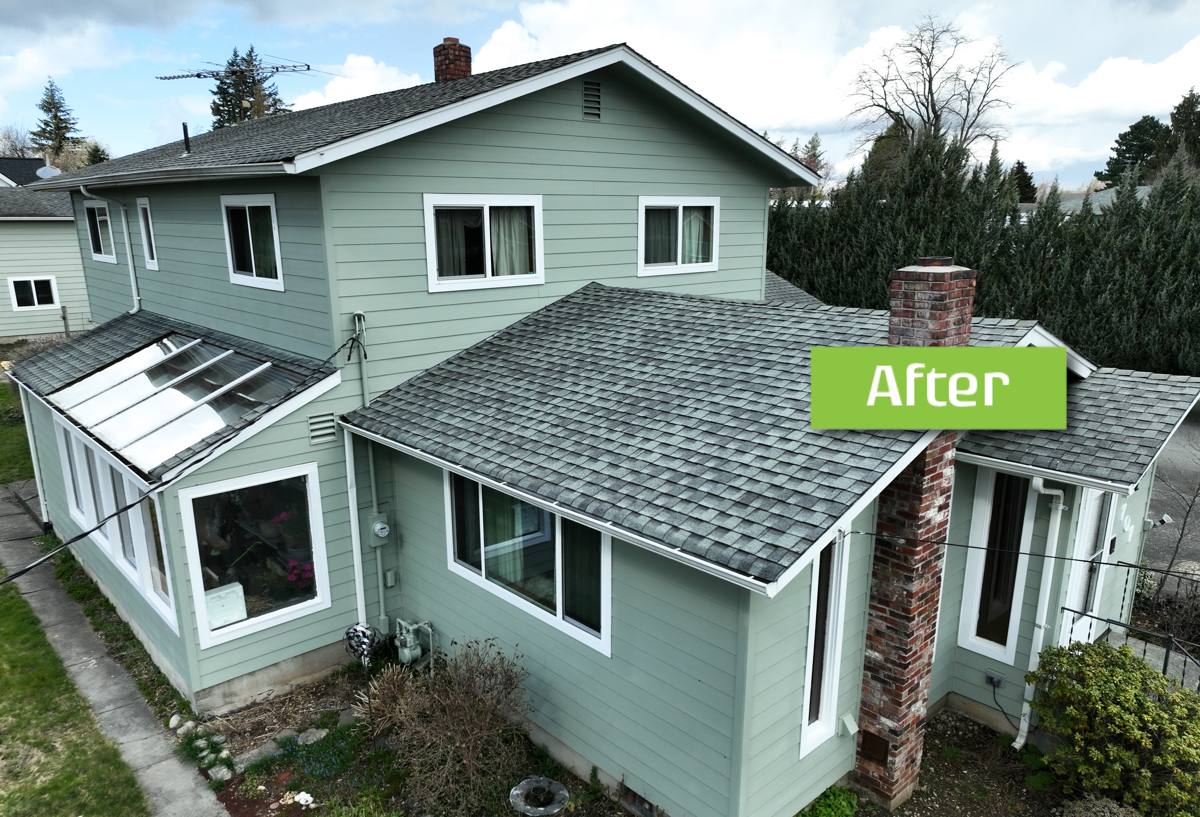
Why Metal Roofing Makes Sense Here
Metal sheds water fast, doesn't give moss the organic surface it needs to root, and — when the panel type and coatings are matched to the site — handles salt-laden air far better than untreated fasteners or bare galvanized steel. That's the short version of why we see more metal roofs going up on Cordata-area homes than in drier inland climates.
What it's actually solving for
- Steep water shed on the panel seams, so standing water and ice damming are less of a factor
- A hard, smooth surface that moss and lichen have a much harder time colonizing than shingles
- Long service life against a climate that never really lets a roof dry out completely
- Lower long-term maintenance if the coatings and fasteners are chosen for coastal exposure
Metal isn't the right call for every roof or every budget, and we'll say so plainly during an estimate. But for homes exposed to wind-driven rain and persistent moss, it solves problems that asphalt shingles just don't solve as well.
Choosing the Right Metal Roofing System
Standing seam vs. exposed-fastener panels
Standing seam panels use concealed clips and interlocking seams — no fasteners penetrate the panel face, which means no exposed screw heads for water or salt air to work on over time. Exposed-fastener panels (sometimes called corrugated or R-panel systems) cost less up front but rely on gasketed screws driven through the panel face, and those gaskets are the first thing to fail in a climate with this much rain and temperature swing. We install both, but we're honest with homeowners about which one fits a wet coastal climate better long-term.
Steel vs. aluminum
Steel panels, properly coated, are strong and cost less than aluminum, but they depend entirely on that coating staying intact. Aluminum won't rust even if the finish gets scratched, which matters more the closer a home sits to salt-influenced air. Neither is objectively "better" — it's a trade-off between upfront cost and long-term corrosion tolerance.
| Factor | Standing Seam | Exposed-Fastener Panel |
|---|---|---|
| Fasteners | Concealed, no face penetrations | Exposed screws with gaskets |
| Typical upfront cost | Higher | Lower |
| Maintenance | Minimal — no gaskets to replace | Gaskets/fasteners need periodic checks |
| Best fit | Long-term ownership, coastal exposure | Outbuildings, budget-driven projects |
| Moss resistance | Excellent — smooth seams shed debris | Good, but ribs can trap organic debris |
What a Correct Metal Roof Installation Actually Involves
A metal roof is only as good as what's underneath it. This is where a lot of the long-term performance — or long-term problems — actually get decided.
Underlayment and moisture barrier
In a climate that stays wet for months, we use a high-temp synthetic underlayment rated for the panel type, not a generic felt product. Ice-and-water membrane goes at eaves, valleys, and any low-slope transition where water lingers longest.
Flashing and penetrations
Every pipe boot, vent, chimney, and wall transition is a place where two materials meet, and that's where driving rain finds its way in if flashing is cut short or caulked instead of properly lapped. We flash these details to shed water by design, not by sealant, because sealant is a maintenance item and proper flashing isn't.
Fastener and coating selection
Fasteners and clips are matched to the panel metal to avoid galvanic reaction, and rated for the corrosion exposure of the site. This matters more for homes with more direct exposure to marine air, and less for a sheltered, tree-covered lot — part of our job is reading which situation a given home actually has.
Ventilation
Metal roofs need the attic below them to breathe. Trapped moisture under a tight metal roof with poor ventilation causes condensation problems that have nothing to do with the roof itself and everything to do with airflow. We check and correct ventilation as part of the scope, not as an afterthought.
Our Process, Start to Finish
1. On-site assessment
We walk the roof, check the decking condition, look at existing flashing and ventilation, and talk through what the home's exposure actually calls for — not a one-size-fits-all recommendation.
2. Written scope and material selection
You get a clear scope: panel type, gauge, coating, underlayment, and flashing detail — in writing, before any work starts, so there's no guessing later about what was actually installed.
3. Tear-off and deck prep
Old roofing comes off, decking is inspected and repaired where needed. Skipping this step to save time is exactly how moisture problems get sealed into a new roof.
4. Installation
Underlayment, flashing, and panels go on in that order, with attention to every seam, valley, and penetration — the details that matter most in a climate that doesn't give a roof much time to dry between storms.
5. Final walkthrough
We walk the finished roof with you, cover what maintenance (if any) it needs, and make sure gutters and drainage are actually working with the new roof, not against it.
Maintenance in a Wet, Salt-Exposed Climate
Metal roofing is genuinely low-maintenance compared to shingles, but "low" isn't "none." A little attention goes a long way toward getting the full service life out of the system.
- Clear debris from valleys and gutters each fall before the heavy rain settles in
- Keep overhanging branches trimmed back so shaded areas get some sun and airflow, which discourages moss
- Have flashing and penetration seals checked every few years, especially around chimneys and vent pipes
- Rinse off any built-up grime near ground level if the home is closer to marine air, where salt residue accumulates faster
- Watch for any scratches through the coating on steel panels and have them touched up before rust can start
Common Mistakes We See on Existing Roofs
We don't say this to knock other crews — most roofing problems we find on older installs come down to shortcuts under time or budget pressure, not bad materials. But it's worth knowing what to watch for, because these are the issues that turn a good product into a maintenance headache.
Under-flashed penetrations
Relying on sealant instead of proper step flashing or pipe boots is the single most common cause of leaks we trace on metal roofs — sealant degrades; correctly lapped flashing doesn't.
Mismatched fasteners
Using the wrong fastener for the panel metal invites galvanic corrosion at every screw head — a slow problem that shows up as staining and eventual leaks years down the road.
Skipped ventilation checks
A new roof installed over an attic with inadequate airflow can trap condensation that looks like a roof leak but is actually a ventilation problem — one more reason we check this every time, not just when asked.
Why Local Cordata Experience Matters
A roof spec that works fine in a dry inland climate doesn't automatically hold up here. Crews who work Whatcom County regularly know which details — underlayment grade, flashing style, fastener coating — actually matter for a home dealing with this much sustained rain and moss pressure, versus which upgrades are just upsells. That local pattern recognition is worth more than a manufacturer's brochure, because it comes from seeing how roofs in this specific climate actually age.
We also know the practical side: permitting expectations in this part of the county, how local weather windows affect scheduling a tear-off safely, and what drainage and gutter setups actually keep water moving off a metal roof instead of pooling against a fascia board. None of that shows up on a spec sheet — it comes from doing the work here, repeatedly, and paying attention to what holds up.
If you're weighing a metal roof for a Cordata-area home, we're glad to walk the roof, talk through what your specific exposure calls for, and put together a clear, no-pressure estimate. There's a form below to get that started.