 Ferndale Window
 Why Birch Bay's Shoreline Climate Is Hard on Roofs
Birch Bay sits right where Whatcom County meets the water, and that location cuts both ways. The views are part of why people live there, but the same exposure that makes the bay pleasant also shortens the working life of an ordinary roof. Salt-laden air drifts inland off the water and settles on shingles, flashing, and fasteners day after day. Combined with the driving, wind-pushed rain that comes through in fall and winter storms, and the long stretch of damp, low-sun months that let moss and algae take hold, a Birch Bay roof is doing more work than a roof a few miles inland in Ferndale proper.
None of this means a roof in Birch Bay needs to be exotic or overbuilt. It means the details that are optional in a drier, more sheltered climate are not optional here — the underlayment, the flashing metal, the fastener choice, and the ventilation all need to be selected with salt exposure and near-constant moisture in mind. A roof installed without accounting for that will look fine for a couple of years and then start showing problems earlier than it should.
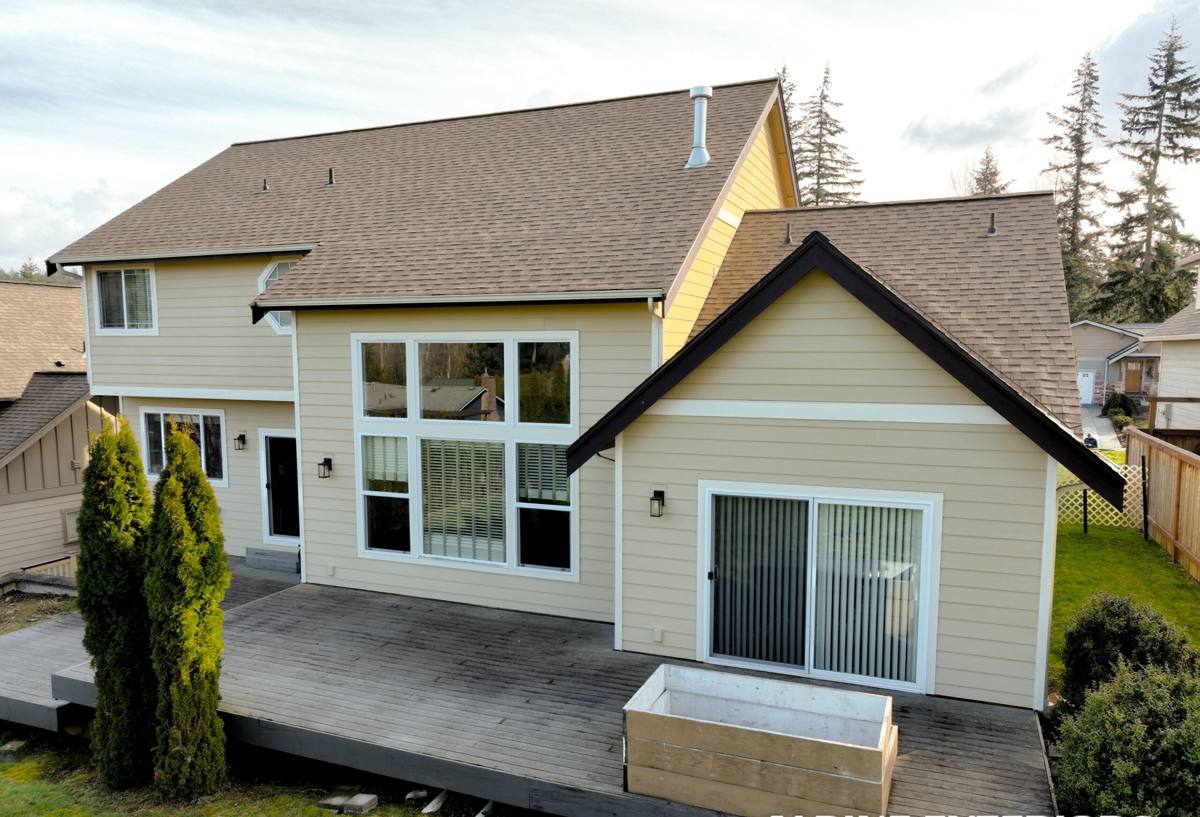
What a New Roof Needs to Handle Local Conditions
A correctly built roof for this area is really a system of layers working together, not just a layer of shingles. Each layer has a specific job in a marine climate like Birch Bay's:
- Underlayment — a synthetic or self-adhering underlayment that stays watertight even if wind-driven rain gets under the shingle tabs, which happens more often on exposed, water-facing slopes.
- Ice and water shield — installed at eaves, valleys, and around penetrations, this membrane protects the areas most likely to see standing water or wind-forced moisture during a winter storm.
- Flashing — corrosion-resistant metal at chimneys, walls, valleys, and roof-to-wall transitions, since salt air accelerates rust on lower-grade metal faster than it would a few miles from the water.
- Ventilation — balanced intake and exhaust airflow that keeps the attic dry and close to outdoor temperature, which matters in a climate where humidity is already working against the roof deck.
- Fasteners — corrosion-resistant nails and hardware rated for coastal or high-moisture exposure, not the standard-grade fasteners that are fine inland but pit and weaken faster near salt air.
Skip or downgrade any one of these and the roof will still pass a quick visual check on installation day. The problems show up later — usually as a leak that traces back to a flashing detail, or moss and streaking that comes back within a season because the roof surface was never treated as part of the whole assembly.
Signs It's Time for a New Roof, Not Another Repair
Most homeowners don't wake up planning a full roof replacement — it's usually a repair call that reveals the roof is past the point where patching makes sense. Some signs point clearly toward replacement rather than another round of spot repairs:
- Granule loss heavy enough that shingles look patchy or bald in sun-facing areas
- Moss or dark algae streaking that returns quickly after cleaning, especially on north-facing or shaded slopes
- Shingles that are curling, cracking, or lifting at the edges, particularly on the sides that catch the most wind off the bay
- Soft spots or sagging when walked, which usually means the decking underneath has taken on moisture
- Repeated leaks around the same chimney, skylight, or valley despite prior repairs
- A roof that's nearing or past the expected service life of its material, especially if it was never re-flashed or re-vented during its lifetime
- Visible rust or corrosion on flashing, vent caps, or fasteners — a common early sign in shoreline-exposed homes
If you're only seeing one or two of these, a repair may still be the right call. If several are showing up together, that's usually the roof telling you it's cheaper in the long run to replace it correctly than to keep chasing individual failures.
What a Correct Roof Installation Actually Involves
Tear-Off and Deck Inspection
A proper job starts with removing the old roofing down to the deck, not layering over it. That's the only way to actually inspect the plywood or plank decking underneath for soft spots, rot, or delamination from years of moisture exposure. Any damaged decking gets replaced before anything new goes down — installing a new roof over a compromised deck just hides the problem until it fails again.
Underlayment and Moisture Barriers
With the deck exposed, this is where the moisture-management layers go in — synthetic underlayment across the field, ice and water shield at the vulnerable areas mentioned earlier. This step matters more in Birch Bay than in drier parts of the state, since it's the backup system that protects the home if wind-driven rain ever works its way past the shingle surface.
Flashing Details
Flashing failures are one of the most common sources of roof leaks, and they're rarely a flashing material problem — they're an installation problem. Step flashing at walls, counter-flashing at chimneys, and properly lapped valley flashing all need to be installed in the correct sequence with the underlayment and shingles, not just caulked into place afterward.
Ventilation and Final Details
Intake vents at the eaves and exhaust at or near the ridge need to be balanced so air actually moves through the attic space rather than stalling. Ridge caps, pipe boot flashing, and any penetrations get sealed and finished last, followed by a full walk of the roof to check nailing patterns and seal lines before calling the job complete.
Choosing the Right Roofing Material for a Coastal Climate
There isn't one "correct" material for every home, but some perform noticeably better than others under Birch Bay's combination of salt air, moss pressure, and driving rain. Here's how the common options compare on the factors that actually matter in this climate:
| Material | Moss & Algae Resistance | Salt Air / Corrosion Resistance | Maintenance Needs |
|---|---|---|---|
| Asphalt composition shingle (standard) | Moderate — depends on slope and shade | Good if flashing/fasteners are upgraded | Periodic cleaning to prevent moss buildup |
| Asphalt shingle, algae-resistant (AR) rated | Better — granules resist algae growth | Good if flashing/fasteners are upgraded | Lower, but not maintenance-free |
| Standing seam metal | Strong — smooth surface sheds moss more easily | Depends heavily on coating and fastener quality | Low, but coating and sealant checks matter |
| Cedar shake / wood shingle | Weaker — porous surface holds moisture, feeds moss | Fair, but wood absorbs salt-laden moisture | Higher — regular treatment and cleaning needed |
We don't push one material on every homeowner. A well-installed standard asphalt shingle with upgraded flashing and fasteners performs fine for most Birch Bay homes; algae-resistant shingles are worth the modest upcharge on shaded or north-facing roofs where moss has been a recurring problem. Metal costs more up front but trades that for lower long-term maintenance. Wood shakes look great but ask for the most upkeep in exactly the conditions Birch Bay has the most of — persistent dampness.
Our Installation Process, Start to Finish
The steps are the same on every job because skipping one is where problems come from:
- On-site inspection and estimate — we look at the existing roof, the decking condition where visible, ventilation setup, and any trouble spots like valleys or chimneys before writing a scope of work.
- Prep — landscaping, siding, and outdoor living areas get protected before tear-off begins.
- Tear-off and deck check — old roofing comes off, decking is inspected and repaired as needed.
- Install — underlayment, ice and water shield, flashing, roofing material, and ventilation components go in, in that order.
- Cleanup and magnetic sweep — job site and surrounding ground are cleared of debris and stray fasteners.
- Final walkthrough — we go over the finished roof with the homeowner and answer questions before calling the job done.
What Affects the Cost of a New Roof in Birch Bay
Every home is different, so we don't quote a roof without seeing it, but the same handful of factors drive most of the cost difference between jobs:
| Factor | Why It Matters |
|---|---|
| Roof size and pitch | More square footage and steeper slopes mean more material and labor time |
| Material choice | Standard asphalt, AR-rated asphalt, and metal all sit at different price points |
| Number of existing layers / decking condition | Extra tear-off work or decking replacement adds time and material |
| Roof complexity | Valleys, dormers, chimneys, and skylights all add flashing work |
| Site access | Trees, tight lots, or difficult staging can affect labor and equipment needs |
| Permitting and disposal | Local permit requirements and debris hauling are part of every job's cost |
As a general range, most straightforward single-family roof replacements land somewhere in the low-to-mid five figures, with complexity, material choice, and decking condition pushing that up or down. We'll walk through the actual numbers for your home during the estimate rather than guess from a phone call.
Moss, Algae, and Keeping a New Roof Healthy Long-Term
Even a well-built roof needs a little upkeep in a climate this damp. Overhanging tree branches should be trimmed back so shaded areas of the roof get more sun and airflow, which slows moss regrowth. Gutters need regular clearing so water isn't backing up under the eave line during heavy rain. A light, roof-safe cleaning every year or two — not pressure washing, which can strip granules — keeps moss and algae from getting a foothold. None of this is complicated, but it's the difference between a roof that looks and performs well for its full service life and one that starts showing streaking and soft spots years early.
Why Local Experience in Birch Bay Matters
A roofing crew that's worked in Birch Bay already knows which slopes take the worst of the wind off the water, which neighborhoods see the heaviest moss pressure, and how Whatcom County permitting and inspection work in practice — not just in theory. That familiarity shows up in small decisions during the job: which valleys get extra flashing attention, where ice and water shield needs to extend further than the minimum, and which fastener upgrades are worth it for a specific home's exposure. A crew installing their first roof in the area is guessing at some of that. A crew that's done it repeatedly isn't.
If you're weighing a repair against a full replacement, or just want an honest look at what condition your roof is actually in, we're happy to come out and take a look. The estimate is free, there's no pressure attached to it, and you'll get a straight answer about what your roof needs — use the form below to get started.