 Ferndale Window
 Bellingham's Marine Climate Asks More of a Roof
Homes near Bellingham Bay sit in one of the more demanding roofing environments in Whatcom County. The same marine air that makes this part of Washington beautiful also carries salt off the water, and salt-laden air is corrosive to fasteners, flashing, and any metal that isn't properly coated or protected. Add in driving rain that comes sideways off the Sound during winter storms, and a long, damp moss season that can run from fall through spring, and you have a roof that's under near-constant stress even when nothing dramatic is happening.
Most roofing problems we see in this area aren't from one big storm. They build slowly — a fastener that starts weeping rust, a low spot where moss holds moisture against the surface, a flashing detail that was fine for drizzle but not for wind-driven rain. Metal roofing, installed correctly for this specific climate, handles all three of those pressures better than most alternatives. Installed poorly, it can actually make some of them worse.
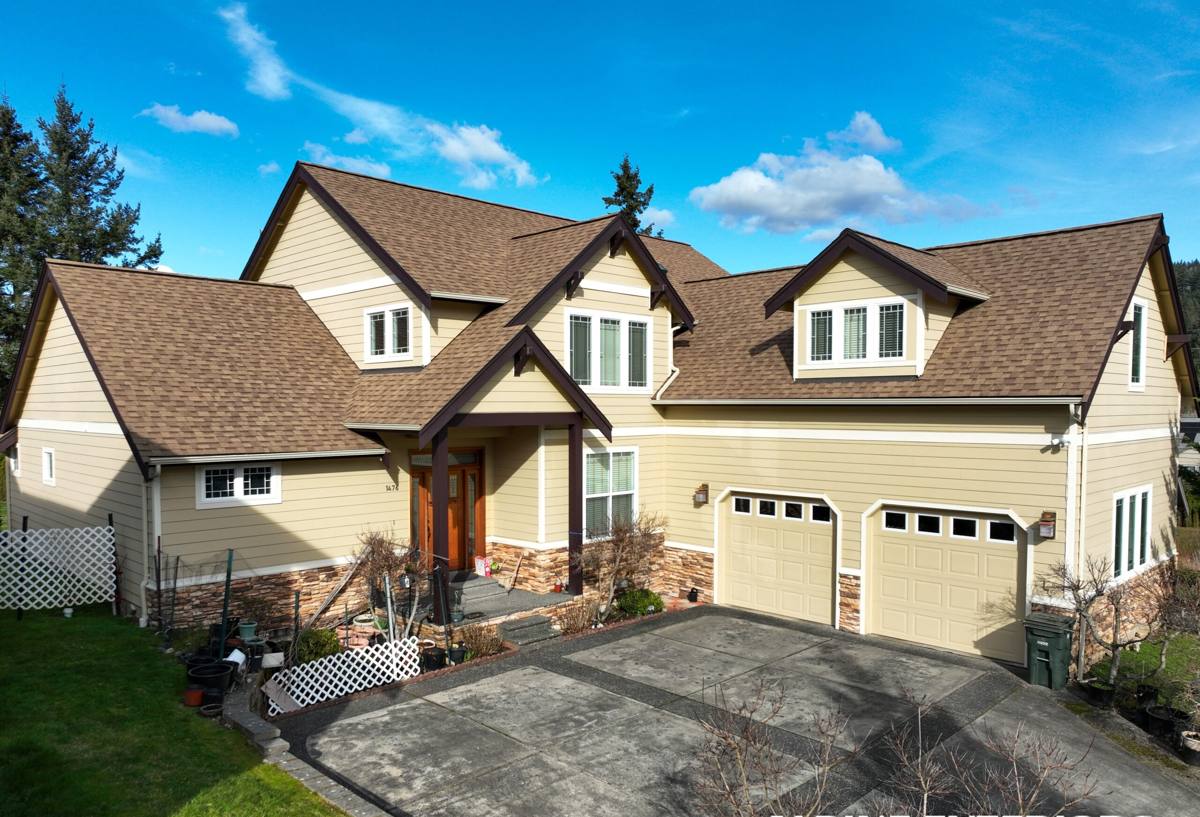
Why Metal Roofing Fits Bellingham Specifically
Corrosion Resistance Where It Matters
Salt air doesn't stop at the waterfront — it travels on wind, and Bellingham's exposure to Puget Sound means homes even a few miles inland get some of that airborne salt over time. The panels themselves are only part of the corrosion story. Cut edges, fastener heads, and dissimilar-metal contact points (where two different metals touch and cause galvanic corrosion) are where real-world failures start. A roof spec'd for this coastline uses corrosion-rated fasteners, factory-coated panel edges wherever possible, and flashing metals that are compatible with the panel material — not just whatever was on the truck.
Shedding Water and Resisting Moss
Metal's smooth, continuous surface gives moss and lichen far less to grab onto than the rougher texture of composition shingles or wood. That doesn't mean a metal roof is moss-proof — anywhere debris collects (valleys, behind chimneys, in shaded north-facing sections) moss can still take hold. But on the open field of the roof, water sheds fast and organic growth has a much harder time establishing itself, which matters in a county where roofs can stay damp for weeks at a stretch during the wet season.
Standing Up to Driving Rain and Wind
Wind-driven rain doesn't just fall on a roof, it pushes sideways and upward under laps and around penetrations. Metal systems rely on mechanical seams, properly lapped underlayment, and correctly flashed penetrations to keep that water out — details that matter more here than in drier parts of the state.
What a Correctly Installed Metal Roof Involves
Underlayment and Ice-and-Water Protection
Metal panels are the visible layer, but the underlayment beneath them is what protects the deck if wind ever drives moisture past a seam or fastener. In our climate we treat eaves, valleys, and low-slope transitions as high-risk zones and use self-adhering waterproof membrane there rather than relying on standard felt or synthetic underlayment across the whole field.
Fastening and Panel Seams
Exposed-fastener panels rely on gaskets and washers doing their job for decades in the rain — that's a maintenance commitment. Standing-seam panels use concealed clips and mechanically formed seams, so there's no exposed fastener for water or salt air to attack in the first place. Which system makes sense depends on the roof's slope, budget, and how hands-off the homeowner wants to be over the roof's life.
Flashing and Penetrations
Chimneys, vents, skylights, and wall transitions are where the vast majority of roof leaks actually originate, on metal or any other material. Correct flashing here means custom-formed metal (not universal boots stretched to fit), proper laps in the direction of water flow, and sealant used as a backup, not as the primary waterproofing strategy.
Ventilation
A metal roof installed over a poorly ventilated attic can trap condensation underneath the panels, which causes problems that have nothing to do with the roofing material itself. We check ridge and soffit ventilation as part of the job rather than treating the roof as an isolated system.
Choosing a Panel System
There isn't one "best" metal roof — the right system depends on the roof's slope, the home's style, and how much long-term maintenance the homeowner wants to take on. Here's how the common options compare for a coastal Whatcom County home:
| Panel Type | Fastening | Typical Lifespan | Best For | Maintenance Notes |
|---|---|---|---|---|
| Exposed-fastener (corrugated/ribbed steel) | Screws through the panel face | 25–40 years | Outbuildings, budget-conscious re-roofs, steeper simple gable roofs | Fastener gaskets should be checked periodically; most cost-effective option |
| Standing seam | Concealed clips, no face penetrations | 40–60+ years | Primary residences, coastal exposure, low-slope sections | Lowest long-term maintenance; higher upfront cost |
| Stone-coated steel | Concealed with interlocking panels | 40–50 years | Homes wanting a shake or tile look with metal's durability | Coating should be inspected after major wind events |
Our Process, Start to Finish
- On-site assessment — we look at slope, existing decking condition, ventilation, and any trouble spots like valleys or chimney flashing before recommending a system.
- Written estimate — panel type, gauge, coating, and underlayment spec'd out in plain language, no vague allowances.
- Tear-off and deck check — old roofing removed and the deck inspected for soft spots or rot before anything new goes down, since covering a bad deck just hides the problem.
- Underlayment and flashing — waterproof membrane at eaves, valleys, and penetrations, then custom-formed flashing at every transition.
- Panel installation — fastened or seamed to spec, with attention to proper overlap and consistent alignment.
- Final walkthrough — we go over the finished roof with the homeowner, including what to watch for seasonally.
Living With a Metal Roof in a Moss-and-Salt Climate
Metal roofing is genuinely lower-maintenance than most alternatives, but "lower-maintenance" isn't "no-maintenance" — especially with the debris and moisture load a Whatcom County winter brings. A short seasonal routine keeps a good roof performing the way it's supposed to:
- Clear needles, leaves, and moss buildup from valleys and behind chimneys or skylights each fall, before the wet season sets in
- Keep gutters and downspouts flowing freely so water isn't backing up under the eave edge
- Do a visual check after major windstorms for lifted flashing or debris impact
- Trim back overhanging branches that keep sections of the roof shaded and damp longer than the rest
- Have fastener and seam condition checked every few years, especially on exposed-fastener systems
- Rinse off any salt residue near the coast if you notice a chalky buildup on panels
What Affects Cost
Homeowners asking for a "per square foot" number upfront usually get an answer that doesn't hold up once the roof is actually assessed. What actually moves the price is the panel system chosen, the roof's complexity, and the condition of what's underneath:
- Panel type and gauge — standing seam runs higher than exposed-fastener panels, but with a longer service life and less exposed hardware
- Coating and finish — corrosion-resistant coatings suited to salt air cost more than standard finishes but pay off in a coastal climate
- Roof complexity — valleys, dormers, chimneys, and multiple pitches all add flashing work and labor time
- Deck condition — any rot or soft decking found during tear-off needs to be replaced before panels go on
- Access — steep pitches or limited staging area can add to labor time
We'd rather walk a roof and give an honest number than quote a range that doesn't reflect the actual job.
Why a Crew That Already Works Bellingham Matters
A roof spec'd for a dry inland climate is a different roof than one built for salt air and driving rain off Bellingham Bay. That's not a marketing distinction — it changes fastener selection, flashing details, underlayment placement, and how seriously ventilation gets treated. A crew that works this area regularly has already seen how roofs in this specific climate age, which details hold up and which ones fail early, and what local permitting and inspection expects. That local pattern-recognition is hard to substitute for, no matter how skilled a crew is elsewhere.
It also means someone who answers the phone when a question comes up two years after the install, not a company that was passing through on a storm-chasing route.
Ready to Talk About Your Roof
If you're weighing a metal roof for a home in the Bellingham area, we're happy to come take a look, walk you through what your specific roof needs, and give you a straight, no-pressure estimate. Use the form below to get started.