 Ferndale Window
 Siding That Has to Work in Kendall's Climate, Not Just Look Good on Day One
Kendall sits inland from the water but still lives inside the same marine-influenced weather system that shapes all of Whatcom County: long wet winters, wind-driven rain that comes in sideways off passing fronts, and a humidity level that rarely lets wood or organic-based siding fully dry out between storms. Add in the tree cover and shaded lots common around Kendall, and you get extended moss and algae season on north-facing walls and anything tucked under overhangs. Siding here isn't just a cosmetic choice — it's the first line of defense against moisture that has months, not days, to find a weak point.
We install James Hardie fiber cement siding exclusively, and on homes in and around Kendall that decision comes down to one thing: fiber cement doesn't feed the problem. It doesn't have the wood fiber and organic binders that moss, mildew, and rot organisms actually feed on, and it doesn't swell, cup, or delaminate the way wood-based and some engineered wood products can when they stay damp for weeks at a time. That matters more here than it does in a drier climate.
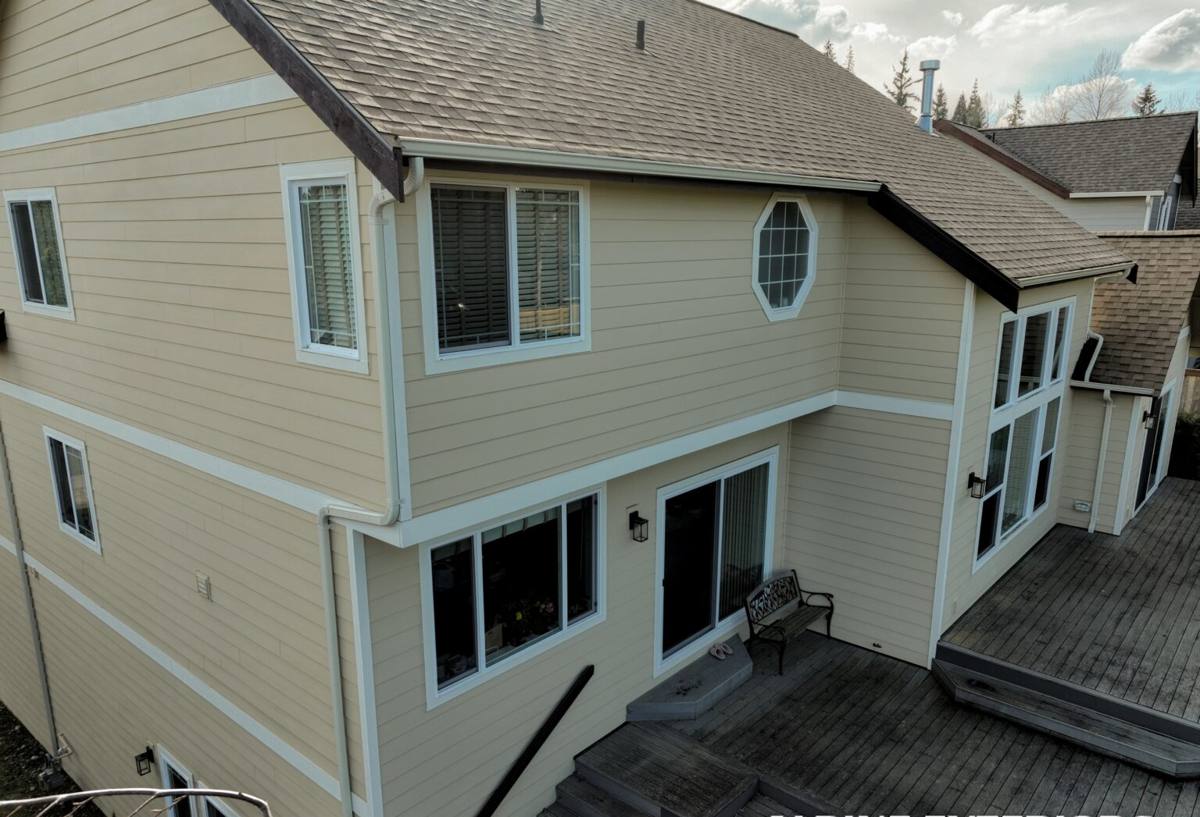
What Kendall Homes Are Up Against
Driving Rain and Wind-Loaded Walls
Storms moving through Whatcom County frequently carry enough wind to drive rain horizontally into wall assemblies, especially on west and south-facing elevations that catch the weather first. Siding that relies on paint film alone for water resistance is only as good as that paint job, and once the film cracks or the substrate absorbs moisture at a seam or fastener hole, water gets behind the cladding and stays there. James Hardie panels and lap siding are engineered specifically for this kind of exposure, with a factory-applied finish that isn't relying on job-site paint to do the water-resistance work.
Extended Moss and Algae Season
Shaded, tree-lined lots around Kendall stay damp longer than open, sun-exposed properties. Moss and algae don't just look bad — on organic siding materials they hold moisture against the surface and accelerate breakdown underneath. Fiber cement doesn't stop moss from landing on a wall (nothing does), but it gives moss and algae nothing to consume, so growth stays a surface cleaning issue instead of a structural one.
Freeze-Thaw and Seasonal Swings
Whatcom County doesn't see the deep freezes of the Cascades or eastern Washington, but Kendall still gets enough cold snaps combined with wet conditions to stress materials that expand and contract with moisture content. Fiber cement is dimensionally stable in a way that matters over a 30-plus year ownership window — it isn't chasing every swing in humidity the way wood does.
Why We Only Install James Hardie
We get asked regularly why we don't offer vinyl, LP SmartSide, cedar, primed spruce, or other fiber cement brands like Cemplank or Allura. The honest answer is that we standardized on one product system so we can guarantee the install, the material behavior, and the warranty all line up — and because James Hardie's engineering is built around exactly the conditions Kendall deals with every winter.
- Non-combustible core — fiber cement doesn't contribute fuel to a fire the way wood-based siding can, which matters for insurance conversations and peace of mind alike.
- ColorPlus factory finish — baked-on color that resists fading and chipping far better than field-applied paint, and it's backed by its own finish warranty separate from the product warranty.
- Climate-engineered HZ5 formulation — Hardie's HZ5 product line is formulated for colder, wetter climates like ours, versus a one-size-fits-all formulation used in warmer, drier regions.
- Proven track record — decades of real-world performance in Pacific Northwest conditions, not a newer product still building a install history here.
- Strong transferable warranty — meaningful coverage that follows the house, which matters if you sell before the siding's service life is up.
We're not saying every alternative product is bad in every climate. LP SmartSide and cedar can perform reasonably in drier regions with disciplined maintenance schedules. Vinyl is inexpensive and low-maintenance in a general sense. But in Whatcom County's wet, moss-prone, wind-driven-rain environment, we've made a professional judgment call: we only put our name behind the product system that's proven itself here, and that's James Hardie.
What a Correct Fiber Cement Install Actually Involves
Fiber cement siding is only as good as the assembly behind it. A rushed or improperly detailed install can trap moisture behind the very product meant to keep it out — which defeats the whole purpose. Here's what we treat as non-negotiable on every Kendall project:
Water-Resistive Barrier and Drainage Plane
Every wall gets a properly lapped weather-resistive barrier underneath the siding, installed shingle-style so water sheds downward and out, never inward. On Kendall's wetter, shadier lots, we pay close attention to how that drainage plane performs over multiple seasons, not just how it looks on install day.
Rainscreen Furring Where It's Warranted
On elevations that take the brunt of wind-driven rain, or on homes with heavier tree cover and slower drying conditions, a rainscreen gap behind the siding gives any incidental moisture a path to drain and the wall assembly a chance to breathe. This is a detail that gets skipped by installers trying to save time — we don't skip it where the conditions call for it.
Fastening and Clearances to Manufacturer Spec
James Hardie's warranty is conditional on installation to their published specifications — fastener spacing, ground clearance, roof-line clearance, and gaps at trim and penetrations. Cutting corners here doesn't just risk premature failure, it can void the manufacturer warranty outright. We install to spec every time, not just when it's convenient.
Caulking, Flashing, and Trim Details
Most siding failures don't happen in the field of the wall — they happen at windows, doors, corners, and penetrations. Correct flashing sequencing and the right caulk in the right joints (and no caulk where it shouldn't be) is where an experienced crew earns its keep.
Our Process for Kendall Projects
- On-site assessment — we walk the property, check existing siding and sheathing condition, note shaded/high-moss elevations, and identify any moisture damage that needs addressing before new siding goes up.
- Product and color selection — we help you choose the right James Hardie plank, panel, or shingle profile and ColorPlus finish for your home's style and exposure.
- Detailed estimate — a clear, itemized quote so you know what's included: tear-off, prep, water-resistive barrier, rainscreen if applicable, siding, trim, and cleanup.
- Prep and removal — old siding comes off, sheathing gets inspected and repaired as needed, and any rot or moisture damage is addressed before anything new goes on.
- Installation to spec — barrier, rainscreen where warranted, fiber cement siding, trim, and flashing installed per James Hardie's requirements.
- Final walkthrough — we go over the finished job with you before we call it done.
Comparing the Common Options
| Material | Moisture/moss resistance | Dimensional stability | Typical maintenance |
|---|---|---|---|
| James Hardie fiber cement | Strong — non-organic, doesn't feed growth | Excellent | Occasional wash, repaint only if desired |
| Cedar / primed spruce | Moderate — organic material, needs upkeep | Swells/shrinks with moisture | Regular repainting/sealing, moss treatment |
| LP SmartSide | Moderate — engineered wood, treated but still organic | Good if maintained, sensitive to prolonged wetting | Caulk and paint upkeep at seams |
| Vinyl | Good — doesn't rot, but can trap moisture behind it | Expands/contracts with temperature, can warp | Low, but limited repair/color options over time |
Cost Factors for a Kendall Project
We won't quote a number without seeing the house, but the main variables that move the price on a fiber cement siding job are consistent from project to project:
- Total square footage and number of stories
- Condition of the existing sheathing and any rot repair required
- Whether a rainscreen assembly is added
- Complexity of trim, corners, and architectural detail
- Siding profile chosen (lap, shingle-style, panel) and ColorPlus color
- Access — tree cover, slope, and site conditions common around Kendall properties
Because moisture-related repair needs vary so much lot to lot in this area, we always build the sheathing inspection into the estimate rather than guessing at it.
Why Hire a Crew That Already Works This Area
Kendall isn't a downtown commercial strip — it's a spread-out community of individual properties, many with mature trees, longer driveways, and lot conditions that don't match a subdivision template. A crew that's worked jobs around Ferndale and greater Whatcom County already knows how local exposure, shade patterns, and moisture behavior affect where a rainscreen matters most, which elevations need the closest attention to flashing, and how the region's moss season actually plays out over a full year — not just what a manufacturer's install guide says in the abstract. That local pattern recognition is what keeps a fiber cement job performing the way it's supposed to for decades, not just for the first dry summer.
Signs Your Current Siding May Already Be Compromised
- Soft or spongy spots when pressed, especially near the bottom of walls or under windows
- Persistent moss or algae that returns quickly after cleaning
- Peeling or bubbling paint that keeps coming back in the same spots
- Visible gaps, cracking, or warping at seams and corners
- Rising energy bills that could point to a compromised wall assembly
- Musty smell or visible staining on interior walls that back onto exterior siding
Any of these are worth a look before they turn into a larger repair, especially heading into another wet season.
If you're in Kendall and thinking about fiber cement siding, we're happy to come take a look, walk the property with you, and put together a straightforward, no-pressure estimate — just fill out the form below to get started.