 Ferndale Window
 Why Fairhaven's Climate Is Hard on Siding
Homes near Fairhaven sit close enough to the water that siding takes a different kind of beating than it would twenty miles inland. Salt-laden air off the bay, wind-driven rain that comes in sideways during winter storms, and a wet season that stretches for months all work against whatever material is on your walls. Siding here doesn't just need to look good on installation day — it needs to hold up through decades of that cycle without rotting, delaminating, or feeding a permanent moss and algae problem.
Salt Air and Moisture Near the Water
Airborne salt accelerates corrosion on fasteners, flashing, and any exposed metal trim, and it holds moisture against a wall surface longer than dry inland air does. Materials that rely on a painted or coated surface for protection are only as good as that coating's ability to resist salt exposure over time. Once that surface layer starts to break down, whatever's underneath is exposed to a much harsher environment than it was designed for.
Driving Rain and Wind-Driven Water
Whatcom County storms don't just drop rain straight down — wind pushes it horizontally into wall assemblies, which means every seam, joint, and penetration is a potential entry point. Siding that depends on caulk alone to stay watertight, rather than proper flashing and drainage behind the cladding, tends to show problems first at these wind-exposed elevations.
Moss, Algae, and the Long Wet Season
With extended periods of damp, shaded, mild weather, moss and algae growth on north-facing and shaded walls is a fact of life here, not a rare occurrence. Porous or wood-based siding materials absorb moisture that keeps organic growth fed, while a dense, factory-finished material sheds it far more effectively and is easier to clean without damaging the surface.
Why James Hardie Fiber Cement Fits This Climate
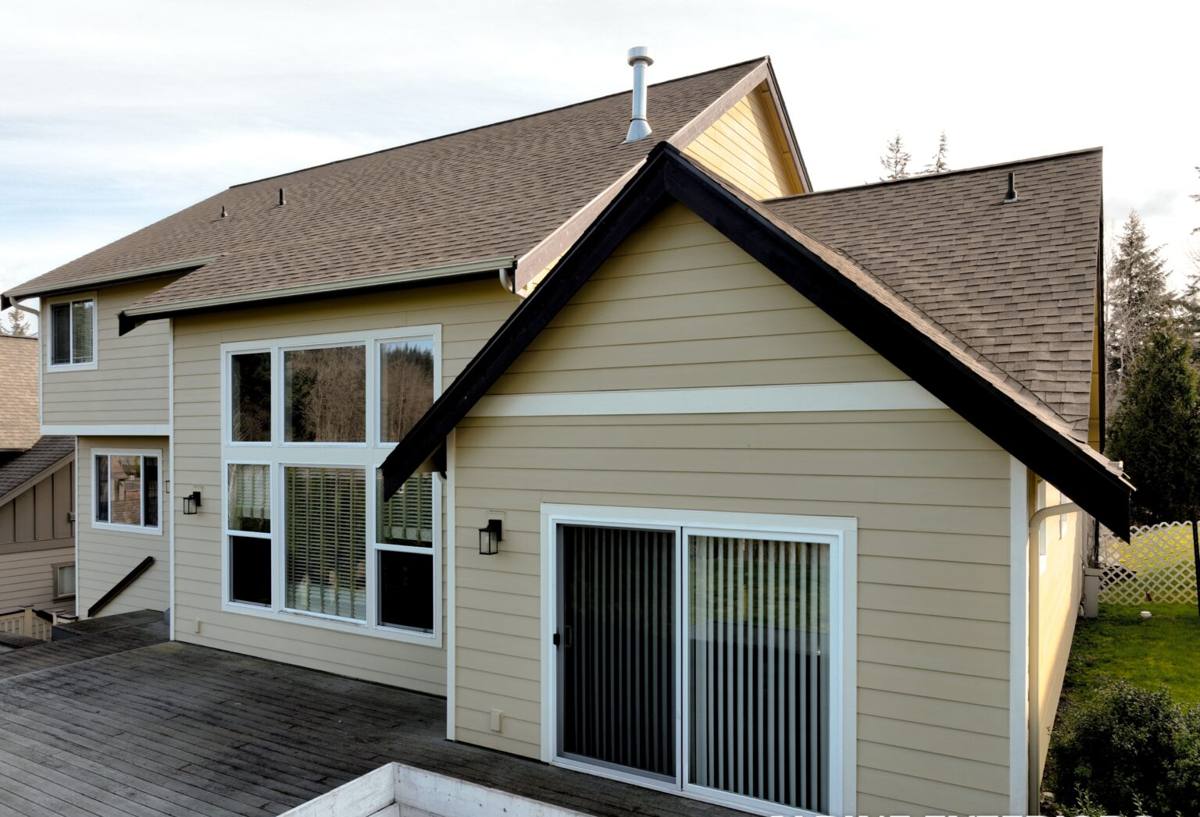
We install James Hardie fiber cement siding exclusively — not LP SmartSide, not vinyl, not Cemplank or Allura, not primed spruce or cedar. That's not a marketing position; it's a standard we hold because of what we've seen these products do, and not do, in coastal Western Washington conditions over the long run.
A Non-Combustible, Moisture-Stable Core
Fiber cement is made from cement, sand, and cellulose fibers, which makes it non-combustible and dimensionally stable in a way that wood-based or engineered-wood products aren't. It doesn't swell, delaminate, or lose structural integrity from repeated wetting and drying the way wood composites can when a seal is compromised.
ColorPlus Factory Finish vs. Field-Painted Siding
James Hardie's ColorPlus finish is baked on at the factory under controlled conditions, producing a more consistent, UV- and moisture-resistant coating than siding painted on-site or products that rely on a field-applied primer coat. In a climate where the finish is doing constant work against salt air and rain, that difference matters over the life of the siding, not just on installation day.
Climate-Engineered HZ Product Lines
James Hardie engineers its products by climate zone. Western Washington falls into the moisture-and-freeze HZ5 zone, and Hardie's HZ5 formulation is built specifically to perform in wetter, cooler climates like ours, as opposed to a one-size-fits-all product. That's a meaningful distinction from generic fiber cement or composite products that aren't formulated for regional conditions.
What a Correct Installation Involves in Fairhaven
The material is only half the equation. Fiber cement siding installed without attention to the details below can still let water into the wall assembly, no matter how good the panel itself is.
Rain Screen and Drainage Plane
Correct installation includes a drainage plane — typically a weather-resistant barrier plus a gap or furring behind the siding — so that any moisture that does get past the cladding has somewhere to drain and dry out instead of sitting against the sheathing. This is especially important on wind-exposed and shaded elevations common in this area.
Fastening, Flashing, and Joint Treatment
Every window, door, and penetration needs proper flashing integrated with the water-resistive barrier — not just caulked at the surface. Fasteners need to be corrosion-resistant and set to Hardie's specifications, and panel joints need the right gap and sealant treatment so they can move with temperature and moisture changes without cracking open.
Trim, Transitions, and Clearances
Siding needs proper clearance from grade, roof lines, decks, and other transitions to avoid trapping moisture against the bottom edge of the panel. These details are easy to skip and are exactly the spots where premature failure shows up first on coastal homes.
Installation Practices: What Separates a Correct Job From a Problem Job
| Detail | Correct Practice | Common Shortcut |
|---|---|---|
| Drainage behind siding | Rain screen gap or furring over the weather barrier | Siding fastened tight to sheathing with no drainage path |
| Window and door flashing | Integrated flashing tied into the water-resistive barrier | Caulk relied on as the primary seal |
| Fasteners | Corrosion-resistant, set per Hardie's fastening schedule | Standard fasteners over- or under-driven |
| Panel joints | Proper gap with compatible sealant, allows for movement | Butt joints tight or sealed with the wrong product |
| Ground clearance | Minimum clearance maintained from grade and decking | Siding installed close to or touching grade |
Our Process for a Fairhaven Siding Project
We treat every home individually, but the sequence of a well-run James Hardie project is consistent:
- On-site assessment of existing siding, sheathing condition, and problem areas specific to the home's exposure
- Removal of old siding and inspection of the sheathing and framing underneath for hidden moisture damage
- Repair of any compromised sheathing before anything new goes on the wall
- Installation of a weather-resistive barrier and drainage system appropriate to the wall assembly
- Flashing of all windows, doors, and penetrations before siding installation begins
- Installation of James Hardie panels, trim, and accessories to manufacturer fastening and clearance specifications
- Final walkthrough covering the completed work and what to expect going forward
Skipping straight from tear-off to new siding without addressing what's underneath is one of the most common ways a siding job fails early — and it's not visible until the problem has already progressed.
What to Expect: Maintenance on a Fiber Cement Home
One of the practical advantages of James Hardie siding in this climate is how little upkeep it demands compared to wood or wood-composite alternatives. That said, no siding is fully maintenance-free.
- Rinse the exterior periodically to keep salt residue and organic buildup from accumulating, especially on shaded or north-facing walls
- Inspect caulking at trim and penetrations every year or two and refresh it if it's cracked or pulling away
- Keep gutters and downspouts clear so water isn't dumping directly onto siding or pooling near the base of the wall
- Trim back vegetation and landscaping that keeps siding shaded and damp for extended periods
- Watch for any soft spots, staining, or discoloration near ground level or at flashing points and have them checked early
Compare that to wood or primed spruce siding, which typically needs repainting or re-sealing on a recurring cycle just to keep water out — a maintenance burden that adds up fast in a climate this wet.
Why Local Installation Experience Matters
Fiber cement siding is a forgiving material when it's installed correctly and an unforgiving one when it isn't — the failures show up as trapped moisture, not obvious defects, which means they're often invisible until real damage has already occurred. A crew that regularly works homes in this part of Whatcom County has already seen how local wind exposure, salt air, and shaded, moss-prone elevations affect a wall assembly, and builds the drainage and flashing details around that reality instead of applying a generic approach. That local pattern recognition is part of what you're paying for, not just the labor of hanging panels.
Cost Factors to Understand Before You Budget
Every home is different, but the main cost drivers on a James Hardie project are consistent. We won't quote a number without seeing the home, but understanding what moves the price helps you evaluate any estimate you receive.
| Factor | Why It Affects Cost |
|---|---|
| Condition of existing sheathing | Hidden rot or water damage found during tear-off requires repair before new siding goes on |
| Home size and wall complexity | More corners, dormers, and trim details mean more cutting, fitting, and labor time |
| Product line and profile | Lap siding, panel siding, and shingle-style profiles carry different material and labor costs |
| ColorPlus vs. field-painted finish | Factory-finished panels cost more upfront but eliminate a separate painting phase |
| Site access and exposure | Multi-story walls, tight lot lines, or difficult access add time and equipment needs |
If a siding estimate looks unusually low, it's worth asking specifically whether it includes sheathing repair, proper flashing at every opening, and a drainage plane — those details are where corners get cut to hit a lower number.
If you're weighing a siding project on a Fairhaven-area home, we're happy to take a look and walk you through what we'd actually recommend for your walls — no pressure, no obligation. Use the form below to request a free estimate.