 Ferndale Window
 Point Roberts Weather Doesn't Go Easy on a Deck
Point Roberts sits out on the water, and that location cuts both ways. The views are part of why people build decks out there in the first place, but the same exposure that makes the setting nice is hard on the structure itself. Salt-laden air off the water works on fasteners and hardware year-round, not just during storms. Wind-driven rain doesn't fall straight down out there — it gets pushed sideways into ledger boards, railing posts, and any gap in the decking that isn't detailed correctly. And with tree cover and a long damp season typical of this part of Whatcom County, shaded or north-facing decks can stay wet long enough for moss and algae to take hold on the surface and in the gaps between boards.
None of that is unusual for the region. It's the same combination of salt air, driving rain, and a long moss season that wears on exterior structures up and down this coastline. But it means a deck built without that climate in mind will show problems faster here than it would somewhere inland — corroded screws bleeding rust streaks, soft spots where water sat against untreated wood, or a slick green film on the boards every spring.
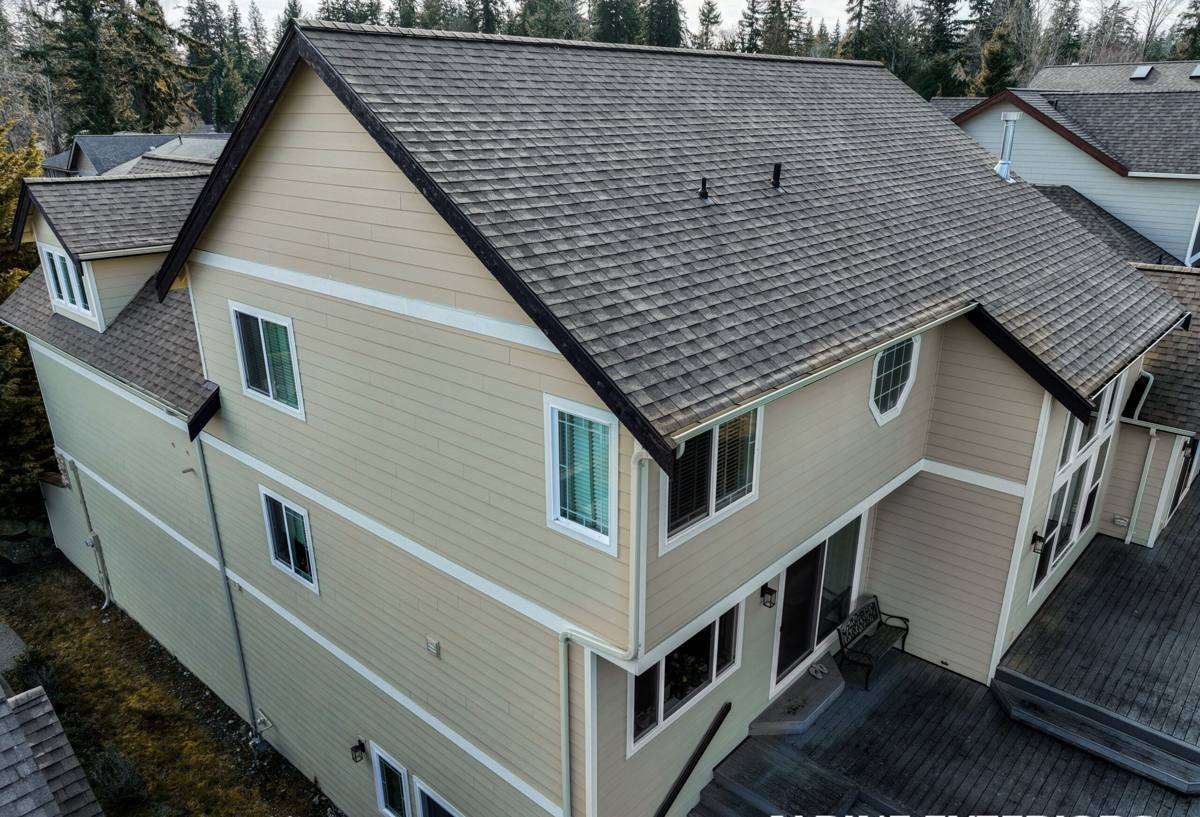
Why Composite Decking Fits This Climate
Composite decking — specifically capped composite, where the board has a polymer shell wrapped around a wood-fiber core — holds up well against the conditions Point Roberts throws at a deck. The cap sheds water instead of absorbing it, so the board isn't cupping, checking, or slowly rotting the way untreated or even pressure-treated wood can once it's been through a few wet seasons. It doesn't need staining or sealing, which matters on a property where getting a crew or a truck out to do annual maintenance isn't as simple as it is in town.
Composite isn't maintenance-free, and we won't tell you it is. It costs more upfront than wood, it's heavier to work with, and it still needs proper ventilation underneath and periodic cleaning to keep moss and algae from finding a foothold on the surface. What it buys you is consistency — the boards don't warp, splinter, or rot the way wood does when it's exposed to this much moisture for this long.
Composite vs. Wood vs. PVC: What Holds Up Out Here
| Material | Salt Air / Moisture | Moss & Mold Resistance | Maintenance | Typical Lifespan | Upfront Cost |
|---|---|---|---|---|---|
| Pressure-Treated Wood | Absorbs water, needs sealing to hold up | Low without regular cleaning/treatment | Annual staining or sealing | Shortest of the three here | Lowest |
| Capped Composite | Strong — polymer shell sheds water | Good, especially with grain-textured caps | Periodic rinse and sweep | Longest, with a manufacturer warranty behind it | Mid to upper |
| PVC Decking | Strong — fully synthetic, no wood core | Good | Low | Long, comparable to composite | Highest |
Wood has its place, and some homeowners prefer the look and the lower entry cost enough to accept the upkeep. Our default recommendation for a Point Roberts deck is capped composite: it strikes the best balance of moisture performance, moss resistance, and cost for a property that sees this much salt air and rain. PVC is a legitimate option too, mainly for homeowners who want to eliminate the wood-fiber core entirely and are willing to pay more for it.
What a Correct Composite Deck Install Actually Involves
Substructure First
The decking itself gets most of the attention, but the framing underneath is what determines whether the deck is still solid in ten years. That means correctly sized, pressure-treated or engineered joists, spaced to the composite manufacturer's specification — composite often calls for tighter joist spacing than wood, and skipping that step is one of the more common corner-cutting mistakes we see on decks we're asked to fix. Footings need to go to the depth the local code requires, not just deep enough to look stable.
Flashing and Drainage
The single most common point of water intrusion on an attached deck is the ledger board — where the deck framing bolts into the house. In a spot that gets driving rain off the water, a ledger without proper flashing is a slow leak waiting to happen, and it's often hidden behind the siding where nobody notices until there's rot. We flash that connection correctly, keep a gap between the decking and the siding, and slope the frame slightly away from the house so water has somewhere to go. Composite boards also get installed with a consistent gap between them, both for drainage and to let air move underneath — that airflow is a big part of what keeps moss and mildew from setting up in the joints.
Fastening
Face-screwed decking is faster and cheaper, but it leaves exposed fastener heads that are the first thing to show corrosion streaking in a salt-air environment. We use hidden fastener clip systems where the product allows for it, and stainless steel or coated fasteners anywhere hardware is exposed. It's a small detail that makes a visible difference within a couple of years out there.
The Point Roberts Factor: Why a Crew That Already Works Out There Matters
Point Roberts is a U.S. exclave — the only way in by land is a drive through Canada, which means every material delivery, trailer, and crew crossing has to clear a border both directions. That's not a minor logistical footnote for a construction job. It affects delivery timing, what paperwork needs to be in order for tools and materials crossing the line, and how a job gets scheduled around it. A lot of contractors either won't take work out there or quietly build the hassle into a higher price for a single trip.
We already work Point Roberts regularly, so that logistics problem is solved before your job starts. We're not pricing in a one-off mobilization headache, and if something needs a warranty callback down the road, it's a normal stop for us rather than a special trip. That matters as much as the material choice does — a well-built deck installed by a crew that treats the trip as routine is a different experience than the alternative.
Our Process for a Point Roberts Composite Deck
- On-site walkthrough and measurement, including a look at the existing structure if this is a replacement
- Assessment of ledger connection, framing condition, and drainage/slope around the deck footprint
- Permit handled through Whatcom County before any work starts
- Material selection — board color, texture, and fastening system based on sun exposure and your preferences
- Build: substructure repair or new framing, flashing, decking installation, railing and stairs
- Final walkthrough so you know how the deck is put together and what maintenance actually looks like
Living With a Composite Deck in a Marine Climate
Composite cuts the maintenance workload compared to wood, but "low-maintenance" isn't "no-maintenance," especially this close to the water. A few habits go a long way toward keeping the deck looking and draining the way it should:
- Rinse off salt spray and general grime a few times a year, more often if the deck faces open water directly
- Sweep debris — needles, leaves, seed pods — out of the gaps between boards so water and air can still move through
- Move planters, mats, and furniture occasionally so moisture doesn't sit trapped underneath in one spot
- Check railing posts and stair connections once a year for looseness; wind exposure works on fasteners over time
- Make sure gutters and downspouts aren't dumping extra water directly onto the deck surface
Permits and Practical Considerations in Whatcom County
Most attached or elevated decks require a building permit in Whatcom County; low, freestanding decks sometimes fall outside that requirement depending on height and how they're attached. Rather than have you guess, we sort out what's needed for your specific deck as part of the estimate, and we handle the permit process directly so it's not something you have to chase down yourself.
If you're weighing a repair against a full rebuild, the framing condition usually decides it. A deck with sound joists and a solid ledger connection can often be re-decked with composite boards without rebuilding the whole structure. One with rot at the ledger or undersized, water-damaged framing needs to be addressed at that level first — putting new composite boards over a compromised frame just hides the problem for a while.
If you're thinking about a new deck or replacing an aging one on your Point Roberts property, we're happy to come take a look and give you a straightforward estimate — no pressure, no upsell, just an honest read on what your deck needs. Use the form below to get in touch.