 Ferndale Window
 Birch Bay Asks More of a Roof Than an Inland Neighborhood Does
Birch Bay sits right on the water, and that changes what a roof has to deal with year-round. Salt-laden air corrodes exposed metal faster than it does a few miles inland. Wind-driven rain off the Strait of Georgia doesn't just fall straight down — it gets pushed sideways under shingle edges and around flashing that would be perfectly fine in a calmer spot. Add in the long, wet stretch of fall and winter that Whatcom County gets every year, and you've got a roof that's rarely given much of a chance to dry out before the next system rolls through.
None of that means asphalt shingles are a bad choice for a home near the bay. It means the installation details that get overlooked elsewhere can't be skipped here. A shingle roof that's properly flashed, ventilated, and sealed will hold up fine in this climate. One that's built to a minimum standard will show problems — curling edges, granule loss, moss colonies, soft spots at the eaves — years before it should.
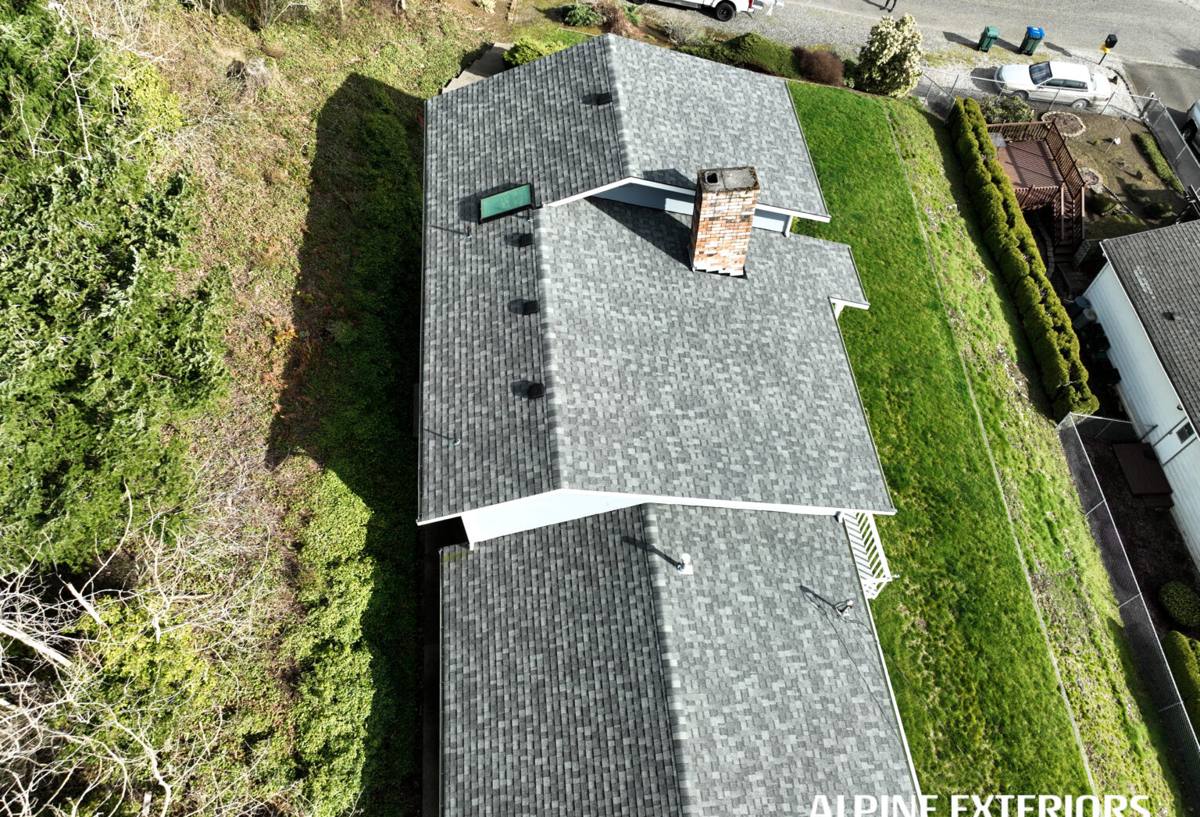
What Local Homes Actually Need From a Shingle Roof
Underlayment That Can Handle Wind-Driven Rain
Standard felt underlayment is fine in dry climates. Near the water, we lean on synthetic underlayment for its coverage and, more importantly, a self-adhering ice-and-water membrane at the eaves, valleys, and around every penetration. Wind-driven rain that gets past the shingles themselves needs a second line of defense, not a thin paper barrier that tears and lets moisture into the decking below.
Flashing That Won't Corrode in Salt Air
Flashing around chimneys, skylights, and roof-to-wall transitions takes the most abuse on a coastal roof. We use corrosion-resistant metals and proper step-and-counter flashing details rather than relying on caulk or roof cement to bridge a gap — sealant is a maintenance item, not a permanent fix, and it fails faster in salt air than people expect.
Ventilation That Actually Moves Air
A shingle roof needs balanced intake and exhaust ventilation to let the attic breathe. In a marine climate, poor ventilation traps humid air against the underside of the roof deck, which speeds up plywood degradation and gives moss and algae a damp environment to establish in from below as well as above. We check intake at the soffits and exhaust at the ridge as a standard part of every shingle project, not an upsell.
Choosing a Shingle That Fits This Environment
Most manufacturers now build algae-resistant granules into their shingle lines specifically because of climates like this one. That's a meaningful upgrade for a bay-front or near-water property, since it slows the black streaking that copper-free algae leaves behind. Beyond that, the bigger decision is architectural versus traditional 3-tab.
| Factor | 3-Tab Shingle | Architectural (Laminate) Shingle |
|---|---|---|
| Wind resistance | Lower — single layer, lighter | Higher — layered construction rated for stronger gusts |
| Typical lifespan | Shorter | Longer, especially with algae-resistant granules |
| Upfront cost | Lower | Moderate premium |
| Performance in driving rain | Adequate with correct install | Better edge seal and thicker profile shed water more effectively |
| Appearance | Flat, uniform | Dimensional, shadow-line look |
For a shoreline property that takes direct wind and rain off the water, we generally steer homeowners toward an architectural shingle rated for higher wind speeds. It's not that a 3-tab shingle can't be installed correctly — it's that the added durability matters more here than it would on a sheltered inland lot, and the price difference is usually smaller than people assume once it's spread across the life of the roof.
How We Approach a Shingle Roofing Project
- On-site inspection. We walk the roof, check the decking from the attic side where possible, and look at flashing, ventilation, and any past repair work before quoting anything.
- Honest scope. We tell you plainly whether this is a repair, a full tear-off, or something in between, and why — including what happens if we skip a step to save money.
- Tear-off and deck check. Old shingles come off down to the decking so we can actually see and address soft or delaminated plywood, not cover it up.
- Underlayment and flashing first. Ice-and-water membrane at vulnerable areas, synthetic underlayment across the field, and new flashing wherever the old flashing is reused past its useful life.
- Shingle installation to manufacturer spec. Correct nailing pattern, exposure, and starter courses — the details that determine the wind and warranty rating actually apply.
- Ventilation check and correction. We won't seal up a roof that can't breathe properly; intake and exhaust get addressed as part of the job.
- Final walk-through. We show you what was done and answer questions before we consider the job finished.
Repair or Replace? Reading the Signs
Not every roof issue near the bay means a full replacement. But a few signs point toward something more than a patch job, especially on a roof that's been through several Whatcom County winters.
| Sign | Usually Points To |
|---|---|
| Isolated missing or damaged shingles after a windstorm | Targeted repair |
| Granule loss concentrated in one section | Repair, with a close look at surrounding shingles' age |
| Widespread curling, cupping, or brittle shingles | Roof is nearing end of service life — replacement likely more cost-effective |
| Soft or spongy decking felt from inside the attic | Water has already gotten past the roofing system — replacement territory |
| Heavy, established moss across large areas | Depends on shingle condition underneath — needs an inspection either way |
The only way to know which category a given roof falls into is to actually get up there and look, including from the attic side when the layout allows it. We'd rather tell a homeowner "this needs a repair, not a full roof" than talk them into more work than the house needs.
Moss, Algae, and the Maintenance That Actually Helps
Birch Bay's tree cover and long damp season make moss close to unavoidable over time, but there's a real difference between a roof with a little moss in the shade and one where moss has been left to grow unchecked for years. Left alone, moss holds moisture against the shingle surface, lifts shingle edges as it grows, and accelerates granule loss underneath it.
- Have moss and debris cleared before it builds up thick mats, not after — a light annual check beats a major cleanup every five years
- Keep gutters and valleys clear so water doesn't pool against shingle edges during heavy rain
- Trim back overhanging branches where practical to cut down on shade and debris buildup
- Never pressure-wash a shingle roof — it strips protective granules and shortens the roof's life
- Have flashing and sealant checked every couple of years, since salt air ages exposed metal and sealant faster than an inland climate would
- Address small leaks or damaged shingles promptly rather than waiting for the next dry stretch
What Affects the Cost of a Shingle Roofing Project
| Factor | Why It Matters |
|---|---|
| Roof size and pitch | More surface area and steeper pitches mean more material and labor time |
| Number of existing layers | Tear-off of multiple old layers takes longer and adds disposal cost versus a single layer |
| Decking condition | Rotted or delaminated plywood found during tear-off needs replacement before shingles go on |
| Roof complexity | Valleys, dormers, skylights, and chimneys all add flashing work and labor time |
| Shingle grade selected | Standard 3-tab, architectural, and premium algae-resistant lines carry different material costs |
| Access and site conditions | Tree cover, steep lots, and limited staging space near the water can affect setup time |
We won't quote a shingle roof over the phone with any real accuracy, and we're skeptical of anyone who will. Every one of these factors has to be checked in person before a number means anything.
Why It Matters to Hire a Crew That Already Works Birch Bay
A roofing crew that mostly works dry, sheltered neighborhoods inland doesn't build the same habits as one that works this coastline regularly. Knowing to spec algae-resistant granules as standard rather than an upsell, defaulting to ice-and-water membrane at every eave rather than the bare code minimum, and recognizing early moss and salt-corrosion patterns for what they are — that comes from doing this work in this specific environment, not from a general roofing background applied to a coastal address.
It also means we're not guessing at what Whatcom County's climate does to a roof over ten or twenty years — we've seen it, and we build accordingly from the first nail.
Get an Honest Look at Your Roof
If you're dealing with moss buildup, a leak, storm damage, or you just know your shingle roof is getting up there in years, we're glad to come take a look. The estimate is free, there's no pressure attached to it, and you'll get a straight answer about whether you need a repair, a replacement, or nothing at all right now — use the form below to get started.